
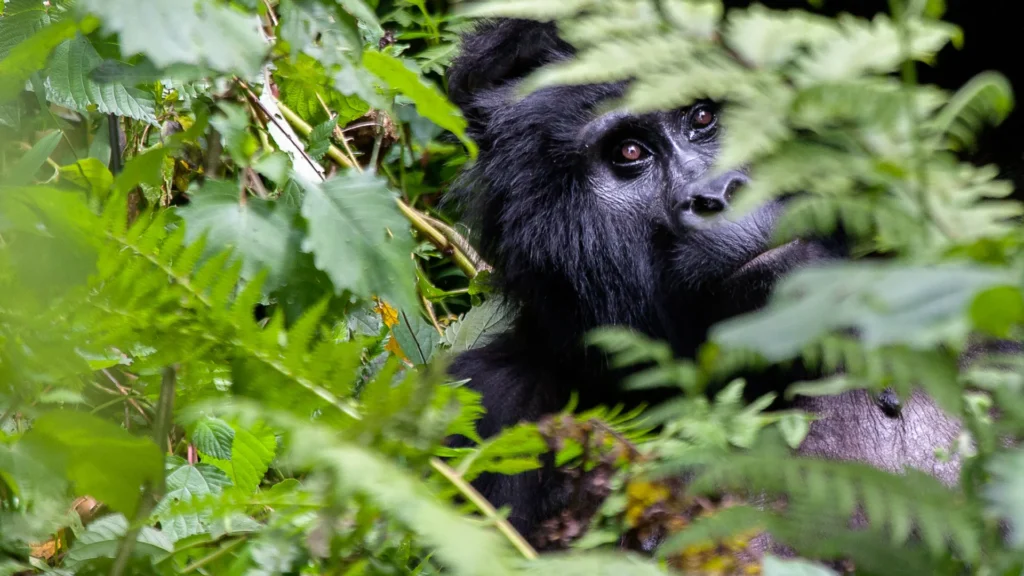
Rwanda mountain gorillas offer older travellers an exceptional opportunity to observe one of the world’s most fascinating great apes in its natural environment. The experience is memorable not because gorillas perform for visitors, but because they continue their ordinary lives while people quietly observe from a carefully controlled distance.
For senior travellers, understanding the gorillas’ behaviour and the nature of the encounter is especially valuable. A mountain gorilla trekking experience may involve substantial walking, but the viewing period itself is focused on patience, observation and appreciation of wildlife. Visitors do not need to be wildlife specialists to recognise the extraordinary relationships within a gorilla family.
This Rwanda Mountain Gorillas Seniors Guide explains what visitors may see during an encounter, how gorilla family groups function, why conservation regulations matter and how older travellers can approach wildlife observation responsibly.
What Makes Rwanda Mountain Gorillas Special?
Mountain gorillas, scientifically known as Gorilla beringei beringei, are a subspecies of eastern gorilla.
They inhabit a limited area of mountainous forest in East and Central Africa.
In Rwanda, they live within Volcanoes National Park, part of the wider Virunga Massif.
Their restricted geographic distribution makes the protection of remaining habitats especially important.
Physical Characteristics
Mountain gorillas have powerful bodies, broad chests, muscular arms and thick dark fur.
The dense fur helps them tolerate cool conditions in their high-altitude environment.
Adult males are generally much larger than females.
Mature males develop silver-grey hair across their backs and are commonly called silverbacks.
Why Their Appearance Can Be Misleading
The imposing appearance of a silverback can suggest constant aggression.
However, mountain gorillas spend much of their time feeding, resting and interacting socially.
Their behaviour is often calm and deliberate.
Understanding this helps visitors appreciate the animals without expecting dramatic displays.
Understanding Mountain Gorilla Family Groups
Mountain gorilla families are complex social groups.
They may contain one or more adult males, adult females, juveniles and infants.
Group composition changes over time as individuals mature, transfer or establish new relationships.
Some groups are relatively small, while others contain numerous members.
The Role of the Silverback
A dominant silverback gorilla commonly plays an important role in group leadership.
He may influence movement, respond to threats and maintain social relationships.
However, gorilla societies are not identical, and the presence of several adult males can create more complex group dynamics.
During a Rwanda gorilla encounter, visitors may observe a silverback resting while other members feed nearby.
Female Gorillas
Adult females are central to reproduction, infant care and social relationships.
They spend considerable time feeding, resting and interacting with their young.
Their relationships with other group members contribute to social stability.
Young Gorillas
Juveniles and infants often attract considerable visitor interest.
Young gorillas may climb, chase one another, wrestle or explore vegetation.
Their behaviour provides opportunities to observe learning and social development.
Visitors must never attempt to attract a juvenile gorilla’s attention.
What Do Mountain Gorillas Do During the Day?
Mountain gorillas spend much of their day feeding, resting and moving through their habitat.
They are predominantly herbivorous, consuming leaves, stems, shoots and other vegetation.
Their activities vary according to food availability, weather and group movements.
Feeding Behaviour
Visitors may observe gorillas selecting plants, stripping leaves or consuming stems.
These activities reveal their adaptation to a vegetation-rich mountain environment.
Although feeding may appear less dramatic than social displays, it is central to gorilla ecology.
Resting Behaviour
Gorillas often rest between feeding periods.
A resting group may appear quiet, with individuals lying or sitting near one another.
For wildlife enthusiasts, these moments provide opportunities to observe group proximity and social relationships.
Grooming and Social Contact
Gorillas use physical contact and other interactions to maintain social relationships.
Visitors may observe individuals touching or interacting gently.
Such behaviour should be interpreted carefully rather than automatically assigned human emotional meanings.
What Happens During a Gorilla Encounter?
The standard Rwanda gorilla trekking encounter allows visitors to observe a habituated gorilla family for up to one hour.
The encounter takes place under the supervision of trained park guides.
The gorillas remain free-ranging wild animals.
They are not confined to an enclosure or required to remain in a particular position.
Why One Hour?
The one-hour viewing limit helps control human presence around the gorillas.
Limiting encounter duration is part of the wider conservation approach used in mountain gorilla tourism.
Visitors should respect the time restriction even when the gorillas are particularly active or photogenic.
What Does Habituated Mean?
Gorilla habituation is a gradual process through which wild gorillas become accustomed to carefully managed human presence.
Habituated gorillas remain wild.
They continue to feed, reproduce, move and interact naturally.
Habituation should never be confused with domestication.
What Can Senior Visitors Expect to See?
The experience varies between groups and individual days.
Visitors may observe a silverback feeding, a mother carrying an infant or juveniles playing.
Sometimes the gorillas remain relatively still.
At other times, they move through vegetation.
No specific behaviour can be guaranteed.
Appreciating Quiet Encounters
Some travellers expect continuous activity.
However, a quiet encounter can be equally meaningful.
Observing breathing, feeding movements, facial expressions and interactions provides insight into the animals’ daily lives.
Patience is often more rewarding than searching for dramatic photographs.
Observing Without Interfering
Visitors should remain calm and avoid unnecessary movement.
The aim is to allow gorillas to continue their normal activities.
Guides determine where visitors may stand and how they should respond to the animals.
Gorilla Viewing Distance and Safety
Mountain gorilla viewing rules are designed to protect both animals and visitors.
Participants must maintain the distance required by park authorities.
The precise instructions provided by guides take priority during the encounter.
Why Distance Matters
Gorillas are susceptible to some human infectious diseases.
Maintaining separation helps reduce the risk of disease transmission.
It also limits unnecessary disturbance.
What If a Gorilla Approaches?
A gorilla may move unexpectedly towards visitors.
Participants should remain calm and follow the guide’s instructions.
They should not attempt to touch the animal or move independently.
Avoiding Sudden Movements
Sudden movements, loud noises and attempts to attract attention can disturb wildlife.
Visitors should avoid unnecessary gestures and remain attentive to their guides.
Health Precautions Around Mountain Gorillas
Gorilla conservation health rules are an essential part of responsible tourism.
Mountain gorillas can be affected by certain respiratory infections associated with humans.
Visitors must follow the current requirements relating to illness, hygiene, masks and distancing.
Anyone experiencing potentially contagious symptoms should notify the operator or park authorities before trekking.
Why These Rules Are Important
Gorilla populations are geographically restricted.
An infectious disease outbreak can create serious conservation concerns.
Organisations such as Gorilla Doctors monitor gorilla health and respond to particular veterinary threats.
Responsible visitor behaviour contributes to this wider protection effort.
Photography During Gorilla Encounters
Rwanda mountain gorilla photography can be rewarding, but forest conditions are challenging.
The vegetation may create low-light conditions, and gorillas can move unexpectedly.
Flash photography is prohibited.
Choosing Suitable Camera Equipment
A camera that performs well in low light can be useful.
Visitors should avoid carrying unnecessarily heavy equipment.
A manageable camera or smartphone may be preferable for someone who wants to concentrate on the experience rather than complex photography.
Photographing Silverbacks
A silverback’s facial expressions, posture and interactions can create compelling photographs.
However, visitors should never move closer than permitted to improve a composition.
Photographing Infants
Young gorillas may be partly hidden by vegetation or other group members.
Visitors must not attempt to attract infants or encourage them to approach.
Patience and respect are more important than obtaining a particular image.
Enjoying the Encounter Without a Camera
Some senior travellers prefer to spend much of the encounter simply observing.
This can be particularly rewarding because the permitted viewing period is relatively short.
Taking a few photographs and then watching quietly allows visitors to appreciate details that may be missed through a camera screen.
Mountain Gorilla Conservation in Rwanda
Rwanda mountain gorilla conservation is the result of long-term cooperation between park authorities, researchers, conservation organisations and surrounding communities.
Mountain gorillas have faced threats including habitat loss, disease, poaching-related injuries and human disturbance.
Conservation programmes have helped support population recovery, but the animals remain endangered.
The Importance of Habitat Protection
Gorillas depend on protected forest for food, shelter and reproduction.
Their habitat also supports other wildlife and important ecological processes.
Protecting the forest therefore benefits more than one species.
Scientific Monitoring
Researchers and conservation personnel monitor gorilla groups to understand their health, behaviour and population changes.
Long-term observation helps identify conservation threats and informs management decisions.
Veterinary Conservation
Veterinary teams may respond to injuries or diseases that threaten individual gorillas.
Such interventions are carefully managed because the animals remain wild.
Tourism and Local Communities
Regulated gorilla tourism contributes to employment and conservation-related economic activity.
Guides, trackers, porters, accommodation staff and transport providers are among those who may benefit from tourism.
Long-term conservation depends partly on maintaining constructive relationships with communities living near protected areas.
The Legacy of Dian Fossey
The history of mountain gorilla research is closely associated with Dian Fossey.
Her work in the Virunga Mountains contributed significantly to scientific understanding of gorilla behaviour.
She also helped draw international attention to threats facing mountain gorillas.
For older travellers interested in conservation history, learning about this research adds context to the modern trekking experience.
The development of gorilla tourism reflects decades of scientific work, protected-area management and changing approaches to wildlife conservation.
How Rwanda’s Gorilla Experience Differs From a Conventional Safari
A conventional African wildlife safari often involves observing animals from a vehicle.
Rwanda mountain gorilla trekking is different because visitors enter the forest on foot and observe one habituated gorilla group at relatively close range under strict rules.
The experience focuses on a single endangered primate species rather than searching for numerous large mammals.
For many travellers, the depth of observation is more important than the number of species encountered.
A More Personal Wildlife Experience
The opportunity to observe individual gorillas interacting can create a strong sense of connection with wildlife.
However, the animals should not be treated as human companions or performers.
The encounter remains a regulated observation of wild primates.
Why Conservation Rules Are More Restrictive
Gorillas are particularly vulnerable to certain human diseases.
The close-range nature of the encounter creates responsibilities that differ from observing distant wildlife from a safari vehicle.
This explains the importance of visitor limits, health precautions and the one-hour viewing period.
Rwanda Mountain Gorillas Compared With Uganda Gorillas
Both Rwanda and Uganda gorilla trekking provide opportunities to observe the same mountain gorilla subspecies.
Rwanda’s trekking takes place in Volcanoes National Park.
Uganda offers trekking in Bwindi Impenetrable National Park and Mgahinga Gorilla National Park.
The main differences concern access, terrain, permit costs and tourism infrastructure.
Senior travellers comparing destinations should focus on the practical arrangements that suit their needs rather than assuming that one country’s gorillas are more impressive.
Responsible Wildlife Viewing for Older Travellers
Senior visitors often bring patience and a strong interest in natural history to wildlife experiences.
These qualities can be valuable during mountain gorilla observation.
The most rewarding approach is to remain attentive, follow the guides and appreciate whatever behaviour the gorillas display.
Visitors should avoid treating the encounter as a race to obtain photographs or complete a checklist.
The experience is fundamentally about observing endangered wildlife in its natural environment.
Frequently Asked Questions About Rwanda Mountain Gorillas
Are Rwanda mountain gorillas wild?
Yes. The gorillas visited by tourists are habituated to controlled human observation but remain wild animals.
What is a silverback gorilla?
A silverback is a mature male gorilla distinguished by silver-grey hair across his back.
Do gorillas live in family groups?
Yes. Mountain gorillas generally live in social groups containing adults, juveniles and infants.
Are gorillas usually aggressive?
Much of their daily behaviour is peaceful, but they are powerful wild animals and must be treated with respect.
How long can tourists observe gorillas?
The standard permitted viewing period is up to one hour.
Can visitors touch gorillas?
No. Physical contact is prohibited.
Can visitors use flash photography?
No. Flash photography is prohibited during gorilla encounters.
Why are visitors required to keep their distance?
Distance reduces disturbance and helps limit disease transmission.
Do mountain gorillas eat meat?
They are predominantly herbivorous, feeding mainly on vegetation.
Are mountain gorillas endangered?
Yes. Conservation progress has been significant, but mountain gorillas remain endangered.
Are gorilla sightings guaranteed?
No. The gorillas are free-ranging wild animals, although experienced trackers work to locate habituated groups.
Can seniors enjoy the experience without professional photography equipment?
Absolutely. Careful observation can be more rewarding than concentrating exclusively on photographs.
Appreciating Rwanda’s Mountain Gorillas
A Rwanda mountain gorilla encounter offers more than a rare wildlife sighting.
It provides an opportunity to observe complex social relationships, understand conservation challenges and appreciate the extraordinary natural heritage of the Virunga Mountains.
For senior travellers, the experience can be especially meaningful when approached with patience, realistic expectations and respect for the animals.
At Gorilla Rwanda Safaris, we help visitors arrange responsible Rwanda gorilla trekking experiences, permits, accommodation and suitable travel support.
The central purpose of visiting Rwanda’s mountain gorillas should always remain the same: to observe remarkable wild animals while contributing to the long-term protection of their habitat.