Travelling alone to see Rwanda’s mountain gorillas is an increasingly appealing option for wildlife enthusiasts, photographers, independent adventurers and travellers who prefer the freedom of exploring Africa at their own pace. A solo gorilla safari provides an opportunity to experience one of the world’s most remarkable wildlife encounters without needing to organise a holiday around the availability, interests or budget of a travelling companion.
One of the most important things to understand about solo gorilla trekking in Rwanda is that travelling alone does not mean entering the forest alone. Gorilla trekking is a regulated activity conducted in small groups under the supervision of authorised national park guides and trackers. Individual travellers can purchase a permit and join an official trekking group, making the experience accessible to visitors who are not part of a couple, family or organised private tour.
The real challenges for solo travellers are usually practical rather than related to access to the gorillas. Private vehicle expenses, single-room accommodation rates, transport to the park briefing point and the possibility of joining shared safari departures all influence the total cost. A traveller who understands these arrangements can make informed choices about whether to book an independent holiday, a private guided safari or a shared small-group experience.
At Gorilla Rwanda Safaris, we assist solo travellers with Rwanda gorilla trekking permits, private transfers, accommodation near Volcanoes National Park and suitable group-joining opportunities where confirmed departures are available. Our goal is to help independent visitors enjoy the experience with realistic expectations, transparent costs and dependable travel arrangements.
Can You Visit Rwanda’s Mountain Gorillas as a Solo Traveller?
Yes. Rwanda mountain gorilla trekking is open to eligible solo travellers, and there is no requirement to arrive with a partner or an existing group. Every visitor must have a valid permit, meet the minimum age requirement of 15 years and follow the official park procedures. A person travelling alone can therefore participate in the same standard gorilla trekking experience as visitors arriving with friends or family.
The distinction between a private safari and an official trekking group is particularly important. A private safari refers to arrangements such as a dedicated vehicle, driver-guide and accommodation. The gorilla trekking activity itself is organised by the national park authorities, who allocate visitors to habituated gorilla families. Regular trekking groups contain a maximum of eight visitors per family, meaning a solo traveller will commonly join other permit holders during the forest encounter.
This arrangement can actually be an advantage for someone travelling independently. The trek provides a shared experience with people who have travelled from different countries to see the gorillas. Visitors may exchange observations, discuss conservation and enjoy the sense of achievement that comes from completing a forest walk together. However, the activity remains focused on wildlife observation rather than social interaction, and all participants must respect the guides’ instructions.
Why Rwanda Is Attractive for Independent Gorilla Travellers
Rwanda offers a relatively compact introduction to mountain gorilla tourism. The country’s principal international gateway is Kigali International Airport, while gorilla trekking takes place in the northern highlands of Volcanoes National Park. The road journey from Kigali to the Musanze region commonly takes approximately two and a half to three hours, depending on traffic, weather and the precise destination.
For solo travellers with limited holiday time, this accessibility can be a significant advantage. It is possible to concentrate a visit on the gorilla trekking experience without needing an extensive multi-country itinerary. Travellers with additional time can explore Kigali, golden monkey trekking, Akagera’s savannah wildlife or the scenic Lake Kivu region.
Rwanda also offers accommodation across several categories, from modest guesthouses in Musanze to internationally recognised luxury lodges near the park. This variety allows solo visitors to prioritise different aspects of the experience. Someone travelling primarily to see gorillas may prefer comfortable, economical accommodation, while another traveller may place greater importance on premium facilities, privacy and a distinctive mountain setting.
Nevertheless, Rwanda should not automatically be described as a cheap solo destination. The standard international gorilla permit is a substantial individual expense, and private transport costs are less easily shared when only one person is travelling.
Understanding the Mountain Gorillas of Rwanda
Mountain gorillas are a subspecies of eastern gorilla found in the Virunga Mountains and Uganda’s Bwindi region. In Rwanda, their protected habitat lies within Volcanoes National Park, where forest vegetation changes with altitude and environmental conditions. The landscape includes bamboo zones, montane forest and other highland habitats that provide food and shelter for the gorillas.
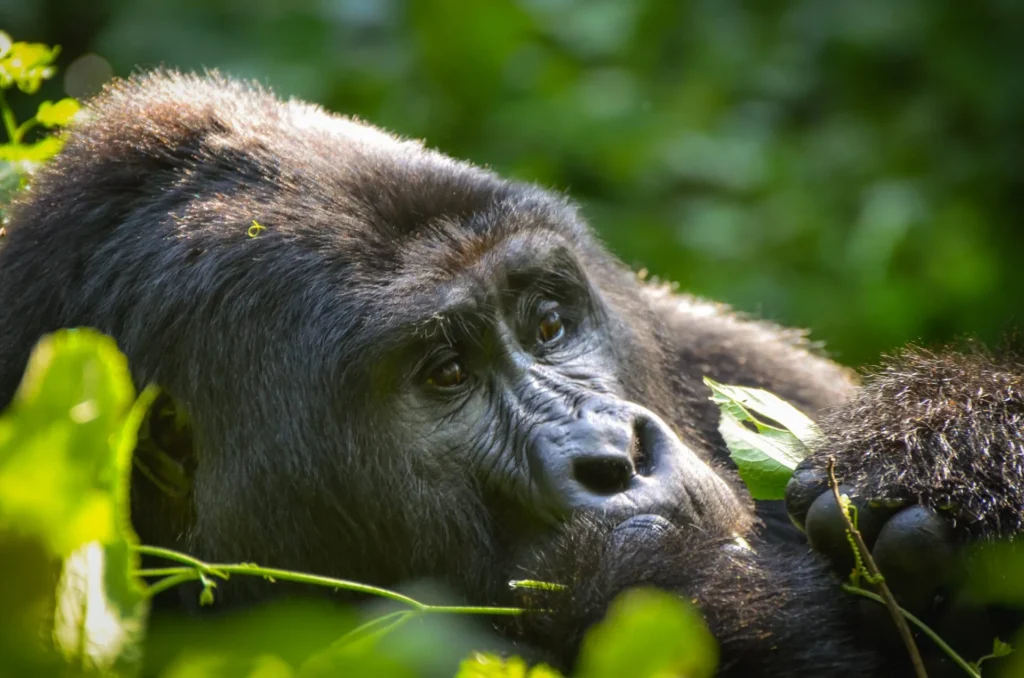
Mountain gorillas live in social groups that commonly contain a mature silverback, adult females, younger males, juveniles and infants. The silverback is often an important figure in the group’s social organisation, influencing movement and responding to potential threats. Adult females care for their young, while juveniles develop social skills through play, exploration and interaction with other group members.
For a solo wildlife enthusiast, observing these relationships can be more meaningful than simply obtaining a photograph. A gorilla family may spend part of the encounter feeding quietly, resting or moving through vegetation. Young gorillas may play while adults remain relatively still, and the silverback may appear calm and watchful. Each encounter reflects the animals’ natural behaviour rather than a performance arranged for visitors.
The gorillas remain wild despite being habituated to controlled human presence. Habituation is a gradual process that allows selected families to tolerate authorised observation, but it does not make them domesticated. Visitors must respect observation rules, avoid sudden movements and follow the instructions of the park guides.
How Solo Gorilla Trekking Works in Volcanoes National Park
The Rwanda gorilla trekking experience normally begins with an early morning briefing at the park headquarters in Kinigi, near Musanze. Visitors register, receive instructions and are allocated to trekking groups. The park authorities determine the arrangements according to operational considerations, including the available gorilla families and tracking information.
After the briefing, visitors proceed to the assigned trailhead. This is an important logistical detail because the briefing location is not necessarily the beginning of the forest walk. Some trailheads require additional driving, and solo travellers should arrange transport for this stage rather than assuming that reaching Kinigi is sufficient.
Once at the starting point, authorised guides and trackers lead the group into the forest. The duration of the walk depends on the gorillas’ location, terrain, weather and the group’s progress. Some treks are comparatively short, while others involve sustained walking across steep, muddy or densely vegetated slopes.
When the assigned gorilla family is located, visitors normally spend one hour observing the animals. The guide manages the encounter, explains appropriate behaviour and ensures that the group follows conservation requirements. After the viewing period, participants return through the forest to their starting point.
A solo traveller participates in this process in essentially the same way as any other visitor. The difference lies mainly in the transport, accommodation and wider holiday arrangements made outside the park.
Rwanda Gorilla Trekking Permits for Solo Travellers
The standard international Rwanda gorilla trekking permit costs USD 1,500 per person per trek. Solo travellers pay the applicable individual permit rate rather than a special solo surcharge. The minimum age is 15 years, and permits are required for every eligible participant.
The permit authorises participation in the regulated gorilla trekking experience. It should not be confused with a complete safari package, which may include accommodation, road transfers, meals, a private driver-guide and other activities. A solo traveller booking only the permit must still make practical arrangements to reach the briefing location and the assigned trekking trailhead.
Permit availability is limited because the number of visitors allowed to observe each habituated gorilla family is restricted. During popular travel periods, desirable dates may sell out in advance. Travellers with fixed international flights should therefore check permit availability before confirming non-refundable accommodation or transport arrangements.
Official concessions may apply to qualifying visitor categories or arrangements, but these should be verified against current regulations. Similarly, permit changes, rescheduling and refunds are subject to official conditions rather than the personal discretion of a safari operator.
Is Gorilla Trekking in Rwanda More Expensive for Solo Travellers?
The gorilla permit price does not increase simply because someone travels alone. However, the total Rwanda solo gorilla safari cost can be higher per person because expenses normally shared by couples or groups must be covered individually.
Private transport is often the most noticeable difference. A safari vehicle, fuel and driver-guide may cost approximately the same whether the vehicle carries one traveller or several. A couple can divide these expenses between two people, while a solo traveller using a dedicated vehicle pays the full amount.
Accommodation can also affect the budget. Some lodges quote rates per person sharing a double or twin room, while a visitor occupying a room alone may pay a single supplement or a separate single-occupancy rate. This difference is particularly significant at luxury properties, where accommodation can represent a substantial part of the holiday cost.
Shared departures can reduce certain expenses, but they should be evaluated carefully. The presence of a group departure on an operator’s website does not necessarily mean that a confirmed group has available space on the desired date. Solo travellers should ask whether the departure is guaranteed, what the maximum group size will be and how accommodation is arranged.
Private Solo Gorilla Safaris Versus Shared Group Tours
A private Rwanda gorilla safari for one person provides a dedicated vehicle and greater control over the wider holiday. This can be attractive to travellers who want to stop for photographs, choose their accommodation independently or include additional destinations without following a fixed group schedule. Private travel also makes it easier to adapt rest breaks and departure times to individual preferences.
The disadvantage is cost. The traveller bears the private transport and guiding expenses alone. For someone whose main priority is obtaining the best possible value, these additional expenses may be difficult to justify.
A shared Rwanda gorilla trekking tour can offer a more economical alternative when a suitable departure is available. Travellers share transport and follow a common programme, while each person retains responsibility for individual permit costs and applicable accommodation charges. Shared tours may also provide companionship, although they offer less flexibility.
A third possibility is independent travel to Musanze with separately arranged accommodation and transport. This approach can suit experienced travellers comfortable coordinating several services. However, it requires careful attention to the early briefing, onward trailhead transport and the unpredictability of trekking duration.
Getting from Kigali to Volcanoes National Park Alone
Most international visitors begin their Rwanda journey in Kigali. The main road connection to Musanze passes through scenic highland landscapes and provides access to the Volcanoes region. Although the drive is relatively manageable compared with some East African safari transfers, it still requires planning.
A private transfer offers the simplest arrangement. The driver can collect the traveller from Kigali International Airport or a city hotel and continue to the selected accommodation. This reduces the need to navigate transport terminals with luggage and can be particularly convenient after a long international flight.
Public transport may provide a lower-cost alternative between Kigali and Musanze. However, reaching Musanze is only part of the journey. Travellers must still arrange onward transport to their accommodation, the Kinigi briefing point and the assigned trailhead. These additional transfers can complicate what initially appears to be a straightforward budget option.
For most visitors, arriving in the Volcanoes region the day before trekking is preferable to attempting a long journey immediately before the early morning briefing. This provides time to confirm the permit details, organise equipment and prepare for the forest walk.
Choosing Accommodation for a Solo Gorilla Safari
The most suitable Rwanda gorilla trekking accommodation for solo travellers depends on budget, preferred comfort and the importance of social interaction. Musanze offers a broader town environment with restaurants and transport services, while Kinigi and the surrounding area provide accommodation closer to the park’s tourism operations.
Budget guesthouses can be appropriate for independent travellers who prioritise affordability. However, the cheapest room is not necessarily the best overall value if it requires expensive additional transport or lacks reliable arrangements for early breakfast and departure.
Midrange hotels and lodges can provide a useful balance between comfort and price. Travellers should confirm whether the property can assist with early morning transport and whether packed meals can be arranged when required.
Luxury lodges near Volcanoes National Park offer distinctive accommodation and premium services, but solo travellers should pay particular attention to single-occupancy rates. A room marketed at a per-person-sharing price may be substantially more expensive when occupied by one guest.
Solo Female Travel and Gorilla Trekking in Rwanda
Solo female gorilla trekking in Rwanda is a practical travel option, and women can participate independently in the official national park experience. However, safety should be approached through careful planning rather than assumptions about any destination being completely risk-free.
Choosing reputable accommodation, arranging reliable transport and keeping important contact details accessible can reduce avoidable difficulties. Travellers should confirm airport collection arrangements in advance, particularly when arriving late in the evening. Early morning transfers to Kinigi should also be organised through dependable providers.
During the gorilla trekking activity, visitors remain with authorised guides and the assigned trekking group. Outside the park, solo travellers should use normal precautions with valuables, personal information and unfamiliar transport arrangements.
Current government travel advice should be reviewed before departure, particularly because the Virunga mountain region lies near international borders where security circumstances can change.
Fitness and Physical Preparation for Solo Gorilla Trekking
Rwanda mountain gorilla trekking can be physically demanding regardless of whether the visitor travels alone or with companions. The forest environment includes steep slopes, slippery ground, exposed roots and dense vegetation. Rainfall can make walking conditions more difficult, while the highland altitude may increase the effort required.
Solo travellers should assess their fitness honestly and prepare through regular walking, hill training and practice on uneven terrain. The objective is not to achieve an athletic standard but to become comfortable with sustained walking and changing ground conditions.
Porter services may be available to assist with carrying bags and equipment. Hiring a porter can be particularly useful for photographers carrying heavy cameras or travellers who prefer to conserve energy for the trek itself.
Visitors with mobility concerns should communicate their needs before booking. Park authorities control trekking arrangements, and no safari operator can guarantee an easy route or a particular gorilla family.
Photography Tips for Solo Gorilla Travellers
Mountain gorillas are extraordinary photographic subjects, but forest photography presents several challenges. Light levels may be low, vegetation can obstruct clear views and the animals’ movements cannot be predicted. A camera that performs well in low light and focuses reliably can be useful, although visitors do not need professional equipment to enjoy the experience.
Flash photography is prohibited during gorilla encounters. Travellers should also avoid carrying more equipment than they can comfortably manage during the forest walk. A large collection of lenses may be less practical than a carefully selected camera setup.
Solo photographers sometimes appreciate the flexibility of choosing their wider travel arrangements independently, but the actual gorilla encounter remains a shared, regulated activity. No visitor has the right to obstruct others, move beyond permitted viewing positions or disturb the animals for a photograph.
The most meaningful images often come from patient observation rather than attempting to control the encounter.
Best Time for Solo Gorilla Trekking in Rwanda
Rwanda gorilla trekking is available throughout the year, and mountain gorillas remain in their natural habitat during both wetter and relatively drier seasons. The months of June to September and December to February are often preferred because forest paths may be less muddy than during periods of heavier rainfall.
However, Rwanda’s mountain climate is variable, and rain can occur at any time. A dry-season booking does not guarantee sunshine or an easy trek, while a wetter-season visit does not necessarily mean poor wildlife viewing.
Solo travellers should also consider accommodation availability and the possibility of joining shared departures. Popular travel periods can increase demand for permits and lodges, while quieter periods may offer greater flexibility but fewer confirmed group-joining opportunities.
The best time ultimately depends on the traveller’s available dates, preferred weather conditions, budget and permit availability.
Combining Solo Gorilla Trekking with Other Rwanda Experiences
A solo visit to Rwanda can extend beyond the mountain gorillas without becoming an unnecessarily complicated journey. Golden monkey trekking in Volcanoes National Park provides another primate encounter, while selected hikes offer opportunities to explore the volcanic landscape.
Kigali offers cultural attractions, restaurants and opportunities to learn about Rwanda’s history. Akagera National Park provides traditional savannah wildlife viewing, including elephants, buffaloes, giraffes, zebras and other species. Nyungwe National Park is known for chimpanzee tracking, forest walks and birdwatching.
Travellers seeking relaxation may consider Lake Kivu, where scenic accommodation and selected lakeside activities offer a contrast to demanding forest trekking.
The most suitable additions depend on available time and transport costs. For solo travellers, including too many distant destinations can increase the overall expense without necessarily improving the experience.
Rwanda Versus Uganda for Solo Gorilla Trekking
Both Rwanda and Uganda offer outstanding opportunities to encounter mountain gorillas. Rwanda’s standard international gorilla permit costs USD 1,500, while Uganda’s standard foreign non-resident permit has been USD 800. This difference is significant, but permit price alone does not determine the total cost of a solo safari.
Rwanda’s relatively short road connection between Kigali and Volcanoes National Park can be attractive to travellers with limited time. Uganda offers gorilla trekking in Bwindi Impenetrable National Park and Mgahinga Gorilla National Park, with opportunities to combine the experience with other wildlife destinations.
For a solo traveller, the most economical destination depends on transport arrangements, accommodation, travel duration and whether suitable shared tours are available. A lower permit price may be offset by additional travel expenses, while a higher permit price may still fit a shorter overall holiday.
Responsible Gorilla Trekking as a Solo Visitor
Every participant contributes to the protection of mountain gorillas by following the park’s conservation regulations. Visitors should maintain the required observation distance, remain quiet, avoid sudden movements and follow all instructions from authorised guides.
Great apes are vulnerable to certain human infectious diseases, making health precautions particularly important. Travellers experiencing symptoms of potentially contagious illness should not participate in a way that places the animals at risk.
Visitors must not touch, feed or attempt to attract gorillas. Litter should never be left in the forest, and photographs should be taken without disturbing the animals.
Solo travel provides independence outside the park, but inside gorilla habitat the same conservation responsibilities apply to everyone.
Frequently Asked Questions About Rwanda Solo Gorilla Trekking
Can I see Rwanda’s mountain gorillas without a travelling companion?
Yes. Eligible solo travellers can purchase individual permits and join official trekking groups in Volcanoes National Park.
Will I trek completely alone?
No. Gorilla trekking is conducted with authorised guides and trackers, and visitors are allocated to regulated trekking groups.
Do solo travellers pay more for gorilla permits?
No. The standard permit rate depends on the visitor category rather than whether the person travels alone.
Can I join a shared safari from Kigali?
Shared departures may be available, but the date, price and confirmed group status should be verified before booking.
Is a private vehicle necessary?
A private vehicle is not mandatory for the entire holiday, but reliable transport to Kinigi and the assigned trailhead must be arranged.
Is solo female gorilla trekking possible?
Yes. Solo female travellers can participate, with appropriate preparation and attention to current travel advice.
Can I choose which gorilla family to visit?
No. Gorilla family allocation is controlled by the park authorities.
Is gorilla trekking suitable for beginner hikers?
Some treks are relatively manageable, while others are demanding. Visitors should prepare for uneven mountain terrain and variable walking distances.
Should I stay in Kigali or Musanze before trekking?
Staying in Musanze or Kinigi before the trek is generally more practical because the park briefing begins early in the morning.
What is the most important consideration when booking alone?
Confirm permit availability and the complete transport arrangements before making non-refundable travel commitments.
Book Your Solo Rwanda Mountain Gorilla Safari
At Gorilla Rwanda Safaris, we help independent visitors organise solo Rwanda gorilla trekking holidays with appropriate permits, accommodation and reliable transport. We can assist with private arrangements or suitable shared departures where confirmed availability exists.
Whether you are travelling alone for wildlife photography, personal adventure or a long-awaited encounter with mountain gorillas, the experience can be organised around your preferred dates, accommodation budget and wider travel interests.
Discover Rwanda’s mountain gorillas as a solo traveller and enjoy the freedom of independent travel combined with the expertise of authorised national park guides.
END-OF: https://www.gorillarwandasafaris.com/gorilla-trekking/mountain-gorillas-solo-travelers-guide/