
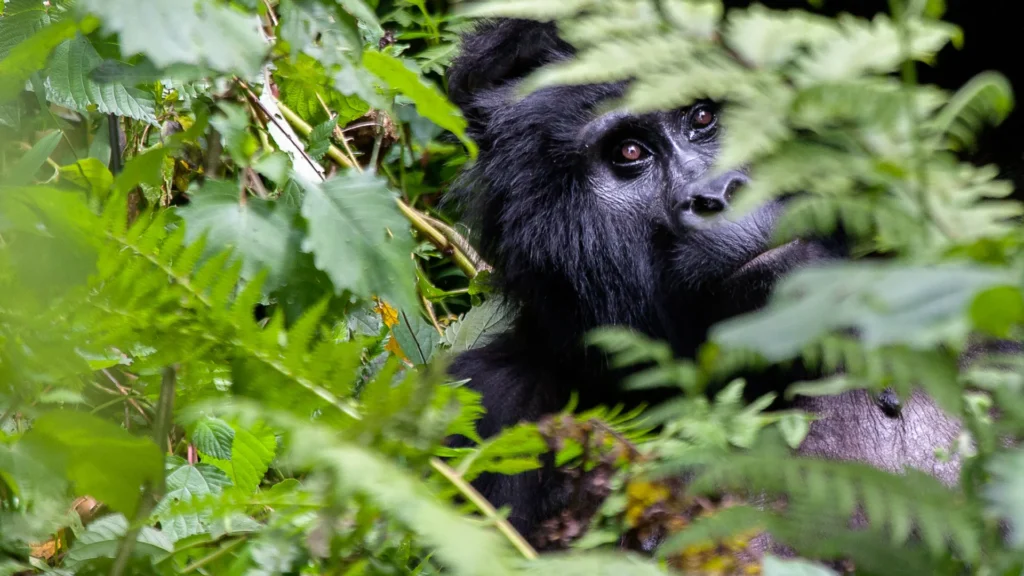
Seeing Rwanda mountain gorillas in their natural forest habitat is among the most extraordinary wildlife experiences available anywhere in Africa. Unlike a conventional wildlife safari, where animals are generally observed from a vehicle, mountain gorilla trekking in Rwanda involves entering a protected highland forest on foot with authorised guides and trackers. Visitors may encounter a habituated gorilla family feeding among vegetation, resting beneath the forest canopy, grooming one another or interacting with young gorillas.
The standard Rwanda mountain gorilla trekking permit costs US$1,500 per person, making it one of the most expensive individual wildlife activities in East Africa. This fee is central to Rwanda’s regulated tourism model, which limits the number of daily visitors and generates revenue connected to conservation and community development. However, the permit is not the entire cost of visiting the gorillas, and understanding the difference is essential when planning a realistic travel budget.
This Rwanda Mountain Gorillas Price Guide examines what visitors actually pay for, why the experience is expensive, how permit revenue relates to conservation, the role of habituation and tracking, the expenses associated with forest access and the factors that influence the value of a gorilla encounter. It also explains preferential permit rates, the economic differences between Rwanda and Uganda, and the responsibilities that come with visiting an endangered species.
Understanding Rwanda’s Mountain Gorillas
The mountain gorilla, scientifically known as Gorilla beringei beringei, is a subspecies of the eastern gorilla. Mountain gorillas inhabit high-altitude forests in a restricted area of Central and East Africa, including the Virunga Massif and Bwindi Impenetrable National Park in Uganda.
Rwanda’s mountain gorillas live in Volcanoes National Park, part of the transboundary Virunga ecosystem shared with Uganda and the Democratic Republic of the Congo. Their habitat includes bamboo forest, montane woodland, herbaceous vegetation and the slopes of several volcanoes.
These gorillas live in social groups typically led by a mature male known as a silverback. Groups may also contain adult females, younger males, juveniles and infants. Their composition changes through births, deaths, dispersal and interactions with other gorilla groups.
Mountain gorillas are predominantly plant-eating animals, consuming leaves, shoots, stems and other vegetation. Their movements depend partly on food availability, habitat conditions and social behaviour.
Visitors do not encounter captive gorillas or animals trained to appear at a particular location. The gorillas remain wild, although designated tourism groups have undergone a carefully managed habituation process that allows them to tolerate the presence of people at regulated distances.
This distinction is fundamental to understanding the cost and conservation responsibilities of Rwanda gorilla tourism.
How Much Does It Cost to See Mountain Gorillas in Rwanda?
The standard Rwanda gorilla permit price is US$1,500 per person for one trekking visit.
This permit is compulsory for participation in an authorised tourist encounter with a habituated gorilla family in Volcanoes National Park.
The fee is charged per person rather than per couple, family or vehicle. Two international visitors undertaking one trek each therefore incur US$3,000 in standard permit charges.
A traveller who wishes to visit gorillas on two separate days must normally purchase two permits, subject to availability. At the standard international rate, this represents US$3,000 in permit expenditure for one person.
The permit is associated with a specified trekking date and does not provide unlimited access to the park.
The full cost of seeing Rwanda’s mountain gorillas also includes reaching the trekking region, staying in suitable accommodation and travelling to the designated briefing point.
Official Rwanda Gorilla Permit Categories
The Rwanda Development Board administers the official gorilla permit system and publishes rates according to visitor categories.
For 2026, the published standard and promotional rates include:
| Visitor category | Permit fee | Conditions |
|---|---|---|
| International foreign visitor | US$1,500 | Standard published rate |
| Rwandan citizen | US$200 | Qualifying 2026 promotional periods |
| East African Community citizen | US$200 | Qualifying 2026 promotional periods |
| Foreign resident in Rwanda | US$500 | Eligibility and promotional restrictions |
| African citizen or qualifying foreign resident in Africa | US$500 | Eligibility and promotional restrictions |
The promotional rates are not applicable from June through October 2026. They should not be assumed to continue into 2027 without an official extension.
Foreign residents applying under relevant residency categories must satisfy documentation requirements, including the applicable minimum residency period.
Applicants should use accurate identity and residency information. The Rwanda Development Board warns that incorrect applications may result in denial of park entry even where a system-generated permit has already been issued.
Why Is the Rwanda Mountain Gorilla Permit So Expensive?
The price of mountain gorilla trekking in Rwanda is closely connected to the way access to endangered wildlife is managed.
Mountain gorillas are highly sensitive to disturbance and certain diseases transmitted by humans. Their habitat is limited, and their survival requires continuous monitoring, protection and management.
Allowing unrestricted numbers of tourists to approach gorilla families would increase the risks of disease transmission, stress and disruption to natural behaviour.
Instead, Rwanda follows a controlled visitor model.
The official Visit Rwanda tourism information states that eight trekking permits are issued per tourism gorilla family per day, with a published daily capacity of 96 permits.
The normal maximum observation period is one hour per gorilla family per day.
These restrictions mean that the number of encounters available for sale is deliberately limited.
The high permit price should not be interpreted as proof that every dollar is transferred directly to a gorilla conservation project. Tourism revenue also forms part of a wider system involving protected-area management, tourism administration and community development.
Nevertheless, the economic value generated by regulated gorilla tourism creates an important incentive for maintaining the protected forest ecosystem.
How Gorilla Tourism Supports Conservation
Mountain gorilla conservation in Rwanda is one of the country’s most important environmental achievements and an internationally recognised example of wildlife protection.
Conservation requires more than protecting individual gorillas. It involves safeguarding habitat, monitoring family groups, addressing threats from illegal activities and maintaining cooperation with neighbouring communities.
The Rwanda Development Board has reported that 10% of national park tourism revenues is allocated to community development initiatives around protected areas.
Such arrangements help connect tourism benefits with the communities that live near national parks.
Tourism also creates employment through guiding, tracking, accommodation, transport, food supply and porter services.
However, conservation benefits should not be overstated. Tourism alone cannot eliminate every threat facing mountain gorillas, and effective protection depends on long-term institutional, scientific and community cooperation.
Responsible visitors contribute most positively when they respect park rules, use legitimate booking channels and support services that provide fair opportunities for local communities.
The Difference Between Gorilla Tracking and Gorilla Habituation
The terms gorilla tracking, gorilla trekking and gorilla habituation are sometimes used interchangeably in travel marketing, but they describe different aspects of gorilla tourism.
Tracking involves locating gorilla groups through knowledge of their movements, feeding areas and other signs.
Trekking refers to the visitor’s journey on foot through the forest to reach the assigned gorilla family.
Habituation is the gradual process through which wild gorillas become accustomed to the controlled presence of humans.
This process requires specialist knowledge, patience and careful observation. It is not a matter of training gorillas to perform for tourists.
Standard Rwanda mountain gorilla trekking involves visiting a family already habituated for tourism, under the supervision of park personnel.
Visitors should not assume that a standard Rwanda permit includes participation in a scientific habituation programme.
Uganda offers a separately regulated gorilla habituation experience in Bwindi, which has its own permit structure and visitor arrangements.
Understanding these distinctions helps travellers compare activities accurately rather than treating every advertised gorilla encounter as the same product.
What Happens During the One-Hour Gorilla Encounter?
The most valuable part of Rwanda mountain gorilla trekking is the opportunity to observe natural social behaviour.
Once the assigned family has been located, visitors follow the guide’s instructions and observe from the required distance.
The group may be resting, feeding or moving through vegetation. Young gorillas sometimes play with one another, while adults may groom, rest or feed.
The silverback may remain relatively still or move with the group.
There is no fixed sequence of events, and visitors cannot request that gorillas move into a clearer photographic position.
The standard maximum viewing period is one hour, beginning when the group has been located and the viewing arrangements are established.
Visitors should remain quiet, avoid sudden movements and never attempt to touch or feed a gorilla.
Flash photography is prohibited.
The experience is memorable precisely because it provides a short, carefully controlled opportunity to witness wild animals behaving naturally.
The Role of Rangers, Guides and Trackers
The permit fee supports access to an organised wildlife experience requiring trained personnel.
Gorilla trackers monitor the movements of habituated families and assist in locating them.
Park guides supervise the visiting groups, explain safety procedures and manage visitor behaviour during the encounter.
The guides also interpret aspects of gorilla ecology, social behaviour and the surrounding habitat.
Their responsibilities extend beyond helping visitors obtain photographs. They must protect the animals, respond appropriately to unexpected behaviour and ensure compliance with park regulations.
The work takes place in challenging mountain environments where weather, terrain and gorilla movements can change quickly.
Visitors should recognise the expertise involved in organising an apparently simple one-hour wildlife encounter.
Why the Trekking Distance Cannot Be Guaranteed
The amount of walking required to see Rwanda mountain gorillas varies significantly.
Mountain gorillas move freely within their habitat. A family that was relatively close to a trailhead on one day may travel to another area before the next visit.
Guides and trackers use their knowledge of recent movements to locate the assigned family.
Some visitors reach gorillas after a relatively short walk, while others undertake several hours of hiking.
The route may include steep slopes, wet ground, dense vegetation and high-altitude conditions.
Travellers should not pay a premium to an operator claiming to guarantee the shortest trek unless the proposed service is clearly defined and legitimately authorised.
The park authorities manage gorilla family allocations, and no operator can control the gorillas’ movements.
What Determines the Total Cost of a Rwanda Mountain Gorilla Visit?
The standard permit is the principal compulsory cost, but several supporting expenses influence the total budget.
Transport to Volcanoes National Park
Most international visitors reach Rwanda through Kigali International Airport.
They then travel towards Musanze and Kinigi, the principal gateway areas for gorilla trekking.
Private road transport may include a vehicle, driver, fuel and transfers between accommodation and the park’s designated meeting point.
The final cost depends on the vehicle type, passenger numbers, itinerary and duration of use.
Travellers should confirm whether the transport price covers all necessary journeys rather than only the transfer from Kigali.
Accommodation
The Rwanda gorilla trekking accommodation cost varies widely.
Musanze offers town hotels and guesthouses, while Kinigi and the surrounding countryside provide a selection of lodges positioned near the national park.
Luxury properties can be considerably more expensive than modest accommodation, but the standard gorilla permit remains the same.
Accommodation should be evaluated according to location, comfort, meals, cancellation conditions and transfer arrangements.
Meals and Personal Expenses
Some accommodation includes breakfast only, while other properties offer half-board or full-board arrangements.
Visitors may also incur costs for drinks, laundry, personal purchases and gratuities.
These expenses should be distinguished from compulsory trekking charges.
Porter Assistance
Hiring a porter is optional but often worthwhile.
Porters can carry daypacks and provide practical support on difficult terrain.
This service also offers a direct opportunity to support local employment.
Travel Insurance
Visitors should consider insurance that covers relevant outdoor activities, medical treatment and unexpected travel disruption.
Policies differ, and travellers should confirm whether trekking at the applicable elevation is covered.
The Economic Difference Between Solo and Shared Travel
The cost of seeing mountain gorillas in Rwanda can vary substantially according to the number of travellers sharing supporting services.
The permit fee is charged individually.
However, private vehicle costs may be shared between passengers.
A couple using one vehicle may therefore have lower per-person transport costs than a solo traveller requiring the same vehicle exclusively.
Accommodation pricing can also differ between single-occupancy and shared rooms.
These differences do not alter the official permit fee, but they influence the complete cost of the visit.
When comparing quotations, travellers should separate fixed individual expenses from shared expenses.
Does Luxury Accommodation Improve the Gorilla Encounter?
Luxury accommodation can significantly improve comfort, privacy and the overall travel experience, but it does not automatically provide a better encounter with the gorillas.
Standard trekking activities remain subject to park management, group allocation and wildlife regulations.
A guest staying at an expensive lodge does not automatically receive a longer viewing period or permission to approach the gorillas more closely.
Premium accommodation may provide better facilities, personalised services, attractive surroundings and convenient transport arrangements.
These benefits can be valuable, particularly for travellers seeking a comfortable holiday.
However, the quality of the gorilla encounter depends largely on natural wildlife behaviour, park arrangements and the conditions encountered on the day.
Is Rwanda Gorilla Trekking Worth US$1,500?
The value of Rwanda mountain gorilla trekking is subjective.
For some visitors, the permit represents a major financial commitment requiring considerable saving.
For others, observing mountain gorillas in the wild is a lifelong ambition that justifies a substantial travel budget.
The experience offers something fundamentally different from a conventional game drive.
Visitors walk through a natural forest, learn about endangered wildlife and spend a limited period observing a gorilla family under regulated conditions.
The encounter also creates an opportunity to understand the conservation challenges facing a species with a restricted geographical range.
However, travellers should recognise that the permit does not guarantee specific photographic conditions, particular animal behaviour or an easy walk.
The experience is best valued as a rare and carefully managed wildlife encounter rather than a guaranteed performance.
Rwanda Mountain Gorillas vs Uganda Mountain Gorillas
Both Rwanda and Uganda provide opportunities to observe mountain gorillas in their natural habitat.
Rwanda’s standard international permit costs US$1,500.
Uganda’s standard foreign non-resident gorilla permit costs US$800.
This creates a difference of US$700 per person in standard permit expenditure.
Uganda offers trekking in Bwindi Impenetrable National Park and Mgahinga Gorilla National Park, while Rwanda’s tourism encounters take place in Volcanoes National Park.
Rwanda is particularly convenient for visitors arriving in Kigali and seeking relatively straightforward access to the trekking region.
Uganda may offer greater value for travellers prioritising lower permit expenditure or combining gorillas with additional wildlife destinations.
The gorillas in both countries are wild animals, and neither destination can guarantee a superior encounter.
Why Mountain Gorilla Health Rules Matter
Mountain gorillas and humans are biologically closely related, creating a risk of transmission of certain infectious diseases.
Respiratory infections are a particular concern.
The official Rwanda Development Board guidance states that visitors with colds, influenza or other contagious illnesses may be denied access.
Visitors must maintain the required distance from gorillas and follow instructions concerning coughing, movement and behaviour.
The published minimum distance is seven metres.
Eating, drinking and smoking near gorillas are prohibited.
Visitors should never touch a gorilla, even if an animal approaches unexpectedly.
These rules protect the animals and help preserve the long-term sustainability of gorilla tourism.
When Is the Best Time to See Rwanda Mountain Gorillas?
Rwanda mountain gorilla trekking is generally available throughout the year.
The relatively drier months, especially June to September and December to February, are popular because walking conditions may be more manageable.
However, the Volcanoes region experiences mountain weather, and rain can occur at any time.
During wetter periods, trails may be muddy and vegetation may be particularly wet.
The gorillas remain in their natural habitat throughout the year, so the main seasonal differences concern trekking conditions and travel preferences rather than the existence of the animals.
Travellers should also consider permit demand and accommodation availability.
How to Book Rwanda Mountain Gorilla Permits Safely
Visitors can arrange permits through the official Rwanda Development Board booking facilities or through a reputable tour operator.
The application requires an available trekking date, accurate traveller details and payment under the relevant conditions.
Applicants seeking preferential rates must provide the required eligibility documentation.
The Rwanda Development Board warns that false or incomplete applications may result in denial of entry even after a permit has been generated.
Visitors should verify the trekking date, permit category and identification details before completing payment.
A safari quotation should clearly indicate whether the official permit is included.
Frequently Asked Questions About Rwanda Mountain Gorilla Prices
How much does it cost to see mountain gorillas in Rwanda?
The standard Rwanda gorilla trekking permit costs US$1,500 per person. Transport, accommodation and personal expenses are additional unless included in a confirmed quotation.
Why are Rwanda gorilla permits expensive?
The permit forms part of a regulated conservation tourism model involving limited visitor numbers, trained personnel, protected habitats and associated community development.
Can African citizens obtain discounted permits?
Qualifying African citizens may obtain a promotional US$500 permit during eligible 2026 periods, subject to official documentation requirements.
How much do East African citizens pay?
Qualifying East African Community citizens may obtain a US$200 promotional permit during eligible periods in 2026. The promotional rate does not apply from June through October 2026.
Are the same discounted rates available in 2027?
The published 2026 promotion does not establish guaranteed rates for 2027. Current official conditions must be checked before booking.
How long can visitors observe the gorillas?
The standard maximum viewing period is one hour.
Can I see mountain gorillas without trekking?
The standard tourism experience involves travelling on foot through the forest. Travellers with mobility limitations should discuss available assistance arrangements in advance.
Can I choose a particular gorilla family?
Family allocation is managed by the park authorities. A particular family cannot ordinarily be guaranteed through a standard booking.
Are mountain gorillas dangerous?
Mountain gorillas are powerful wild animals. Habituated groups are accustomed to regulated human presence, but visitors must follow guide instructions and avoid behaviour that could provoke a reaction.
Are gorilla sightings guaranteed?
No. Trackers work to locate habituated families, but the gorillas remain wild and their movements cannot be controlled.
Is Rwanda better than Uganda for mountain gorilla trekking?
Both destinations provide exceptional opportunities. Rwanda is often preferred for convenient access from Kigali, while Uganda offers a lower standard permit price and different trekking environments.
Does the permit support conservation?
Gorilla tourism contributes to the wider conservation and protected-area management system. Rwanda also operates community revenue-sharing arrangements associated with national park tourism.
Plan Your Rwanda Mountain Gorilla Encounter
The Rwanda mountain gorilla permit price represents a significant investment in a carefully regulated wildlife experience.
Understanding what the fee includes, how the visitor categories work and why conservation rules matter helps travellers make informed decisions.
Gorilla Rwanda Safaris can assist with official permit enquiries, accommodation selection, reliable transport and practical preparation for visiting Rwanda’s endangered mountain gorillas.
Contact our team for current permit availability, applicable visitor rates and expert advice on planning a responsible Rwanda mountain gorilla trekking experience.