
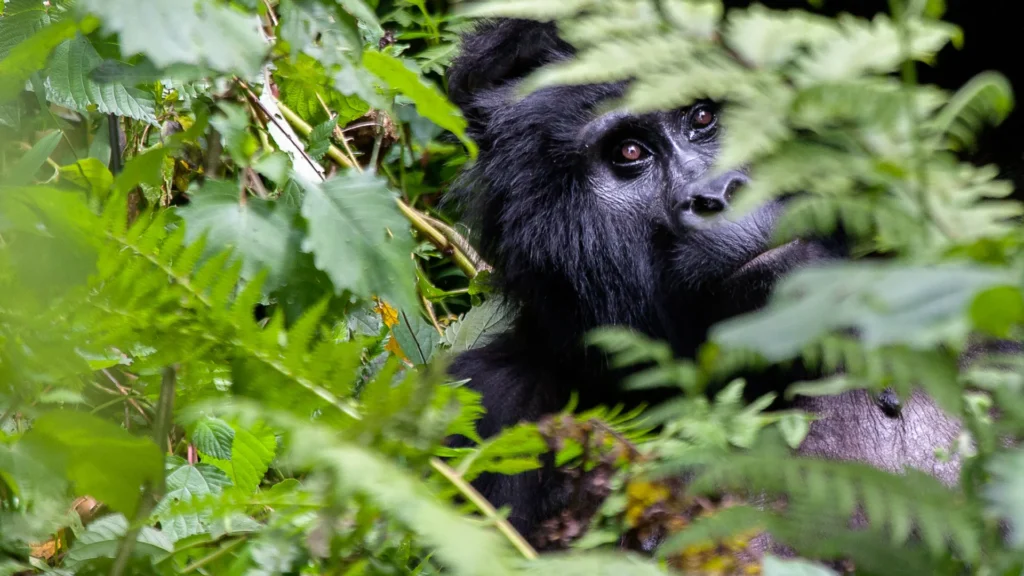
Gorilla trekking difficulty in Volcanoes National Park is closely connected to the distinctive geography of Rwanda’s Virunga Mountains. Unlike a wildlife excursion on open savannah, gorilla trekking takes place in a protected mountain landscape characterised by volcanic slopes, bamboo vegetation, montane forest, uneven ground and changing weather conditions.
Visitors may begin their experience at the park’s briefing facilities in Kinigi, but the actual forest route depends on the location of the assigned habituated gorilla family. Some groups undertake relatively manageable walks, while others must negotiate steep gradients and difficult vegetation before reaching the animals.
The terrain can be especially challenging after rainfall, when soil becomes muddy and plants retain moisture. Even during relatively drier months, the forest may remain damp and slippery in shaded areas. Altitude can also increase the effort required during uphill walking.
This detailed Volcanoes Gorilla Trekking Difficulty Guide focuses specifically on the physical landscape of Volcanoes National Park, explaining the different vegetation zones, the effect of volcanic terrain, the role of Kinigi and the importance of choosing suitable equipment and assistance.
Why Volcanoes National Park Presents Unique Trekking Challenges
Volcanoes National Park protects part of the Virunga volcanic chain in northwestern Rwanda. The landscape includes mountain environments associated with Karisimbi, Bisoke, Sabyinyo, Gahinga and Muhabura.
The park is not a uniform forest with a single walking trail. Its terrain varies according to elevation, slope, vegetation and local conditions.
Some routes pass through relatively open vegetation, while others enter dense forest where movement can be slower. Steep slopes may require careful climbing or descending, particularly when the ground is wet.
The natural setting is one of the main attractions of the experience, but it also means that trekking cannot be compared directly with walking on a maintained urban path.
Visitors should prepare for a genuine mountain forest activity.
Understanding the Virunga Volcanic Landscape
The Virunga Massif is a chain of volcanic mountains extending across Rwanda, Uganda and the Democratic Republic of the Congo. Volcanoes National Park protects the Rwandan portion of this remarkable landscape.
Volcanic activity has shaped the terrain over long periods, creating mountains, slopes and varied ecological habitats.
For trekkers, the most important consequence is the presence of uneven ground and substantial changes in elevation. Some routes involve ascending or descending slopes where careful footing is necessary.
The terrain can become slippery after rain, particularly where soil, vegetation and moisture combine.
Visitors should not expect the route to follow a single maintained hiking path throughout the activity.
How Elevation Influences Physical Effort
Volcanoes National Park occupies a high-altitude environment. The precise elevation encountered depends on the assigned route and the location of the gorilla family.
Walking uphill at altitude may feel more demanding than similar exercise at lower elevations. Visitors may become breathless more quickly, particularly when carrying equipment or moving over steep ground.
The effect varies between individuals. Some travellers adapt comfortably, while others notice reduced endurance.
A steady pace, hydration and regular communication with the guide are important. Visitors should avoid attempting to keep up through excessive exertion.
Travellers with relevant medical conditions should seek personalised advice before undertaking strenuous activity at altitude.
The Difference Between Kinigi and the Forest Trailheads
Kinigi is associated with the main gorilla trekking briefing facilities. Visitors must report at the designated headquarters at 7:00 a.m.
However, the briefing point is not necessarily the beginning of the forest walk.
After registration and group allocation, visitors may travel by vehicle to different starting points. The exact arrangements depend on the assigned gorilla family and operational conditions.
This distinction is important when assessing trekking difficulty. Staying close to Kinigi may reduce the early morning transfer, but it does not guarantee a short forest walk.
Travellers should confirm transport arrangements for both the briefing and any onward journey to the trailhead.
Walking Through Bamboo Forest
Bamboo vegetation is a distinctive feature of parts of Volcanoes National Park.
Some bamboo areas may provide relatively open walking conditions, while others contain uneven ground, dense stems and wet vegetation.
The forest floor can be slippery, especially after rain. Bamboo leaves and surrounding plants may retain moisture even when the weather is clear.
Visitors may need to step carefully around vegetation and maintain balance on irregular surfaces.
The presence of bamboo does not automatically indicate an easy route. Terrain, slope and the gorillas’ location remain important.
Montane Forest and Dense Vegetation
Other trekking routes may enter montane forest, where trees, undergrowth and changing ground conditions create a different walking environment.
Dense vegetation can slow movement and require careful navigation. Roots, branches and uneven surfaces may be difficult to see.
Wet plants can make clothing damp, while muddy sections may require additional support.
Visitors should wear long trousers and long-sleeved clothing to protect against vegetation.
Guides determine the appropriate route, and visitors should remain with the group rather than attempting to find easier paths independently.
Steep Slopes and Changes in Gradient
Steep gradients are among the most demanding features of Volcanoes National Park gorilla trekking.
Ascending requires stamina and leg strength. Descending requires balance and controlled movement, especially when the ground is slippery.
Visitors with knee concerns may find downhill sections particularly uncomfortable.
The difficulty depends on the steepness, surface conditions and length of the route.
A relatively short trek with substantial elevation changes may feel more demanding than a longer walk over gentler terrain.
This is why walking distance alone is not a reliable measure of difficulty.
Mud, Rain and Slippery Ground
Rainfall is common in the Virunga mountain environment. The principal wetter periods are generally March to May and October to November.
During these months, paths may become muddy and vegetation particularly wet. However, rain can occur throughout the year.
Slippery ground increases the need for careful footing and may slow the group’s progress.
Visitors should wear hiking boots with reliable traction and avoid footwear intended primarily for paved surfaces.
Waterproof clothing and a manageable daypack can improve comfort.
The rainy season does not make trekking impossible, but it may increase physical demands.
Why Dry-Season Trekking Can Still Be Difficult
The relatively drier periods, commonly June to September and December to February, may offer firmer trails.
However, the mountain terrain remains uneven, and steep slopes do not disappear.
The gorillas may also be located far from the starting point.
A dry-season trek can therefore involve several hours of demanding walking.
Visitors should not book a particular month expecting a guaranteed easy route.
The best preparation is to develop reasonable fitness and bring suitable equipment regardless of the season.
How Gorilla Family Movements Determine the Route
Mountain gorillas move freely within their habitat. Their movements are influenced by feeding opportunities, social behaviour and environmental conditions.
Trackers monitor habituated families and provide information that helps guides organise trekking groups.
However, the gorillas do not remain at fixed tourist viewing points.
A family may be relatively close to a trailhead on one day and farther away on another.
The park authorities use current information when allocating visitors.
Consequently, trekking difficulty cannot be guaranteed in advance.
Can Visitors Choose a Shorter Route?
Visitors may communicate fitness or mobility concerns before trekking.
The park authorities may consider these concerns during group allocation.
However, the final arrangements depend on the location of gorilla families and operational conditions.
A short or easy route cannot be guaranteed.
Travellers should avoid relying on promises that a particular family will always be easy to reach.
The gorillas remain wild animals, and their movements determine the practical trekking requirements.
How Long Does the Forest Walk Take?
There is no fixed duration for Volcanoes gorilla trekking.
Some groups may reach their assigned family after a relatively short walk, while others may spend several hours hiking.
The return journey must also be considered.
Weather, terrain and group pace influence the total duration.
The standard one-hour viewing period begins once the gorillas have been located.
Visitors should avoid scheduling tightly timed onward travel immediately after trekking.
The Physical Demands of Descending
Travellers often focus on uphill walking, but descending can be equally demanding.
Steep downhill sections require controlled movement and good balance.
Wet ground can increase the risk of slipping, particularly where vegetation obscures the surface.
Visitors with knee problems may find descents uncomfortable.
Suitable boots and a steady pace are important.
Porters may provide practical support, but they cannot remove every challenge associated with natural terrain.
The Importance of Proper Footwear
Hiking boots with reliable grip are strongly recommended for Volcanoes National Park.
Footwear should provide stability on uneven ground and traction on muddy surfaces.
Visitors should wear boots that have already been tested during walks.
New footwear can cause blisters or discomfort, particularly during longer treks.
Shoes intended mainly for city walking may not provide adequate support.
Comfortable socks and appropriate clothing can also reduce discomfort.
Gloves and Protective Clothing
Long trousers and long-sleeved clothing help protect against vegetation and stinging nettles.
Gloves may be useful when negotiating dense plants or uneven slopes.
A waterproof jacket is advisable throughout the year.
Visitors should choose clothing that allows comfortable movement.
Heavy garments that retain excessive moisture may become uncomfortable during prolonged walking.
Layering can help visitors adapt to changing temperatures between the early morning briefing and the forest.
Carrying Water and Equipment
Visitors should carry drinking water, essential medication and suitable rain protection.
Photographic equipment should be manageable because unnecessary weight increases fatigue.
A small daypack is generally preferable to a large bag.
Porters can carry equipment and provide practical assistance.
Visitors should organise belongings before leaving the accommodation so that unnecessary items remain behind.
Porter Support in Volcanoes National Park
Gorilla trekking porters are local assistants who help visitors carry daypacks and negotiate difficult terrain.
Their assistance can be particularly useful on steep or muddy routes.
The service is generally separate from the standard permit fee.
Travellers should confirm the applicable charge and arrangements before trekking.
Hiring a porter can also support local employment in communities surrounding Volcanoes National Park.
Porters do not replace official guides, and they cannot guarantee a short route.
Trekking for Older Visitors
Many older travellers participate successfully in Volcanoes National Park gorilla trekking.
The most important considerations are fitness, balance, mobility and relevant health conditions.
Some older visitors are experienced hikers and may manage the terrain comfortably.
Others may benefit from porter assistance or specialised support arrangements.
Visitors should communicate their needs before booking.
Relatively drier months may offer more manageable walking conditions, but no season eliminates every physical challenge.
Trekking with Mobility Limitations
Visitors with mobility limitations should discuss their needs well before travel.
Certain specialised support arrangements may be possible, depending on individual circumstances and local availability.
However, these arrangements require advance coordination and should not be assumed to be universally available.
The forest contains natural obstacles that cannot be removed.
Travellers should provide accurate information about their mobility and assistance requirements.
The operator and relevant park personnel can then assess what may be practical.
Safety During the Gorilla Encounter
Once the assigned family has been located, visitors follow the guide’s instructions.
- The standard maximum viewing period is one hour.
- The published minimum distance is seven metres.
- Flash photography is prohibited.
Visitors should remain calm and avoid sudden movements.
The gorillas may move naturally during the encounter.
The guide determines where the group may safely stand.
What If the Gorillas Are on a Steep Slope?
The gorillas may be resting or feeding on uneven terrain.
Visitors cannot choose where the animals will be positioned.
The guide assesses the appropriate viewing location and provides instructions.
Visitors should not attempt to climb independently for a better photograph.
Safety and conservation regulations take priority over photographic opportunities.
The one-hour encounter takes place within the natural forest rather than a constructed viewing area.
How the Weather Affects Visibility
Mist, cloud and rain are common features of the Virunga mountain environment.
These conditions can affect views across the landscape and the amount of light reaching the forest floor.
During overcast weather, photographers may benefit from softer light, but rain can make equipment handling more difficult.
Bright sunlight can create strong contrasts beneath the canopy.
Visitors should prepare for changing conditions rather than expect a particular photographic environment.
Flash photography is prohibited regardless of weather.
Fitness Preparation for Volcanic Terrain
Visitors can prepare by walking regularly and gradually introducing hills or stairs.
The aim is to improve stamina, leg strength and balance.
Walking on safe, uneven surfaces can help develop confidence.
Travellers should practise wearing their intended hiking boots.
Those with relevant medical conditions should seek appropriate professional advice before increasing exercise.
Preparation should be gradual rather than excessively demanding.
Frequently Asked Questions
How difficult is gorilla trekking in Volcanoes National Park?
Difficulty varies. Some treks are relatively manageable, while others involve steep slopes, muddy paths and several hours of walking.
Is the terrain volcanic?
Yes. The park forms part of the Virunga volcanic landscape, which includes mountains, slopes and varied forest habitats.
Does trekking begin at Kinigi?
Visitors report to Kinigi for the briefing. They may then travel by vehicle to the assigned forest starting point.
Are the trails steep?
Some routes involve steep gradients. The exact terrain depends on the assigned gorilla family’s location.
Is bamboo forest easier to walk through?
Not necessarily. Bamboo areas may contain uneven ground, wet vegetation and slippery surfaces.
Is the dry season easier?
Relatively dry conditions may reduce mud, but steep terrain and long walking distances remain possible.
Can I request a shorter trek?
You may communicate your needs, but a short route cannot be guaranteed.
Are porters available?
Yes. Porters provide practical assistance for an additional charge.
Can older travellers participate?
Yes, depending on individual fitness, mobility and health considerations.
What footwear should I wear?
Sturdy hiking boots with reliable grip are strongly recommended.
How long can I stay with the gorillas?
The standard maximum viewing period is one hour.
Are sightings guaranteed?
No. Mountain gorillas remain wild animals.
Prepare for the Terrain of Volcanoes National Park
Volcanoes National Park gorilla trekking difficulty is shaped by volcanic slopes, forest vegetation, altitude, rainfall and the natural movements of mountain gorillas.
The experience can be physically demanding, but careful preparation, appropriate equipment and realistic expectations can make it more manageable.
Gorilla Rwanda Safaris can assist with official permit enquiries, porter arrangements and advance discussions about mobility requirements.
Contact our team with your preferred trekking dates and physical considerations to begin planning a responsible Volcanoes National Park gorilla trek.