
1 Day Bwindi Gorilla Trek
A one-day mountain gorilla trek in Bwindi for travellers who are already in southwestern Uganda.
View SafariHandpicked Kenya Safari Tours for Every Traveler
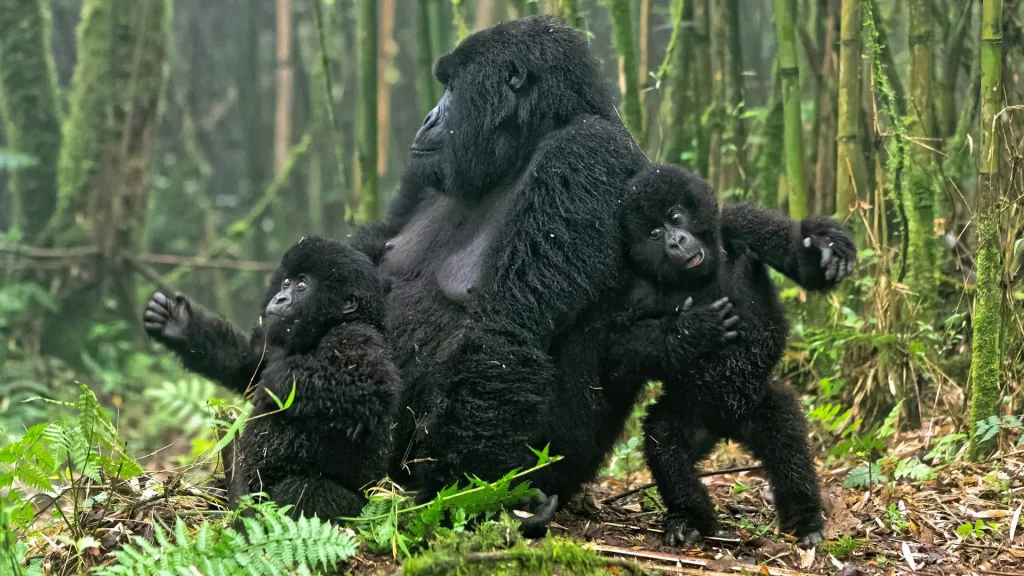
Rwanda gorilla trekking is one of the world's most extraordinary wildlife experiences, offering visitors the opportunity to observe endangered mountain gorillas in their natural forest habitat.
All regular tourist gorilla trekking in Rwanda takes place in Volcanoes National Park, located in the country's northwestern region.
The park forms part of the Virunga mountain ecosystem, an important conservation landscape shared by Rwanda, Uganda and the Democratic Republic of the Congo.
The forests provide habitat for endangered mountain gorillas, along with golden monkeys, forest birds and other wildlife.
The nearby town of Musanze is a major tourism centre, while the park headquarters at Kinigi serves as the principal meeting point for gorilla trekking visitors.
The journey from Kigali to the Volcanoes National Park region typically takes approximately two and a half to three hours by road, depending on traffic, weather and the exact destination.
This relatively manageable journey makes gorilla trekking from Kigali practical for travellers with limited time.
Most visitors choose to spend at least one night near the park before trekking because registration and briefing begin early in the morning.
The Virunga Mountains are a chain of volcanoes extending across the borders of Rwanda, Uganda and the Democratic Republic of the Congo.
Their montane forests and bamboo zones provide important habitat for mountain gorillas.
The combination of volcanic scenery, forest biodiversity and conservation significance makes Volcanoes National Park gorilla trekking a distinctive wildlife adventure.
Showing 1–12 of 216 safaris
A one-day mountain gorilla trek in Bwindi for travellers who are already in southwestern Uganda.
View SafariA single day in Kampala for the kasubi and palace area, a cultural show, and a market or…
View SafariA full day in Kigali covering the Genocide Memorial, a neighborhood market, and one or two museums.
View SafariA single day on Mount Bisoke, with the crater lake as the turnaround point.
View SafariThe 1 Day Rwanda Family Safari offers an exciting and educational wildlife adventure for families visiting Rwanda.
View SafariThe 3 Day Rwanda Gorilla and Akagera Safari combines mountain gorilla trekking in Volcanoes National Park with wildlife…
View SafariThe 4 Day Rwanda Gorilla and Nyungwe Safari combines mountain gorilla trekking in Volcanoes National Park with chimpanzee…
View SafariThe 1 Day Rwanda Gorilla Trekking Safari offers an unforgettable opportunity to encounter endangered mountain gorillas in their…
View SafariThe 1 Day Rwanda Honeymoon Safari offers couples a romantic escape to the beautiful shores of Lake Kivu,…
View SafariThe 1 Day Rwanda Luxury Safari offers an exclusive wildlife experience in Akagera National Park, Rwanda's premier Big…
View SafariThe 1 Day Rwanda Primates Safari offers an exciting opportunity to encounter Rwanda's endangered golden monkeys in the…
View SafariThe 1 Day Rwanda Wildlife Safari offers an exciting opportunity to explore Akagera National Park, Rwanda's premier savannah…
View SafariA typical Rwanda gorilla trekking experience begins with an early morning transfer from your accommodation to the park headquarters.
Visitors report to the park headquarters at Kinigi for registration and briefing.
The Rwanda Development Board lists 7:00 a.m. as the reporting time for gorilla tracking.
Park personnel check relevant documentation and explain the activity's rules and procedures.
Visitors are assigned to available habituated gorilla groups.
Park authorities may consider factors such as physical fitness and mobility when allocating trekking groups, although a specific family or trek difficulty cannot be guaranteed.
Each regular trekking group is limited to a maximum of eight visitors.
After the briefing, visitors travel to the appropriate starting point.
The location depends on the assigned gorilla family and its movements.
Some trailheads are relatively close to the park headquarters, while others require additional driving.
The group enters the forest with authorised guides and trackers.
The hike may pass through farmland near the park boundary, bamboo vegetation, montane forest and uneven volcanic terrain.
Trekking conditions vary considerably depending on rainfall, vegetation and the location of the gorillas.
Once the assigned family is located, visitors are normally permitted one hour observing the gorillas.
During this time, you may see gorillas feeding, grooming, resting and interacting with one another.
Young gorillas sometimes play or climb through vegetation, while silverbacks may remain close to the family.
The experience is carefully regulated to reduce disturbance to the animals.
After the observation period, the group leaves the gorillas and returns along the forest route.
The total duration varies, so travellers should avoid scheduling tight onward connections immediately after trekking.
The standard Rwanda gorilla trekking permit cost for international visitors is USD 1,500 per person per trek.
The Rwanda Development Board publishes separate rates and promotional arrangements for certain eligible visitor categories, including some citizens and residents.
These rates are subject to official eligibility conditions, documentation requirements and applicable travel periods.
A Rwanda gorilla trekking permit provides access to the scheduled gorilla tracking activity, authorised park guiding and the regulated observation period.
The permit does not automatically include private transport from Kigali, hotel accommodation, meals or other national park activities.
Yes. Travellers can arrange double gorilla trekking in Rwanda, subject to permit availability.
Each trekking day requires its own permit.
A second trek provides another opportunity to observe mountain gorillas, potentially under different forest and weather conditions.
However, allocation to a different gorilla family is not guaranteed.
Permits can be booked through the official Rwanda Development Board booking arrangements or through an authorised safari operator.
Travellers should provide accurate identification details and verify their intended trekking date before payment.
The official booking portal warns that incorrect documentation can result in refusal of entry, even when a permit has been issued.
Because daily visitor numbers are limited, advance booking is advisable.
The minimum age for gorilla trekking in Rwanda is 15 years.
This rule applies to regular gorilla tracking in Volcanoes National Park.
Families travelling with children younger than 15 can organise alternative activities, such as selected cultural experiences, scenic excursions or other suitable wildlife activities.
Older teenagers who meet the minimum age requirement can participate, provided they are adequately prepared for the physical demands of the trek.
Age verification may be required during permit processing or at the park.
Rwanda gorilla trekking difficulty varies from one day to another.
The location of the assigned gorilla family is the main factor influencing walking distance and trekking duration.
Some groups may be reached after a relatively short hike, while others require several hours of walking through challenging terrain.
The forest environment may include muddy slopes, uneven paths, thick vegetation and steep sections.
Rain can make trails slippery, even during months generally considered relatively dry.
Walking poles and sturdy footwear can improve stability.
Volcanoes National Park lies at relatively high elevation, and some trekking routes ascend further into the mountains.
Visitors who are not accustomed to altitude may find uphill walking more demanding.
Travellers should maintain a comfortable pace and inform their guides about relevant physical limitations.
Gorilla trekking for seniors in Rwanda is possible for many older travellers, depending on their fitness, mobility and health.
There is no general maximum age restriction comparable to the minimum age requirement.
Porters can assist with carrying belongings, and specialised mobility assistance may be available through advance arrangements.
However, visitors should discuss individual requirements before booking rather than assuming that every trekking route will be suitable.
Regular walking, moderate hill climbing and general cardiovascular exercise can help visitors prepare for mountain gorilla trekking.
It is useful to practise walking on uneven ground while wearing the boots intended for the safari.
Travellers do not need to be professional hikers, but they should understand that trekking conditions are unpredictable.
Suitable gorilla trekking clothing protects against rain, vegetation, insects and muddy conditions.
Avoid clothing that restricts movement or becomes uncomfortable when wet.
A small waterproof daypack is useful for drinking water, snacks, rain protection and personal items.
Travellers should also carry any essential medication, identification required for the activity and appropriate camera equipment.
A porter can be helpful for carrying belongings and providing practical assistance on difficult sections.
Rwanda gorilla trekking is available throughout the year, although weather conditions vary seasonally.
The period from June to September is generally among Rwanda's relatively drier seasons.
These months are popular for gorilla trekking because forest trails may be less muddy than during periods of heavier rainfall.
However, rain remains possible in the mountains.
December to February is another relatively drier period and can be suitable for gorilla trekking holidays.
Conditions vary between individual days, so visitors should still prepare for wet weather.
The period from March to May is generally associated with heavier rainfall.
Forest scenery can be exceptionally green, but trails may be slippery and trekking more physically demanding.
October and November are also commonly wetter months.
Visitors who travel during this period should allow flexibility and bring suitable waterproof equipment.
The best time for Rwanda gorilla trekking ultimately depends on your preferences, available permits and tolerance for changing weather.
Rwanda gorilla trekking regulations are designed to protect both visitors and the endangered gorillas.
Visitors must follow the instructions of authorised park guides throughout the experience.
Important rules include maintaining the required distance, avoiding direct contact with gorillas and remaining calm around the animals.
Flash photography is prohibited, and visitors must not eat, drink or smoke during the gorilla observation period.
Travellers should not participate when suffering from potentially contagious illnesses that could endanger the gorillas.
The permitted viewing time is normally limited to one hour.
Rwanda gorilla photography can be rewarding but technically challenging.
Forest light is often limited, and gorillas may move between shaded vegetation and brighter clearings.
A camera capable of working at higher ISO settings can be useful.
A moderate telephoto lens provides flexibility without requiring visitors to approach the animals.
Photographers should avoid flash and follow all instructions regarding distance and movement.
It is also important to spend some time observing the gorillas without looking through a camera.
A gorilla trekking tour from Kigali is one of the most convenient ways to organise a short primate safari.
Travellers can arrive at Kigali International Airport and transfer to accommodation near Volcanoes National Park.
Day 1: Kigali pickup and scenic transfer to Musanze or Kinigi.
Day 2: Gorilla trekking in Volcanoes National Park, followed by return transport to Kigali.
Day 1: Arrival and transfer to the Volcanoes region.
Day 2: Guided gorilla trekking and relaxation at the lodge.
Day 3: Optional cultural experience or return transfer to Kigali.
The three-day option is generally more relaxed and provides additional flexibility around travel arrangements.
Travellers planning gorilla trekking in Africa often compare Rwanda with Uganda.
Rwanda's main advantage is the relatively short journey from Kigali to Volcanoes National Park.
Uganda offers gorilla trekking in Bwindi Impenetrable National Park and Mgahinga Gorilla National Park, along with a wider range of extended wildlife safari combinations.
The standard foreign non-resident Uganda gorilla permit has been USD 800, compared with Rwanda's standard USD 1,500 permit.
The lower permit price can make Uganda attractive to budget-conscious travellers, although total safari expenses depend on route, accommodation and transport.
Both countries offer exceptional mountain gorilla encounters, and neither can guarantee the exact location or behaviour of a gorilla family.
The standard international visitor permit is USD 1,500 per person per trek. Accommodation, transport and other services are additional unless included in a safari package.
The total experience varies according to the gorilla family's location and trekking conditions. Visitors should allow much of the day for the activity rather than assuming a fixed finishing time.
Visitors must maintain the minimum distance required by current park regulations and follow the guide's instructions if gorillas move unexpectedly.
Gorilla trekking in Rwanda is conducted under the supervision of trained park personnel. Visitors must follow safety instructions and respect the animals' behaviour.
Many older travellers participate successfully, but suitability depends on fitness, mobility and individual health considerations. Assistance options should be discussed in advance.
No. Gorilla tracking success is generally high, but these are wild animals, and sightings cannot be guaranteed.
Yes. Multiple trekking days can be arranged, subject to purchasing separate permits and confirming availability.
For travellers interested in primates, wildlife conservation and exceptional natural experiences, Rwanda gorilla trekking can be a highly rewarding investment.
Yes. Visitors must participate in the authorised park-guided trekking arrangements rather than entering gorilla habitats independently.
Yes. Rwanda gorilla trekking packages can be combined with Akagera National Park, Nyungwe Forest, Lake Kivu and wildlife destinations in Uganda.
At Gorilla Rwanda Safaris, we organise professionally planned Rwanda gorilla trekking tours, gorilla permit arrangements, private transfers from Kigali, comfortable accommodation and personalised safari extensions.
Whether you are planning a 2-day gorilla trekking trip, a 3-day Rwanda gorilla safari, a luxury primate holiday or a combined Rwanda Uganda gorilla trekking adventure, our team can help create an itinerary suited to your needs.
Contact us with your preferred trekking date, number of travellers and accommodation preferences. We will help you understand the booking process, review suitable travel arrangements and plan your mountain gorilla experience.
Begin planning your Rwanda gorilla trekking adventure and discover the remarkable mountain gorillas of Volcanoes National Park.