
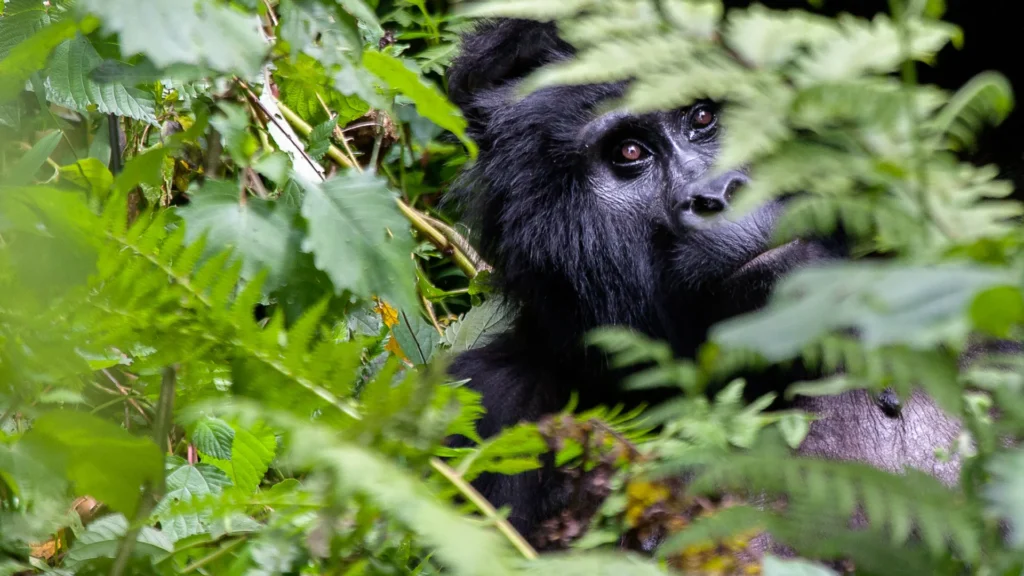
Volcanoes gorilla trekking guides work in one of Africa’s most distinctive mountain environments. Their daily responsibilities take them through volcanic slopes, bamboo forests, dense vegetation and high-altitude ecosystems where endangered mountain gorillas move freely. The expertise of these professionals is essential to locating habituated gorilla families, managing visitor safety and ensuring that tourism does not compromise the animals’ welfare.
Volcanoes National Park occupies Rwanda’s section of the Virunga Massif, a chain of mountains extending across three countries. The landscape is characterised by dramatic changes in elevation, varied vegetation and weather conditions that can change rapidly. Gorilla families may travel between feeding areas, rest beneath dense vegetation or move across difficult terrain, making their locations unpredictable.
Professional gorilla trackers and park guides combine local environmental knowledge, field observation, communication and conservation experience to manage this complexity.
Visitors often see only the final stage of their work: a guide leading a group towards gorillas that have already been located. In reality, the process depends on a wider system of monitoring, information sharing and careful decision-making.
This guide explores how tracking teams operate inside Volcanoes National Park, how they identify gorilla movements, what happens when conditions change, how they supervise encounters and why their observations are valuable for conservation science.
The Virunga Mountains: A Challenging Environment for Gorilla Guides
Volcanic Geography
Volcanoes National Park protects a mountainous landscape associated with several major volcanoes, including Karisimbi, Bisoke, Sabyinyo, Gahinga and Muhabura.
These mountains create a complex environment of steep slopes, ridges, valleys and changing vegetation.
The terrain influences both gorilla movements and the routes used by trekking teams.
A gorilla family feeding on a relatively accessible slope may be reached more easily than one moving through dense vegetation at higher elevation.
Guides must interpret these conditions and select practical routes.
Bamboo Forest
Bamboo vegetation forms an important part of the Virunga landscape.
Gorillas may feed on bamboo shoots and other available plants.
Dense bamboo can restrict visibility and make movement difficult.
Trackers must recognise signs of recent activity while navigating vegetation that may obscure footprints and other evidence.
Montane Forest and Higher Vegetation Zones
The park includes different vegetation communities influenced by elevation, rainfall and local conditions.
Some areas contain thick undergrowth, while others have more open vegetation.
Guides must understand how these habitats affect walking conditions and gorilla movement.
Weather Conditions
Rainfall can occur throughout the year.
Wet soil, slippery vegetation and reduced visibility may complicate tracking.
Guides must adapt their pace and route to changing conditions.
Visitors should not expect trekking difficulty to remain consistent from one day to another.
How Trackers Begin Locating Gorilla Families
Monitoring Known Gorilla Groups
Volcanoes National Park gorilla trackers monitor habituated families as part of the park’s conservation and tourism operations.
Their familiarity with particular groups helps them recognise movements and changes in behaviour.
Information from previous observations may provide a starting point for the following day’s tracking.
However, gorillas are free-ranging animals.
Their overnight or early morning movements may alter the expected location.
Using Previous Nesting Areas
Mountain gorillas construct nests for resting.
Nest locations can provide useful evidence of where a group spent the night.
Trackers may examine the general condition and distribution of nesting sites to help interpret group movements.
Fresh nests suggest recent occupation, while older nests provide historical information.
Trackers use this evidence alongside other signs rather than assuming that the gorillas remain nearby.
Identifying Feeding Activity
Gorillas feed extensively on forest vegetation.
Recent feeding may leave signs such as disturbed stems, broken shoots or other changes in plant material.
Experienced trackers can distinguish relevant evidence from ordinary vegetation damage.
These observations help them determine possible movement directions.
Following Movement Signs
Footprints, disturbed vegetation and other traces can contribute to locating gorillas.
The usefulness of individual signs depends on terrain, weather and how recently the animals passed.
Heavy rain may obscure tracks.
Dense vegetation can make evidence difficult to interpret.
Tracking therefore requires experience and judgement rather than simply following a visible path.
How Guides and Trackers Communicate
Communication between field teams is essential.
Trackers may provide updated information about the location of a habituated family.
The guide leading tourists uses this information to plan the approach.
When gorillas move unexpectedly, the route may need to change.
The guide must consider the group’s physical capabilities, the terrain and the conservation requirements associated with approaching the animals.
Visitors may notice that the trekking party pauses while the guide receives information.
These pauses are part of the coordination process.
Tourists should remain patient rather than assuming that the team has lost its way.
Why Gorilla Tracking Is Not an Exact Science
Mountain gorilla tracking involves wild animals whose movements cannot be predicted precisely.
A family may change feeding locations, move away from another group or travel through difficult vegetation.
Weather can also affect visibility and trail conditions.
Trackers use experience to interpret the available evidence, but uncertainty remains.
This is why gorilla trekking duration cannot be guaranteed.
Some groups may be located after a relatively short walk.
Others require a much longer effort.
Visitors should prepare for variable conditions and avoid assuming that the park can promise a particular walking time.
Understanding Gorilla Family Territories and Movements
Mountain gorilla groups occupy home ranges within suitable forest habitat.
Their movements are influenced by food availability, social relationships and environmental conditions.
Home ranges may overlap, and interactions between neighbouring groups can occur.
A group does not necessarily remain within a fixed, clearly marked territory.
Guides and trackers must understand these movement patterns without assuming that a family will always return to the same location.
Seasonal vegetation changes can influence feeding opportunities.
The composition of a gorilla family may also affect movement.
These factors contribute to the dynamic nature of Volcanoes National Park gorilla trekking.
The Role of Trackers in Gorilla Identification
Trackers who regularly monitor a family may become familiar with individual gorillas.
Identification can involve physical characteristics, age, sex, body size and distinctive features.
The dominant silverback is often recognisable, but other group members may also have identifying characteristics.
Long-term familiarity helps trackers notice changes in family composition.
Births, deaths, dispersal and transfers between groups are important conservation observations.
Tourists should recognise that accurate identification requires experience.
A visitor should not assume that every gorilla photographed can be identified reliably from a single image.
What Happens When a Gorilla Family Is Found?
When the assigned family is located, the tracking and guiding teams coordinate the approach.
The guide prepares visitors for the encounter.
Tourists may be asked to leave walking sticks or unnecessary equipment at a designated point.
The guide explains the required viewing distance and reminds visitors to remain quiet.
The approach is managed to minimise disturbance.
Gorillas may be feeding, resting or moving through vegetation.
The guide determines the appropriate viewing position.
Visitors should not independently move around the family to obtain photographs.
Why Guides Sometimes Change the Viewing Position
A gorilla family may move during the one-hour encounter.
The dominant silverback may lead the group towards another feeding area.
Juveniles may move through nearby vegetation.
The guide may ask tourists to adjust their position or remain still.
These decisions depend on the animals’ movements and surrounding terrain.
Visitors should not interpret every change as an opportunity to move closer.
Sometimes the safest and most respectful response is to allow the gorillas to pass without following immediately.
Managing Gorilla Behaviour During Encounters
Silverback Displays
A silverback may vocalise, beat his chest or move rapidly.
Such behaviour can occur in different social contexts.
The guide interprets the situation and instructs visitors accordingly.
Tourists must not imitate displays or attempt to challenge the animal.
Curious Juveniles
Young gorillas may approach visitors out of curiosity.
The guide ensures that tourists do not encourage physical contact.
Visitors should remain calm and avoid sudden movements.
Mothers With Infants
Guides pay particular attention to the space surrounding mothers and infants.
Tourists must not approach infants or position themselves deliberately between family members.
Group Movement
A family may begin moving away during the encounter.
The guide determines whether visitors can safely continue observing within the permitted viewing period.
The gorillas’ movements take priority over tourists’ preferences.
The Seven-Metre Viewing Rule
The Rwanda Development Board’s published guidance specifies a minimum distance of seven metres between visitors and gorillas.
This requirement helps reduce the risk of transmitting human diseases and disturbing the animals.
Greater separation is advisable where practical.
The guide may instruct tourists to remain farther away depending on the circumstances.
Visitors should never deliberately close the distance for photography.
If a gorilla approaches, the guide manages the situation.
The minimum distance should be understood as a conservation safeguard, not a target for proximity.
The One-Hour Viewing Limit
Standard Volcanoes National Park gorilla encounters are limited to one hour.
The viewing period begins when the guide determines that the group has reached the gorillas and the encounter is underway.
The forest walk before and after the encounter is separate.
Guides are responsible for managing the time limit.
Visitors should not request additional time or remain behind after the group departs.
The restriction reduces the duration of human presence around habituated families.
Gorilla Guides and Visitor Health Protection
Mountain gorillas are vulnerable to certain human infectious diseases.
Guides help enforce health precautions during tourist visits.
Visitors experiencing potentially contagious illness must report their symptoms.
The Rwanda Development Board warns that people with colds, flu or other contagious illnesses may be denied access.
Guides also remind tourists to maintain distance, avoid touching gorillas and follow applicable hygiene requirements.
These measures protect endangered animals from preventable health risks.
The Importance of Trackers in Veterinary Monitoring
Trackers contribute important information to gorilla health monitoring.
Because they observe habituated families regularly, they may recognise changes in behaviour or physical condition.
Possible warning signs include coughing, unusual lethargy, injuries, reduced feeding or visible wounds.
These observations can be communicated to veterinary specialists.
Gorilla Doctors has documented the importance of collaboration with park trackers and rangers in monitoring mountain gorilla health.
In its Rwanda field reporting, the organisation explains that tracker observations help veterinary teams identify individuals requiring closer assessment.
What Happens When a Tracker Finds an Injured Gorilla?
A tracker who observes a possible injury does not automatically attempt treatment.
The concern is reported through the appropriate conservation channels.
Veterinary specialists may then conduct a monitoring visit.
They assess the animal’s condition and determine whether intervention is necessary.
Not every injury requires direct treatment.
Veterinary teams consider the severity of the condition and the risks associated with intervention.
Tourists should never attempt to approach or assist an injured gorilla independently.
Snare Injuries and Conservation Patrols
Although snares are often set for other wildlife, mountain gorillas can become accidentally entangled.
Such injuries can be serious, particularly when a wire or rope restricts circulation.
Gorilla Doctors has documented veterinary interventions involving snare removal.
In an October 2025 case reported by the organisation, veterinary personnel treated a subadult female in Volcanoes National Park after trackers identified a snare around her arm.
This illustrates the importance of regular field monitoring.
Trackers and rangers provide early warning, while specialised veterinarians determine the appropriate medical response.
How Guides Protect the Forest Environment
Guides help prevent visitors from damaging vegetation or leaving designated routes.
They also enforce restrictions on littering and the removal of natural materials.
The forest supports numerous species beyond mountain gorillas.
Responsible visitor management therefore protects the wider ecosystem.
Tourists should avoid collecting plants, disturbing nests or leaving food waste.
Even small actions can create cumulative impacts when repeated across many visits.
Navigation and Safety in Difficult Terrain
The Virunga landscape can be physically demanding.
Guides must assess steep slopes, slippery paths and dense vegetation.
They may adjust the route according to weather and group capabilities.
Visitors should wear appropriate footwear and follow instructions carefully.
Do not rush ahead or attempt to find shortcuts.
If you need assistance, communicate promptly.
A safe trek depends on cooperation between guides, porters and visitors.
The Role of Porters in Volcanoes National Park
Porters provide assistance with bags and difficult walking sections.
Their services can be particularly helpful for visitors carrying photographic equipment.
Porters also contribute to the local economy.
The International Gorilla Conservation Programme has supported responsible porter initiatives, recognising their role in conservation tourism.
Visitors should agree on arrangements clearly and treat porters as valued members of the trekking support team.
How Guides Manage Different Visitor Abilities
Tourist groups may include people with different levels of fitness.
Some visitors are experienced hikers, while others are undertaking their first mountain trek.
Guides must consider these differences when managing the pace.
However, the terrain and gorilla movements may limit the available options.
Visitors should disclose mobility concerns before trekking.
Porter assistance may help, but it does not eliminate all physical demands.
The guide’s responsibility is to manage the group safely within the park’s operational requirements.
Why Visitors Should Not Pressure Guides
Some travellers may request a shorter route, a particular gorilla family or a closer photographic position.
Guides may consider reasonable requests where permitted.
However, conservation and safety rules cannot be overridden by visitor preferences.
A permit does not entitle tourists to exclusive access, physical contact or an extended viewing period.
Respecting professional judgement is essential.
Guide Knowledge and Conservation Education
Professional guides provide opportunities for visitors to learn about the Virunga ecosystem.
They may explain the differences between vegetation zones, the feeding habits of mountain gorillas and the role of conservation monitoring.
They can also discuss the importance of local communities in protecting wildlife.
This educational dimension distinguishes guided gorilla trekking from an ordinary forest walk.
Visitors who understand the conservation context often leave with a deeper appreciation of the animals.
Frequently Asked Questions About Volcanoes Gorilla Trekking Guides
How do trackers find gorillas in Volcanoes National Park?
Trackers combine knowledge of gorilla movements with observations of nests, feeding signs, tracks and other evidence of recent activity.
Do trackers know the gorillas individually?
Experienced trackers may recognise individuals within families they monitor regularly, using physical characteristics and long-term observations.
Can gorillas move after trackers locate them?
Yes. Mountain gorillas move freely, and their positions can change before tourists arrive.
Why do guides sometimes stop during the trek?
Guides may pause to assess terrain, receive tracking information or allow visitors to rest.
Do guides choose the gorilla family?
Allocations are managed through park operations. Guides work with the assigned arrangements and available tracking information.
How long does tracking take?
The duration varies according to gorilla location, weather, terrain and visitor capabilities. A fixed walking time cannot be guaranteed.
What happens if a gorilla family moves away?
The guide assesses whether the group can continue observing safely within the permitted viewing period.
Can I leave the group to photograph a gorilla?
No. Visitors must remain under the guide’s supervision.
Are trackers involved in conservation research?
Tracker observations can contribute to monitoring gorilla health, group composition and movements.
What happens if a gorilla is injured?
The concern is reported through conservation channels, and veterinary specialists determine whether monitoring or treatment is required.
Can I approach a silverback?
No. Visitors must maintain the required distance and follow the guide’s instructions.
What is the minimum viewing distance?
The official Rwanda minimum is seven metres, subject to current ranger instructions.
Why is the viewing period limited?
The one-hour limit reduces human disturbance and disease-exposure risks.
Can I request a particular guide?
Specific staffing requests depend on park arrangements and cannot be assumed.
Are Volcanoes gorilla guides important to conservation?
Yes. Their work supports visitor regulation, wildlife monitoring, conservation education and the protection of the forest environment.
Understanding the Expertise Behind Volcanoes Gorilla Trekking
Volcanoes gorilla trekking guides and trackers combine specialised field knowledge with conservation responsibilities.
Their work requires familiarity with the Virunga landscape, an understanding of mountain gorilla behaviour and the ability to manage visitors in a sensitive wildlife environment.
Trackers help locate and monitor gorilla families, while guides supervise the encounter and enforce conservation regulations.
Together with rangers, veterinarians and researchers, they form part of the wider system protecting Rwanda’s mountain gorillas.
Visitors who appreciate this expertise are better prepared to participate responsibly.
At Gorilla Rwanda Safaris, we encourage travellers to learn about the work of park guides and trackers before visiting Volcanoes National Park. Practical trekking arrangements, including porter services and permits, can be discussed separately, while the emphasis of this guide remains on understanding the people and conservation systems behind the experience.