
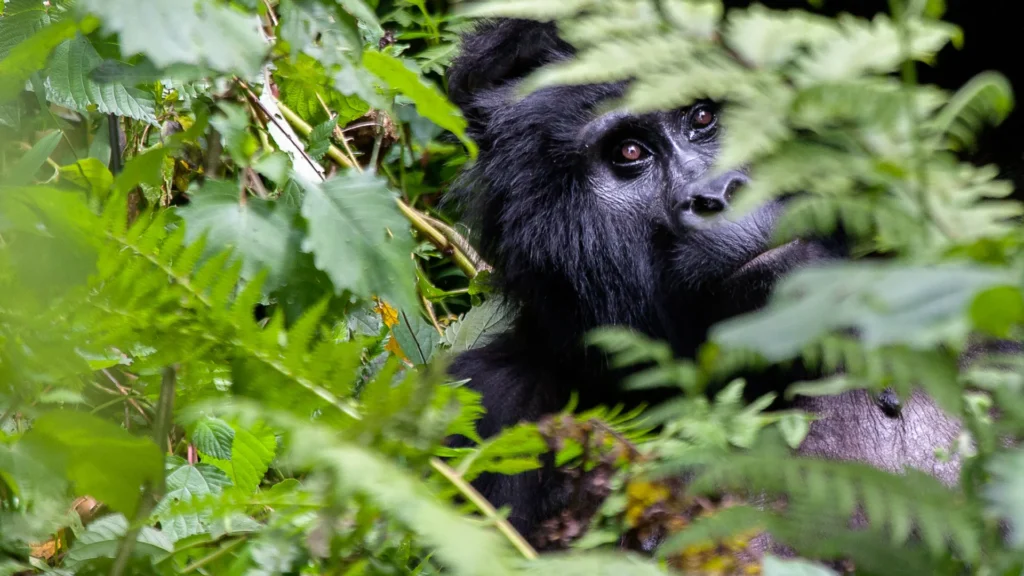
Volcanoes gorilla trekking trackers operate in a remarkable but demanding mountain environment. Their work takes place across the volcanic slopes, bamboo forests and montane vegetation of Rwanda’s Volcanoes National Park, where endangered mountain gorillas move freely through the Virunga landscape.
For visitors, the highlight of gorilla trekking is usually the hour spent observing a habituated family. Yet reaching that point requires substantial expertise. Trackers interpret signs of recent gorilla activity, monitor known groups, communicate with park guides and contribute observations that may be important to wildlife conservation.
The work is particularly challenging because the Virunga Mountains are not a uniform forest. Vegetation, altitude, rainfall and terrain vary across the landscape. A gorilla family may feed in relatively open vegetation one day and move into dense forest or steep terrain the next.
Gorilla tracking in Volcanoes National Park is therefore a dynamic process that combines knowledge of animal behaviour with practical understanding of mountain ecology.
This guide explains the distinctive conditions facing Volcanoes National Park trackers, how they locate gorillas, what happens when families move unexpectedly and why their work contributes to conservation far beyond the tourist encounter.
Understanding the Tracking Environment of Volcanoes National Park
The Virunga Volcanic Landscape
Volcanoes National Park lies in northwestern Rwanda and protects part of the Virunga Massif.
The landscape includes several prominent volcanoes, notably Karisimbi, Bisoke, Sabyinyo, Gahinga and Muhabura.
These mountains create steep slopes, valleys and varied vegetation zones.
The terrain affects where gorillas feed and rest, as well as how tracking teams move through the forest.
Some areas are accessible through established approaches, while others require difficult walking.
Bamboo Vegetation
Bamboo is an important component of the Virunga ecosystem.
Mountain gorillas may feed on bamboo shoots when available.
Dense bamboo stands can make navigation and observation difficult.
Trackers must interpret signs of feeding and movement while maintaining awareness of the surrounding terrain.
Montane Forest
Montane forest provides important gorilla habitat.
Thick vegetation may limit visibility to short distances.
Trackers rely on careful observation rather than expecting to see animals from afar.
Higher-Altitude Vegetation
Vegetation changes with elevation.
Some areas contain more open plant communities, while others remain densely covered.
Tracking conditions vary accordingly.
Knowledge of these habitat differences helps field teams interpret gorilla movements.
How Gorilla Families Move Through Volcanoes National Park
Mountain gorillas travel between feeding and resting locations.
Their movements depend on vegetation availability, social relationships and other environmental factors.
A family may remain within a relatively small area for part of a day or travel farther under different conditions.
Trackers develop familiarity with these patterns through repeated observations.
However, gorillas do not follow fixed tourist routes.
Their movements cannot be scheduled.
This is why the duration of a Volcanoes National Park gorilla trek can vary considerably.
Why Gorilla Tracking Begins With Previous Observations
Field teams may use information from earlier monitoring to identify where a gorilla family was last observed.
Previous resting or feeding areas can provide useful starting points.
However, such information must be updated through current field evidence.
A family may have moved during the night or early morning.
Trackers therefore combine historical knowledge with fresh observations.
This approach reduces unnecessary searching while recognising the unpredictability of wild animals.
Reading Gorilla Nesting Sites
How Gorillas Construct Nests
Mountain gorillas construct nests from available vegetation.
Nests are used for resting, particularly overnight.
Their structure and location vary according to circumstances.
What Nest Sites Reveal
A recent nest site can provide evidence of where a family rested.
Trackers may examine the distribution and condition of nests.
These observations can help interpret the group’s movements.
Why Nests Are Important to Conservation
Nest information has also been used in gorilla population monitoring and research.
However, a nest does not provide a complete record of an individual animal.
Field observations must be interpreted carefully.
Visitors should never disturb nests or remove materials.
Identifying Fresh Feeding Signs
Mountain gorillas consume substantial quantities of vegetation.
Feeding can leave signs such as broken stems or disturbed plant material.
Trackers may use these observations to identify recent activity.
However, other animals and natural processes can also disturb vegetation.
Experienced trackers consider the wider context.
Fresh feeding evidence is most useful when combined with other signs.
Following Tracks in Volcanic Terrain
Footprints may be visible in soft or muddy soil.
In other areas, the ground may be too rocky or densely vegetated to preserve clear tracks.
Rainfall can erase evidence.
Trackers therefore use multiple sources of information.
They may examine vegetation disturbance, nesting sites and known movement patterns.
This illustrates why gorilla tracking expertise depends on experience rather than a single technique.
How Rainfall Changes Tracking Conditions
Rainfall is a defining feature of the Virunga mountain environment.
Heavy rain can make paths slippery and obscure evidence.
It may also affect visibility and walking speed.
Trackers must adapt to these conditions.
The guiding team may need to adjust its route.
Visitors should prepare for wet conditions even during relatively dry months.
A waterproof jacket, suitable boots and careful walking are important.
Tracking During Fog and Low Visibility
Fog can occur in mountain environments.
Reduced visibility may complicate observation and navigation.
Trackers rely on their familiarity with the terrain and available evidence.
Tourists should remain close to their assigned guide.
Do not attempt to move independently to obtain a clearer view.
How Trackers Recognise Gorilla Families
Trackers may become familiar with the composition and characteristics of individual habituated groups.
They can recognise certain silverbacks, females and younger animals through repeated observation.
This knowledge helps distinguish one family from another.
It also supports monitoring of births, deaths and changes in group membership.
However, gorilla identification requires experience.
Visitors should not assume that a single photograph is sufficient to identify an individual reliably.
The Role of Silverbacks in Group Movement
A dominant silverback often influences the movement and organisation of his family.
He may respond to potential threats or interactions with other gorillas.
However, gorilla social systems are complex.
Group movements cannot always be explained by the actions of one individual.
Trackers consider the wider family context when interpreting behaviour.
How Trackers Respond to Group Interactions
Mountain gorilla groups may encounter one another within overlapping home ranges.
Such encounters can involve displays, vocalisations or changes in movement.
Trackers observe these situations carefully.
They do not attempt to control natural social interactions for the benefit of tourists.
If conditions are unsuitable for a visitor encounter, park personnel determine the appropriate response.
Conservation priorities take precedence over tourism expectations.
Communication Between Trackers and Guides
Tracking teams communicate information about gorilla locations and movements to the authorised guides.
The guide uses this information to manage the tourist approach.
The route may change as new observations become available.
Visitors may be asked to wait while the team coordinates.
These pauses are part of the operation.
They should not be interpreted as evidence that the trek is disorganised.
What Happens at the Kinigi Briefing?
Visitors normally report to Kinigi park headquarters before their trek.
The Rwanda Development Board’s published guidance specifies a 7:00 AM reporting time.
Park personnel verify permits and identification.
Tourists receive instructions about safety and appropriate behaviour.
They are allocated to authorised gorilla trekking groups.
The standard maximum tourist group size is eight people per habituated gorilla family.
Tracking information helps support the day’s arrangements.
However, final conditions depend on the animals’ movements.
From the Trailhead to the Gorilla Family
After registration, tourists normally travel to the designated trailhead.
The location varies according to the assigned gorilla family.
The group then proceeds under the supervision of park guides.
The walking route may cross agricultural land before entering protected forest.
Visitors should remain together and follow instructions.
The guide manages the pace according to terrain and group capabilities.
Trackers provide information about the gorillas’ location.
Why Trekking Times Vary
The time required to reach a gorilla family depends on several factors.
These include the group’s current location, terrain, weather and walking pace.
A family may be relatively close to the forest boundary.
Another may require a longer climb.
Even when trackers have located the gorillas, the animals may continue moving.
Visitors should therefore prepare for a variable walking duration.
No responsible operator can guarantee an exact trekking time.
What Happens When the Gorillas Are Located?
The guide prepares visitors for the encounter.
Walking sticks or unnecessary belongings may need to be left at a designated location.
Tourists are reminded of the viewing distance and behaviour rules.
The approach is controlled to reduce disturbance.
The gorillas may be feeding, resting or moving through vegetation.
The guide determines where visitors may stand.
Tourists should not independently move around the family.
The Importance of Maintaining Distance
Rwanda’s official minimum gorilla viewing distance is seven metres.
Greater separation is preferable where practical.
This rule helps reduce disease-transmission risks and unwanted interaction.
Visitors must not deliberately approach gorillas for photographs.
If an animal moves closer, follow the ranger’s instructions.
Touching gorillas is prohibited.
The One-Hour Viewing Rule
The standard tourist encounter is limited to one hour.
This restriction helps reduce prolonged human presence around habituated gorillas.
The time spent trekking to and from the family is separate.
Visitors must leave when instructed.
Trackers may continue authorised conservation monitoring under different operational arrangements.
Tourists should not confuse professional monitoring with unlimited recreational viewing.
How Trackers Contribute to Gorilla Health Monitoring
Trackers regularly observe habituated gorilla families.
They may notice coughing, injuries, unusual behaviour or changes in feeding.
These observations can be reported to veterinary specialists.
Gorilla Doctors works with park personnel to monitor gorilla health.
Regular field reporting is important because it can identify concerns before they become more serious.
Respiratory Disease and Mountain Gorilla Protection
Mountain gorillas are susceptible to certain human respiratory pathogens.
Tourist visits create potential opportunities for transmission.
Visitors experiencing potentially contagious illness must report their symptoms.
The Rwanda Development Board warns that people with colds, flu or other contagious conditions may be denied access.
Trackers and guides help enforce appropriate precautions.
Visitors should follow current mask requirements and other instructions issued by park personnel.
Detecting Injuries in the Forest
Trackers may observe injuries during routine monitoring.
These can include wounds or signs of entanglement.
Snares intended for other wildlife have occasionally injured mountain gorillas.
When a concern is identified, the appropriate conservation team is informed.
Veterinary specialists determine whether intervention is necessary.
Visitors should never attempt to approach or treat an injured gorilla.
Trackers and Long-Term Gorilla Research
The Virunga mountain gorillas have been the subject of long-term scientific study.
Research has contributed to understanding their behaviour, social relationships and conservation needs.
Trackers’ observations can support this work.
Regular monitoring helps document changes in group composition and individual health.
Long-term records are particularly valuable for a species with a restricted geographical distribution.
Why Tracking Supports Conservation Beyond Tourism
Tracking contributes to several conservation objectives.
It helps monitor habituated families.
It provides information about animal health.
It supports responsible visitor management.
It may help identify injuries or unusual behaviour.
It also contributes to knowledge of gorilla movements within the protected landscape.
These benefits extend beyond the tourism experience.
The Relationship Between Trackers and Local Communities
The communities surrounding Volcanoes National Park are closely connected to the regional tourism economy.
Employment in tracking, guiding, porter services and related activities can create economic opportunities.
Local environmental knowledge may be valuable in conservation work.
However, sustainable tourism depends on responsible management and fair community participation.
Visitors should respect local people and support legitimate services.
Ethical Responsibilities of Visitors
Tourists should understand that trackers work to protect gorillas, not simply to provide entertainment.
Visitors must follow ranger instructions.
They should maintain the required distance and avoid touching or feeding gorillas.
Flash photography is prohibited.
Litter must not be left in the forest.
Potentially contagious illness must be reported.
These responsibilities help protect the animals and the wider ecosystem.
Common Misconceptions About Volcanoes Gorilla Tracking
One misconception is that trackers always know exactly where gorillas will be.
In reality, their work involves interpreting changing evidence.
Another misconception is that gorillas remain in fixed locations for tourism.
They do not.
Some visitors assume habituated gorillas are tame.
They remain wild animals.
Others believe a tracker can guarantee a close-up photograph of a particular silverback.
Such expectations are inappropriate and cannot be guaranteed.
Frequently Asked Questions About Volcanoes Gorilla Trackers
Where do gorilla trackers work in Rwanda?
They work within authorised conservation operations in Volcanoes National Park and its mountain gorilla habitat.
How do trackers locate gorilla families?
They interpret nesting sites, feeding signs, tracks, vegetation disturbance and knowledge of previous movements.
Do trackers work in bamboo forest?
Yes. Bamboo vegetation forms part of the Virunga habitat used by mountain gorillas.
Does rain make tracking more difficult?
Yes. Rain can obscure evidence and make terrain slippery.
Can trackers identify individual silverbacks?
Experienced trackers may recognise individuals through physical characteristics and repeated observation.
Do gorilla families move every day?
Gorillas move according to feeding, resting and social needs. Their daily movement patterns vary.
How do trackers communicate with tourist guides?
They coordinate through the park’s operational communication arrangements to share information about gorilla locations and conditions.
Can a gorilla family move before tourists arrive?
Yes. Mountain gorillas move freely and may change location after trackers first observe them.
Do trackers monitor gorilla health?
Yes. Their observations may help identify illnesses, injuries and changes in behaviour.
What happens if trackers find a sick gorilla?
They report the concern through conservation channels. Veterinary specialists determine the appropriate response.
Do trackers remove snares themselves?
Wildlife interventions are managed through authorised conservation procedures. Veterinary specialists assess injuries and treatment needs.
Can tourists accompany trackers independently?
Ordinary tourist permits do not authorise independent participation in tracking operations.
Why are trackers important to research?
Their repeated observations can contribute to long-term records of gorilla health, movements and family composition.
How long does it take to locate gorillas?
The time varies according to terrain, weather and the animals’ movements.
Are gorilla sightings guaranteed?
No. Trackers work to locate habituated families, but wild animal movements and environmental conditions remain unpredictable.
Appreciating the Expertise of Volcanoes Gorilla Trackers
Volcanoes gorilla trekking trackers perform demanding work that combines forest navigation, wildlife observation and conservation monitoring.
Their knowledge of the Virunga landscape helps authorised guides approach habituated gorilla families responsibly.
Their observations also contribute to understanding the health and movements of endangered mountain gorillas.
The work requires patience, experience and cooperation with park authorities, researchers and veterinary specialists.
For visitors, understanding the tracking process adds depth to the gorilla trekking experience.
It reveals the substantial conservation effort behind what may appear to be a simple wildlife encounter.
At Gorilla Rwanda Safaris, we encourage travellers to appreciate the expertise of tracking teams, follow official park regulations and support responsible mountain gorilla tourism. Practical travel arrangements and relevant tour options can be explored separately.