
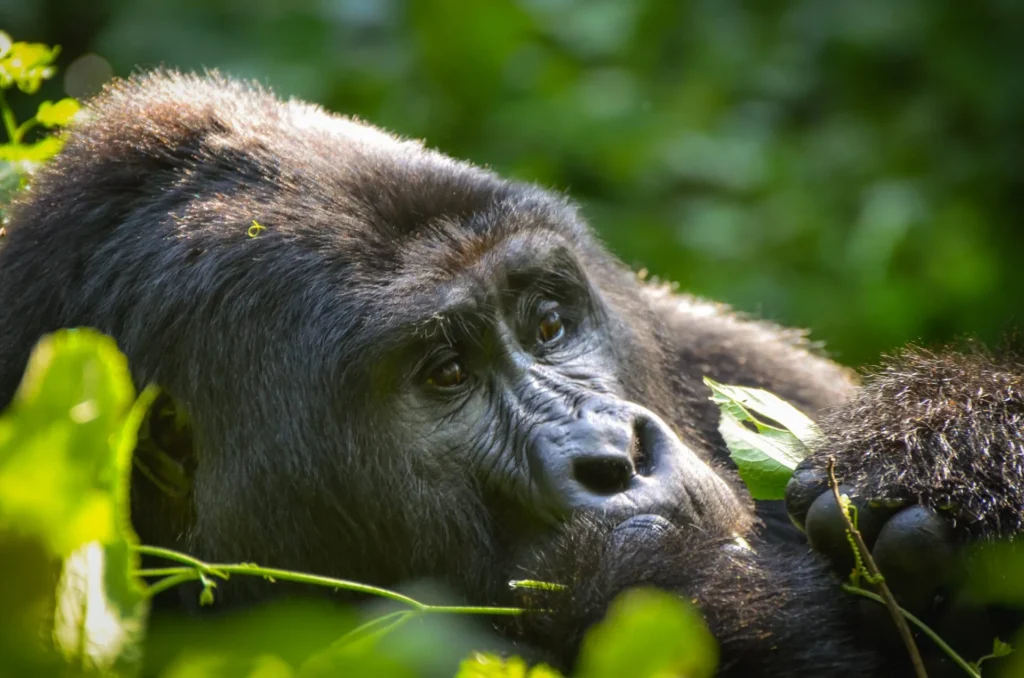
The survival of Rwanda’s mountain gorillas depends on much more than protecting the forest in which they live. It also requires regular monitoring, accurate information about individual animals, effective responses to illness and injuries, and a detailed understanding of how gorilla families move and interact. At the centre of much of this fieldwork are mountain gorilla trackers, highly experienced professionals whose observations help connect daily forest activity with wider conservation programmes.
For tourists, trackers are often associated with locating gorillas before a trekking group arrives. That is an important responsibility, but it represents only one dimension of their work. Trackers also help recognise individual gorillas, identify changes in family composition, observe unusual behaviour and communicate concerns to the appropriate conservation specialists.
The mountain gorillas inhabiting Volcanoes National Park are part of the Virunga population, which extends across Rwanda, Uganda and the Democratic Republic of the Congo. These animals belong to the subspecies Gorilla beringei beringei, one of the world’s most closely monitored endangered primates.
Their social lives are complex. Families may include dominant silverbacks, additional adult males, females, juveniles and infants. Group composition changes through births, deaths and dispersal, while movements through the forest depend on feeding opportunities and social circumstances.
Understanding the role of Rwanda mountain gorilla trackers provides a deeper appreciation of the scientific and conservation effort behind regulated gorilla tourism.
Who Are Mountain Gorilla Trackers?
Mountain gorilla trackers are trained field personnel who locate, observe and monitor gorilla families within protected forest habitats. Their responsibilities depend on their assignments and the conservation arrangements of the park.
Some work primarily with habituated families associated with tourism, while other monitoring activities may support research or conservation objectives.
Trackers develop familiarity with the forest and with particular groups of gorillas. They learn to recognise signs of movement, interpret feeding evidence and identify individuals through repeated observations. Their work requires physical endurance, patience, observational ability and careful communication.
A tracker is not simply a tourist guide walking ahead of visitors. The position involves specialised knowledge of wildlife and habitat conditions.
Why Individual Gorilla Monitoring Matters
Mountain gorillas are classified as endangered, despite important population recovery achieved through sustained conservation efforts. Their remaining populations occupy geographically restricted habitats. This makes careful monitoring especially valuable.
A change in the health or survival of individual animals can have consequences for a relatively small population. Trackers may help document births, deaths, injuries and changes in family membership. These records support long-term understanding of population trends.
Regular monitoring also helps conservation specialists recognise problems that might otherwise go unnoticed.
Understanding Gorilla Family Social Structure
Dominant Silverbacks
A silverback gorilla is a mature adult male distinguished by the silver-grey hair that develops across his back. Dominant silverbacks often play important roles in group protection and social organisation. They may influence movements and respond to perceived threats.
However, gorilla social systems vary, and not every family has exactly the same structure.
Adult Females
Adult females maintain important relationships with their offspring and other group members. Their reproductive histories and movements contribute to understanding family development.
Juveniles
Young gorillas frequently engage in play and exploration. These behaviours are associated with physical development and social learning.
Infants
Infant survival is particularly important for long-term population recovery. Trackers may observe births and monitor the wellbeing of young gorillas through regular family observations.
How Trackers Recognise Individual Gorillas
Identifying individual gorillas requires repeated observation. Experienced trackers may recognise animals through facial features, body proportions, distinctive markings and other physical characteristics.
Silverbacks may be easier to distinguish because of their size and mature appearance. However, accurate identification of females and younger gorillas also contributes to conservation records. A single tourist photograph is not always sufficient for reliable identification.
Trackers’ familiarity develops through regular contact with the same families.
Monitoring Births and Infant Development
A new gorilla birth is an important conservation event. Trackers may identify a newborn during routine monitoring and report the observation. Subsequent visits can provide information about the infant’s survival and development.
Young gorillas are dependent on maternal care. Visitors must not approach or interfere with infants. Monitoring should be conducted with minimal disturbance.
Recording Changes in Family Composition
Mountain gorilla groups are dynamic. Individuals may leave their natal group, join another group or form new social units. Adult males may become dominant or establish different relationships within a family.
Trackers who monitor groups regularly can help document these changes. Such information supports research into gorilla social organisation and population dynamics. It also helps park personnel maintain accurate knowledge of habituated families.
How Trackers Locate Gorilla Families
Trackers combine knowledge of previous movements with current field evidence. They may examine nesting areas, feeding signs, tracks and vegetation disturbance.
No single sign is always conclusive. Rainfall can obscure footprints, while dense vegetation may limit visibility. Trackers interpret evidence in the context of known gorilla behaviour and habitat conditions.
Their work helps authorised guides approach habituated families without unnecessary searching.
Understanding Gorilla Nests
Mountain gorillas construct nests from available vegetation for resting. Nest sites can provide evidence of recent occupation. Trackers may use their location and condition to interpret group movements.
Nest observations can also contribute to certain research and population-monitoring methods. However, a nest does not prove that gorillas remain nearby. Visitors should never disturb nesting sites.
Monitoring Feeding Behaviour
Mountain gorillas consume a varied plant-based diet. Their food includes leaves, stems, shoots and other vegetation available within their habitat.
Trackers may observe feeding patterns and changes in appetite. A gorilla that stops feeding normally or becomes unusually inactive may require closer attention. However, changes in behaviour can have several explanations. Trackers report observations rather than making unsupported medical diagnoses.
The Importance of Long-Term Field Records
One isolated observation provides limited information. Repeated monitoring allows conservation specialists to compare behaviour over time. Trackers may recognise when an individual is behaving differently from its usual pattern.
Long-term records help researchers understand group development, reproductive trends and health concerns. This continuity is particularly valuable for endangered species.
Trackers and Gorilla Health Monitoring
Gorilla Doctors works with park authorities and field personnel to monitor the health of habituated gorillas. Trackers may report visible injuries, coughing, unusual lethargy or other concerning observations.
Veterinary specialists then assess whether additional monitoring or intervention is necessary. This relationship illustrates the importance of communication between field teams and medical professionals. Trackers provide information that can help specialists respond appropriately.
Respiratory Illness and Mountain Gorilla Vulnerability
Mountain gorillas are susceptible to certain human infectious diseases. Respiratory illness is a significant conservation concern. Because gorillas live in social groups, infections may spread between family members.
Trackers may observe coughing, nasal discharge or reduced activity. These signs require appropriate assessment.
Visitors should never conceal symptoms of potentially contagious illness before trekking. Disease prevention is a shared responsibility.
Snare Injuries and Veterinary Intervention
Snares intended for other wildlife can accidentally injure gorillas. An entangled limb may develop swelling, wounds or restricted circulation. Trackers may identify such injuries during routine monitoring.
The concern is reported through conservation channels. Qualified veterinary teams determine whether treatment is necessary. Tourists should never attempt to intervene directly.
Why Trackers Do Not Replace Veterinarians
Trackers are skilled observers, but veterinary diagnosis and treatment require specialist training. A visible symptom may have several possible causes. Not every injury requires immediate intervention.
Veterinary specialists consider the condition of the animal and the risks of treatment. Trackers contribute by providing accurate observations and supporting authorised monitoring.
Gorilla Habituation and Tracking
Gorilla habituation is the gradual process through which selected wild gorilla groups become accustomed to controlled human presence. Specialised teams observe the animals over an extended period. The process requires patience and careful interpretation of gorilla responses.
Habituation does not mean domestication. Gorillas remain wild and continue their natural activities. Not every gorilla family is habituated for tourism.
Tracking and Scientific Research
Long-term mountain gorilla research has contributed substantially to understanding primate behaviour and conservation. Studies may examine reproduction, social relationships, feeding ecology, dispersal and population trends.
Trackers’ field observations can support this work. Their familiarity with individual animals provides valuable continuity. Research and monitoring should be conducted under appropriate conservation authorisation.
Tracking and Tourism Management
Tourist groups depend on trackers to help locate assigned gorilla families. This reduces unnecessary searching and supports controlled access.
However, trackers cannot guarantee a particular location or encounter. Gorillas move freely through the forest. The official park guide remains responsible for supervising visitors. The distinction between tracking and guiding is important.
The Role of Trackers in Disease Prevention
Trackers and guides help reinforce visitor rules. These include maintaining the required separation, avoiding physical contact and respecting the one-hour viewing limit.
Rwanda’s published minimum viewing distance is seven metres. Greater separation is advisable where practical. Visitors must follow current ranger instructions.
Tracking and Regional Conservation Cooperation
The Virunga gorilla population extends across national boundaries. Conservation therefore benefits from cooperation involving Rwanda, Uganda and the Democratic Republic of the Congo.
The International Gorilla Conservation Programme supports regional approaches to mountain gorilla protection. Monitoring, habitat conservation and community engagement are interconnected. Trackers contribute local field knowledge within this wider framework.
Ethical Responsibilities of Visitors
Tourists should respect the work of trackers and avoid pressuring them to produce a particular wildlife encounter.
- Do not request unauthorised access.
- Do not approach gorillas more closely than permitted.
- Avoid touching or feeding animals.
- Flash photography is prohibited.
Visitors should also respect the forest and surrounding communities.
Frequently Asked Questions About Rwanda Mountain Gorilla Trackers
Do trackers recognise individual gorillas?
Experienced trackers may recognise individuals through repeated observations and distinctive physical characteristics.
Do trackers monitor gorillas every day?
Monitoring schedules depend on park operations and conservation assignments. Regular observation is an important part of habituated gorilla management.
How do trackers identify a new birth?
A newborn may be observed during routine monitoring and reported through the appropriate conservation channels.
Can trackers diagnose gorilla diseases?
Trackers report observations. Veterinary specialists assess medical conditions and determine treatment.
Do trackers help locate gorillas for tourists?
Yes. Locating habituated families is an important part of their work.
Can trackers guarantee sightings?
No. Gorilla movements and environmental conditions remain unpredictable.
Are trackers involved in research?
Their observations can support conservation research and long-term monitoring.
Why are gorilla nests important?
Nest sites provide evidence of recent activity and can contribute to monitoring methods.
What happens when a gorilla is injured?
Trackers report the concern, and authorised specialists determine the appropriate response.
Are all gorilla families habituated?
No. Some families remain unhabituated or are monitored for other conservation purposes.
Why is tracking important to conservation?
It provides information about animal health, movements, reproduction and group composition.
Can tourists join trackers independently?
Ordinary tourist permits do not authorise independent participation in conservation tracking operations.
Why Mountain Gorilla Trackers Matter
Rwanda mountain gorilla trackers provide an essential link between the daily lives of wild gorillas and the conservation programmes designed to protect them. Their observations support individual identification, family monitoring, health surveillance and responsible tourism management.
The expertise involved is developed through extensive field experience and familiarity with the animals. Understanding this work helps visitors appreciate that mountain gorilla conservation depends on sustained human commitment as well as protected habitat.
At Gorilla Rwanda Safaris, we encourage travellers to recognise the importance of trackers, follow official park regulations and approach gorilla tourism with respect for the animals and the professionals protecting them.