
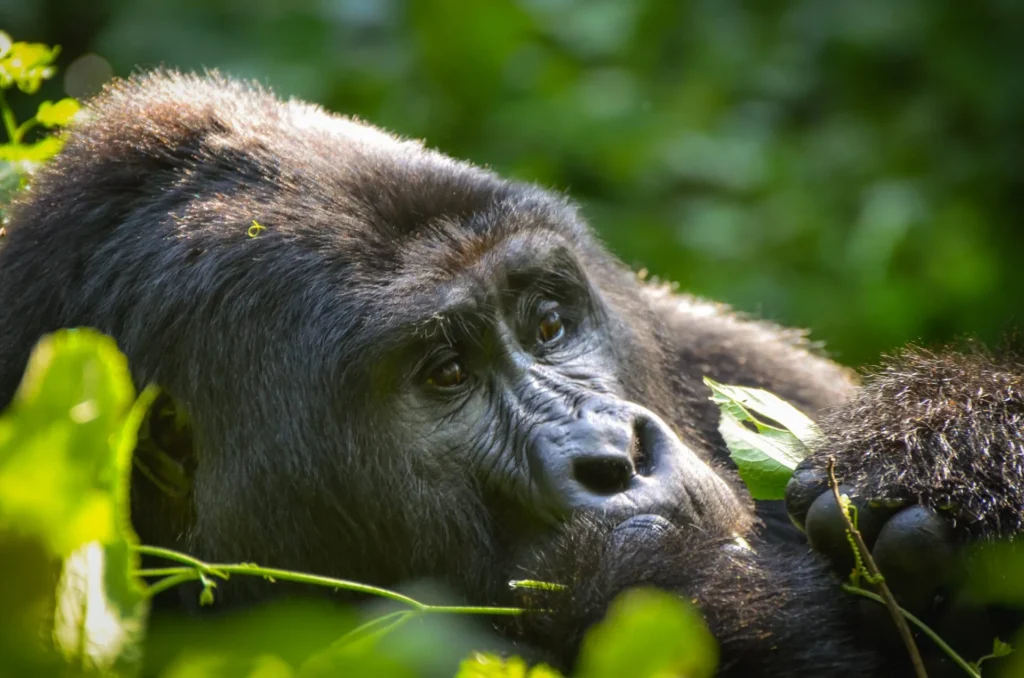
Volcanoes National Park conservation is central to the survival of Rwanda’s mountain gorillas. Situated in the country’s northwestern highlands, the park protects a portion of the Virunga volcanic landscape, where endangered mountain gorillas live among bamboo forests, montane vegetation and steep mountain slopes. It is also the setting for Rwanda’s internationally recognised gorilla trekking experience, which operates under strict conservation regulations.
The relationship between gorilla trekking in Volcanoes National Park and wildlife protection is closely managed. Tourists are permitted to observe selected habituated gorilla families, but their access is limited by park rules, group allocations, health precautions and the supervision of authorised guides. These measures are necessary because the gorillas remain wild animals and are vulnerable to disturbance and human infectious diseases.
Conservation within the park extends far beyond tourist encounters. Rangers protect habitat, trackers monitor gorilla families, veterinary specialists respond to health concerns and researchers study the animals and their environment. Park management also works within a wider regional and community context because the Virunga ecosystem crosses international boundaries and is surrounded by densely populated agricultural landscapes.
Understanding the conservation work taking place inside Volcanoes National Park Rwanda allows visitors to appreciate why the forest is protected, how trekking is regulated and what continued protection requires.
The Geography of Volcanoes National Park
Volcanoes National Park lies in Rwanda’s Northern Province, near Musanze and the Virunga Mountains. The park protects part of a volcanic massif that extends across Rwanda, Uganda and the Democratic Republic of the Congo.
Its landscape is associated with several major volcanoes, including Karisimbi, Bisoke, Sabyinyo, Gahinga and Muhabura. These mountains create substantial differences in altitude, slope, rainfall and vegetation.
The resulting habitats are varied. Bamboo vegetation occurs in parts of the mountain landscape, while other areas contain montane forest, dense undergrowth and higher-altitude plant communities.
These habitats provide feeding and resting opportunities for mountain gorillas. They also support other wildlife and ecological processes, making the park important for biodiversity conservation beyond a single species.
Why the Virunga Habitat Is Special
The Virunga Massif is one of only two principal landscapes where mountain gorillas survive. The other is the Bwindi-Sarambwe ecosystem.
The Virunga population is distributed across protected areas in three countries, making the landscape ecologically connected but politically divided.
Gorillas move according to natural feeding and social requirements rather than national boundaries. This means that effective conservation depends on maintaining habitat and coordinating protection across the region.
The volcanic environment also creates distinctive ecological conditions. Rainfall, elevation and soil characteristics influence vegetation, while steep terrain affects how people and wildlife move through the forest.
Protecting the Virunga landscape therefore requires attention to both its biological importance and its practical management challenges.
Mountain Gorillas as a Conservation Priority
Mountain gorillas are large, predominantly plant-eating great apes with complex social relationships. They typically live in family groups containing adult males, females, juveniles and infants.
Dominant silverbacks often play important roles in group organisation and protection. Females invest substantial time in raising offspring, and young gorillas develop through play, exploration and social interaction.
These characteristics make the survival of individual animals important to long-term population growth.
Mountain gorillas are classified as Endangered by the IUCN. Their numbers have increased following decades of conservation work, but their limited range and continuing vulnerability mean that intensive protection remains necessary.
Protecting the Forest Boundary
One of the fundamental responsibilities of Volcanoes National Park management is maintaining the integrity of the protected forest.
The park is surrounded by communities and agricultural land, creating a sharp contrast between protected habitat and surrounding human activity.
Forest boundaries help define where particular land uses are permitted and where wildlife protection rules apply.
However, conservation cannot rely on boundary enforcement alone. Long-term habitat security also depends on relationships with neighbouring communities, responsible land management and measures that address the pressures associated with population growth.
The objective is to preserve suitable habitat while recognising the legitimate needs of people living around the park.
The Role of Park Rangers
Rangers contribute to wildlife protection, patrols, enforcement and protected-area operations. Their responsibilities may include monitoring human activity, responding to illegal access and supporting the implementation of park regulations.
The work can be physically demanding because of the park’s mountainous terrain and changing weather.
Rangers also contribute to the safe management of authorised visitors. During gorilla trekking, official personnel explain regulations and supervise the encounter.
Effective ranger operations are essential because protected status alone does not prevent threats to wildlife.
Anti-Poaching and Snare Prevention
Illegal hunting activities can create risks for mountain gorillas even when the animals are not the intended targets.
Snares set for other wildlife may accidentally entangle gorillas, causing injuries that require veterinary assessment.
Conservation teams work to detect and address illegal activities, while trackers may identify injured animals during routine monitoring.
When a gorilla is found with a serious injury, the appropriate veterinary specialists assess whether intervention is required.
The prevention of snare injuries depends on patrols, enforcement, community cooperation and broader efforts to reduce pressures associated with illegal resource use.
Daily Gorilla Family Monitoring
One of the distinctive features of mountain gorilla conservation is the regular monitoring of habituated families.
Gorilla trackers in Volcanoes National Park develop familiarity with individual animals and their group relationships. They may recognise births, injuries, illness and changes in family composition.
Their observations also help locate gorillas for authorised tourism operations.
Daily monitoring provides continuity that occasional research visits or tourist encounters cannot replace.
The information contributes to conservation records and can help veterinary teams identify animals requiring attention.
How Trackers Recognise Gorilla Health Problems
Trackers may notice when an individual gorilla behaves differently from its usual pattern.
A normally active animal may become lethargic. A gorilla may cough repeatedly, show nasal discharge or stop feeding normally. Visible injuries may also be detected.
These observations are reported through conservation channels.
Trackers do not replace veterinary professionals, but their familiarity with the animals provides valuable information.
Early recognition of unusual behaviour can be particularly important when illness affects several members of a family.
Veterinary Conservation in Volcanoes National Park
Gorilla Doctors provides specialised veterinary monitoring and treatment for gorillas in the region, working with park authorities and field teams.
Veterinary specialists may assess body condition, respiratory symptoms, injuries and other signs of illness.
Treatment decisions depend on the severity of the condition and the risks of intervention. Some cases require observation, while others may justify medication or more complex procedures.
Wildlife veterinary care differs from treating domestic animals because the gorillas must remain wild and human contact must be minimised.
The objective is to protect health without unnecessarily interfering with natural behaviour.
A Documented Respiratory Illness Case
A notable example of conservation monitoring occurred in the Kwitonda gorilla group in Volcanoes National Park.
Gorilla Doctors reported that respiratory illness appeared in the group in December 2025. Trackers observed concerning symptoms in silverback Karevuro, including lethargy and reduced feeding activity.
Veterinary personnel subsequently assessed the animal and provided supportive treatment.
This case illustrates the practical importance of cooperation between trackers and veterinarians. It also demonstrates why respiratory disease is treated as a serious conservation risk.
Tourism-related disease prevention is therefore an essential component of park management.
Why Gorilla Trekking Visitors Must Follow Health Rules
Humans can carry infectious agents capable of affecting mountain gorillas.
Visitors with colds, flu-like symptoms or other potentially contagious conditions may pose a risk to the animals.
Rwanda’s official guidance requires visitors to follow health restrictions and ranger instructions.
The seven-metre minimum viewing distance helps reduce unwanted contact and disease exposure. Greater separation is advisable where practical.
Visitors must not touch gorillas, and current mask or other hygiene requirements should be followed when instructed.
A responsible tourist should disclose illness rather than attempt to conceal symptoms to avoid missing a trek.
How Gorilla Trekking Is Regulated
Tourism access is limited to authorised habituated gorilla families.
The standard maximum group size is eight tourists per family, and the viewing period is restricted to one hour.
Visitors receive a briefing before entering the forest and are accompanied by authorised guides.
The rules also prohibit feeding, touching and flash photography.
These restrictions reduce prolonged human presence and help manage visitor behaviour.
They are central to the conservation model, not optional additions to the tourism experience.
Why the One-Hour Limit Matters
A mountain gorilla family may spend much of its day feeding, resting and interacting socially.
Extended tourist presence could increase disturbance and opportunities for disease transmission.
The one-hour viewing limit helps establish a consistent boundary between wildlife observation and excessive human intrusion.
Professional trackers and researchers may conduct authorised monitoring under different arrangements, but ordinary tourism permits do not provide unrestricted access.
Visitors should leave when instructed, even if the gorillas are active or photographic opportunities appear particularly attractive.
Gorilla Habituation Within the Park
Gorilla habituation allows selected wild families to become accustomed to controlled human presence through a gradual process of observation.
It supports tourism, research and veterinary monitoring.
However, habituated gorillas remain wild animals. Their movements, feeding and social relationships are not controlled for visitors.
Not every family is habituated for tourism.
Park authorities determine which groups are available for authorised encounters, taking conservation and operational considerations into account.
The Role of Kinigi in Conservation Tourism
Kinigi serves as the principal reporting and briefing area for gorilla trekking in Volcanoes National Park.
Visitors normally arrive early in the morning for registration and instructions.
The briefing explains appropriate conduct, safety precautions and the importance of respecting gorilla behaviour.
Tourist groups are then allocated according to park operations and travel towards their assigned trailheads.
This organised system allows park personnel to control access and reinforce conservation requirements before visitors enter the forest.
Tourism Revenue and Park Protection
Gorilla trekking generates revenue through official permits and associated tourism services.
This revenue contributes to Rwanda’s broader protected-area and tourism management system.
Visitor spending also supports accommodation, transport, guiding and other services around the park.
However, tourism must be managed so that economic demand does not lead to excessive wildlife exposure.
The long-term value of gorilla tourism depends on maintaining the health of the animals and the integrity of their habitat.
Revenue Sharing With Surrounding Communities
The Rwanda Development Board reports that 10% of national park tourism revenues is reinvested in development projects benefiting neighbouring communities.
Around Volcanoes National Park, these benefits may support priorities such as education, healthcare, water access and livelihoods.
The programme is important because communities living near the forest have a direct relationship with conservation outcomes.
Economic benefits can help strengthen support for protected-area management.
Nevertheless, revenue sharing must be understood as part of a broader strategy involving community participation, employment and responsible governance.
Employment and Local Conservation Incentives
Musanze and the surrounding districts support a range of tourism services associated with Volcanoes National Park.
Guides, porters, drivers, lodge employees and other workers may earn income connected to gorilla tourism.
These opportunities help link the continued existence of protected wildlife with local economic activity.
The relationship is important but should not be oversimplified. Not every resident benefits equally, and tourism employment alone cannot resolve every land-use or livelihood challenge.
Sustainable conservation requires long-term cooperation and meaningful opportunities for local communities.
Conservation of Other Species
Although mountain gorillas attract international attention, Volcanoes National Park protects a wider ecosystem.
Golden monkeys are another notable primate species associated with the park’s bamboo habitats.
The forest also supports birds, smaller mammals, plants and ecological processes that contribute to the functioning of the mountain environment.
Protecting gorilla habitat can therefore provide wider biodiversity benefits.
Conservation planning should consider the health of the entire ecosystem rather than focus exclusively on the most commercially visible species.
The Importance of Forest Vegetation
Mountain gorillas consume a varied plant-based diet, including leaves, stems and shoots.
The availability of suitable vegetation influences feeding and movement patterns.
Bamboo, montane forest plants and other vegetation communities contribute to the ecological character of the park.
Damage to these habitats can affect more than food availability. It may influence soil stability, water movement and conditions for other species.
Protecting vegetation is therefore fundamental to the conservation of the park’s biodiversity.
Climate Change and Mountain Habitats
Mountain ecosystems may be sensitive to changes in temperature, rainfall and seasonal conditions.
Potential changes in vegetation distribution could influence gorilla feeding opportunities and habitat use.
However, the precise effects of climate change on individual gorilla families are complex and require scientific investigation.
Conservation planning should incorporate long-term environmental monitoring rather than assume that current habitat conditions will remain unchanged.
The protection of connected and ecologically functioning habitats is important for resilience.
Cross-Border Conservation in the Virunga Massif
The Virunga gorilla population extends into Uganda and the Democratic Republic of the Congo.
Regional conservation cooperation is therefore necessary.
The International Gorilla Conservation Programme supports collaboration involving protected-area management, conservation science, responsible tourism and community engagement.
Cross-border cooperation helps address shared challenges and maintain a wider landscape perspective.
The conservation of Rwanda’s gorillas is closely connected to the protection of the entire Virunga ecosystem.
What Responsible Visitors Should Do
Visitors should follow official regulations from the moment they arrive at Kinigi until they leave the forest.
They must respect the viewing distance, avoid touching or feeding gorillas and refrain from flash photography.
They should report potentially contagious illness and follow current hygiene instructions.
Visitors should also remain with their guide, avoid littering and respect surrounding communities.
The purpose of a gorilla trek is to observe wild animals without disrupting their natural lives.
Frequently Asked Questions About Volcanoes National Park Conservation
Why is Volcanoes National Park important?
It protects Rwanda’s portion of the Virunga mountain gorilla habitat and supports a wider high-altitude ecosystem.
Are mountain gorillas protected throughout the park?
Mountain gorillas are protected wildlife, and access to their habitat is regulated by park authorities.
How do rangers protect gorillas?
Rangers contribute to patrols, enforcement, visitor supervision and protected-area management.
What do gorilla trackers do?
They locate and monitor gorilla families, identify individuals and report observations relevant to conservation.
Who treats sick gorillas?
Qualified veterinary specialists, including Gorilla Doctors teams working with park authorities, assess and treat animals when appropriate.
Why is respiratory illness dangerous?
Mountain gorillas can contract certain human pathogens, and infections may spread within social groups.
Why are tourists limited to one hour?
The restriction helps reduce disturbance and prolonged disease-exposure opportunities.
How close can visitors approach gorillas?
Rwanda’s published minimum viewing distance is seven metres, subject to ranger instructions.
Does tourism support local communities?
Tourism creates employment, and Rwanda operates a national park tourism revenue-sharing programme.
Are gorillas found outside Rwanda?
Yes. Mountain gorillas also occur in Uganda and the Democratic Republic of the Congo.
Is Volcanoes National Park only important for gorillas?
No. It protects other wildlife, vegetation communities and important mountain ecosystems.
What is the greatest conservation challenge?
There is no single threat. Disease, habitat pressures, injuries and wider environmental changes all require attention.
The Long-Term Importance of Volcanoes National Park Conservation
Volcanoes gorilla trekking conservation depends on protecting a living mountain ecosystem while allowing carefully managed opportunities for people to experience it.
Rangers, trackers, veterinarians, researchers and local communities contribute different forms of expertise and support. Tourism provides economic benefits, but those benefits are sustainable only when the animals’ welfare remains the priority.
For travellers, understanding this conservation system adds meaning to the experience of observing mountain gorillas.
At Gorilla Rwanda Safaris, we encourage visitors to respect the work taking place throughout Volcanoes National Park, follow official trekking regulations and recognise the connection between wildlife protection and surrounding communities. Practical trekking arrangements can be explored separately without distracting from the conservation purpose of this guide.