
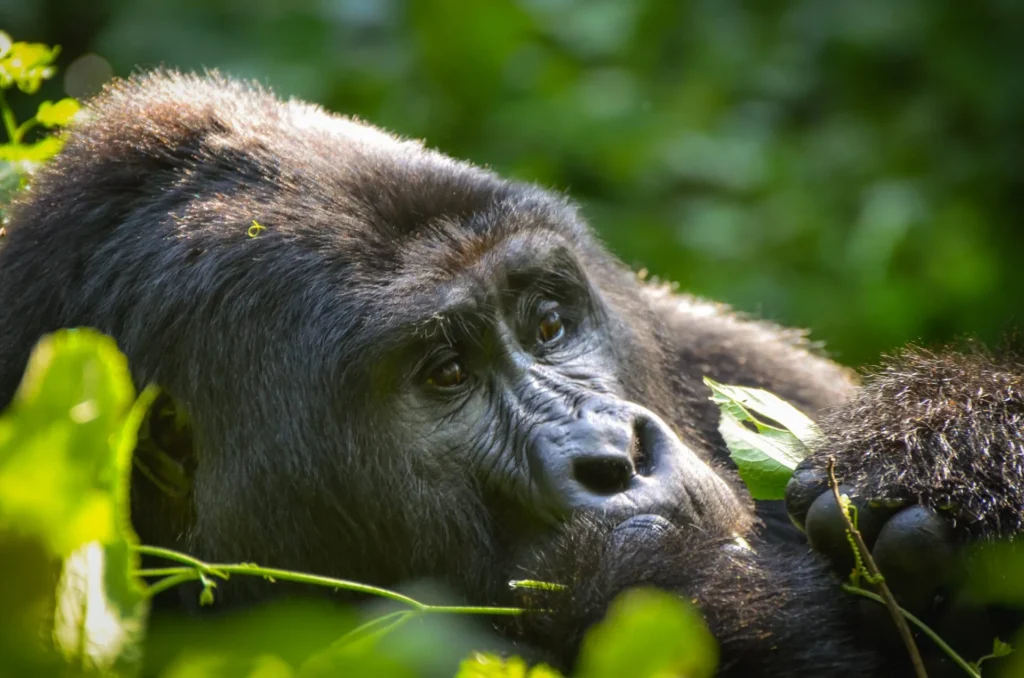
Rwanda mountain gorilla guides provide an important connection between visitors and one of the world’s most carefully protected primate populations. Their work is closely associated with the efforts of trackers, researchers, park rangers and veterinary specialists who monitor the health, behaviour and movements of endangered mountain gorillas.
Within Volcanoes National Park, habituated gorilla families are observed through an organised conservation system. The purpose of this monitoring extends beyond tourism. Conservation teams collect information about individual animals, family relationships, births, injuries, illness and changes in group composition.
Professional guides help translate this scientific and field knowledge into an educational experience for visitors. They explain the behaviour of silverbacks, mothers, juveniles and infants while ensuring that tourists do not interfere with natural interactions.
The work requires a careful balance. Mountain gorillas must remain wild animals capable of living naturally, yet authorised human observers need sufficient access to monitor their wellbeing and support conservation.
Understanding this balance is essential to appreciating mountain gorilla conservation in Rwanda.
This guide examines the role of professional gorilla experts, the methods used to identify and monitor individuals, the importance of habituation, the relationship between trackers and veterinarians, and the ethical responsibilities associated with observing endangered gorillas.
Understanding Rwanda’s Mountain Gorilla Population
Where Rwanda’s Mountain Gorillas Live
Rwanda’s mountain gorillas inhabit Volcanoes National Park, which protects part of the Virunga Massif.
The wider Virunga ecosystem extends into Uganda and the Democratic Republic of the Congo.
Mountain gorillas also inhabit the separate Bwindi-Sarambwe landscape, primarily associated with Uganda’s Bwindi Impenetrable National Park.
These populations belong to the subspecies Gorilla beringei beringei.
Their restricted distribution makes conservation monitoring especially important.
Unlike widespread wildlife species, mountain gorillas occupy relatively limited forest habitats.
Why Individual Monitoring Matters
Mountain gorillas are endangered, and changes affecting even small numbers of individuals can be important.
Conservation teams monitor births, deaths, injuries, illness and group movements.
Long-term observations help researchers understand population trends.
They also allow veterinary specialists to recognise changes that may require attention.
This individual-based approach is one of the distinctive features of modern mountain gorilla conservation.
The Different Experts Involved in Gorilla Protection
Park Guides
Mountain gorilla trekking guides supervise authorised tourist encounters.
They explain gorilla behaviour, enforce visitor regulations and help minimise disturbance.
Their work provides opportunities for conservation education.
Gorilla Trackers
Trackers regularly monitor habituated gorilla families.
They help identify group locations and observe individual animals.
Their familiarity with particular families can make them valuable sources of information about changes in health and behaviour.
Park Rangers
Rangers contribute to protected-area management, patrols, wildlife protection and visitor supervision.
Their responsibilities vary according to assignment.
Conservation Researchers
Researchers study gorilla ecology, behaviour, population dynamics and other aspects of conservation biology.
Their work helps improve understanding of the species.
Veterinary Specialists
Gorilla Doctors and associated veterinary teams monitor the health of habituated eastern gorillas and may provide treatment when necessary.
Veterinary interventions are carefully considered because the animals remain wild.
These professionals work within a broader conservation framework involving park authorities and field personnel.
How Mountain Gorillas Are Identified
Recognising Individual Gorillas
Long-term monitoring requires the ability to distinguish individual animals.
Experienced trackers and researchers may use physical characteristics, age, sex, body size and distinctive features.
Some individuals have recognisable facial characteristics or other physical differences.
Identification becomes more reliable through repeated observations.
A tourist who sees a gorilla for one hour may find it difficult to distinguish individuals, but trackers who regularly monitor the same family develop greater familiarity.
Identifying Silverbacks
Silverback gorillas are mature adult males distinguished by the silver-grey hair that develops across their backs.
Individual silverbacks may also have distinctive facial features, body proportions and behavioural characteristics.
The dominant silverback often plays an important role in family organisation.
Guides may explain his position within the group when reliable information is available.
Monitoring Females and Infants
Female gorillas and their offspring are important to population monitoring.
Births contribute to understanding reproductive success and population development.
Researchers may record infant survival, maternal relationships and changes in family composition.
Visitors should not interfere with mothers or infants.
Their natural behaviour provides valuable information.
Understanding Gorilla Family Social Structure
Mountain gorilla families are complex social groups.
Some contain a single dominant silverback, while others include several adult males.
Adult females maintain relationships with their offspring and other group members.
Juveniles engage in play and gradually develop social skills.
Group composition can change through births, deaths and dispersal.
Guides help visitors understand these relationships without encouraging direct interaction.
The objective is to observe a functioning wild family rather than treat the animals as individual tourist attractions.
The Role of the Dominant Silverback
The dominant silverback often influences group movements and responds to potential threats.
He may intervene in disputes or interact with younger gorillas.
His behaviour can range from quiet resting to assertive displays.
Visitors should not assume that chest beating or vocalisation always indicates aggression.
These behaviours occur in different social contexts.
Guides interpret them according to the circumstances.
Tourists should never imitate silverback displays or attempt to attract his attention.
Gorilla Mothers and Infant Development
Mountain gorilla infants depend heavily on their mothers during early development.
Mothers provide protection, nourishment and opportunities for social learning.
Young gorillas gradually become more independent.
They may explore nearby vegetation or interact with other juveniles while remaining close to adults.
These observations are valuable for understanding gorilla development.
However, visitors must not approach infants or attempt physical contact.
A mother may respond defensively if she perceives a threat.
Guides help maintain appropriate separation.
Juvenile Gorilla Behaviour
Juvenile mountain gorillas frequently engage in play.
They may chase one another, climb vegetation or participate in mock wrestling.
Play contributes to physical coordination and social development.
Visitors often find these interactions entertaining.
Nevertheless, young gorillas remain wild animals.
A curious juvenile approaching tourists should not be encouraged.
Do not offer food, imitate play behaviour or attempt to touch the animal.
The guide manages the situation.
Gorilla Habituation and Its Conservation Importance
What Is Gorilla Habituation?
Gorilla habituation is the gradual process through which selected wild gorilla groups become accustomed to carefully controlled human presence.
The process involves repeated observation by specialised personnel over an extended period.
Habituation allows authorised researchers, trackers and tourists to observe selected groups.
It also facilitates veterinary monitoring.
Habituation Does Not Mean Domestication
Habituated gorillas retain their natural behaviour.
They continue feeding, travelling, reproducing and interacting independently.
They are not trained to perform for tourists.
Their tolerance of human presence does not justify touching, feeding or approaching them.
This distinction is essential to ethical mountain gorilla tourism.
Why Not Every Gorilla Family Is Habituated
Some gorilla groups remain unhabituated.
Others may be monitored primarily for research or conservation purposes.
Park authorities determine which groups are eligible for tourism.
This helps manage human exposure and conservation priorities.
Visitors cannot independently select an unhabituated family for viewing.
The Importance of Daily Gorilla Monitoring
Gorilla Doctors has documented the role of trackers and rangers in monitoring habituated mountain gorillas.
Daily observations may include information about group location, behaviour, feeding and visible health concerns.
Trackers who regularly observe the same family may recognise subtle changes.
For example, an individual that normally feeds actively may become unusually lethargic.
A gorilla may develop a persistent cough or visible injury.
These observations can be reported to veterinary specialists.
Long-term monitoring improves the ability to identify potentially serious problems.
How Veterinary Teams Assess Gorilla Health
Veterinary monitoring may involve observing an animal’s body condition, activity, breathing and visible injuries.
Specialists may also examine signs such as coughing, nasal discharge or unusual behaviour.
The objective is to assess whether an individual appears healthy or requires further attention.
Gorilla Doctors describes routine health checks and additional monitoring visits when trackers report concerns.
Not every health problem requires direct intervention.
Veterinarians consider the severity of the condition and the risks associated with treatment.
When Veterinary Intervention Becomes Necessary
Mountain gorillas are wild animals, and veterinary intervention can be challenging.
Treatment may require specialised equipment and careful coordination with park personnel.
In some circumstances, medication can be administered remotely.
More complex interventions may require anaesthesia.
Such decisions are made by qualified professionals.
Tourists must never attempt to treat an injured or sick gorilla.
Any concern should be reported to the guide.
Respiratory Disease and Gorilla Conservation
Why Respiratory Illness Is a Major Concern
Mountain gorillas share a close evolutionary relationship with humans.
They are susceptible to certain human infectious diseases.
Respiratory illnesses are particularly important because infections may spread through close social contact.
Gorilla Doctors’ 2024–2025 annual report documents respiratory illness affecting gorillas in Rwanda, including an outbreak involving the Kwitonda group in Volcanoes National Park.
The report describes veterinary treatment of an affected silverback.
This provides a practical example of why disease prevention is central to responsible gorilla tourism.
Why Visitors Must Report Illness
A visitor with a cold, flu-like symptoms or another potentially contagious condition may pose a risk to gorillas.
The Rwanda Development Board warns that such visitors may be denied access.
Tourists should not conceal symptoms.
The conservation of endangered animals takes priority over an individual trekking appointment.
Why Viewing Distance Matters
The official Rwanda minimum viewing distance is seven metres.
Greater separation is advisable where practical.
Distance reduces opportunities for disease transmission and unwanted interaction.
Visitors should follow ranger instructions and avoid approaching gorillas for photographs.
Snare Injuries and Gorilla Protection
Snares intended for other wildlife can injure mountain gorillas.
Wire or rope may become entangled around a limb, causing pain, swelling or restricted circulation.
Trackers may identify such injuries during routine monitoring.
Veterinary teams can then assess whether intervention is necessary.
Gorilla Doctors has documented successful snare-removal operations in the region.
These cases demonstrate the importance of cooperation between trackers, park authorities and veterinarians.
The Role of Research in Mountain Gorilla Conservation
Long-term research provides information about population dynamics, social behaviour and ecological requirements.
The work associated with Dian Fossey helped establish international awareness of mountain gorilla conservation.
Modern research continues through institutions and conservation partnerships.
Researchers may study reproduction, dispersal, feeding behaviour, social relationships and the effects of environmental pressures.
Accurate long-term records are valuable because mountain gorillas have relatively slow reproductive rates.
Understanding changes across generations requires sustained observation.
Why Gorilla Conservation Requires Regional Cooperation
Mountain gorillas inhabit landscapes extending across Rwanda, Uganda and the Democratic Republic of the Congo.
Conservation challenges do not always follow national boundaries.
The Virunga population depends on protected habitats and cooperation between conservation authorities.
The International Gorilla Conservation Programme has supported regional approaches to gorilla conservation.
Collaboration can involve habitat protection, monitoring, community engagement and responsible tourism practices.
Visitors should recognise that Rwanda’s gorilla conservation achievements form part of a wider regional effort.
Gorilla Tourism and Conservation Funding
Regulated tourism generates revenue associated with protected-area management and conservation.
The standard Rwanda gorilla permit price publicly listed for foreign visitors is USD 1,500, although eligibility-based categories and special conditions may apply.
Permit prices should be verified before booking.
Tourism can also create employment for guides, trackers, porters, drivers and accommodation staff.
These benefits can strengthen local incentives for conservation.
However, tourism must remain carefully managed.
Uncontrolled visitor access could increase disturbance and disease risks.
Why Visitor Numbers Are Restricted
The standard maximum tourist group size is eight visitors per habituated gorilla family.
The viewing period is limited to one hour.
These restrictions help reduce the intensity of human presence.
They also support consistent visitor management.
A permit does not entitle tourists to unlimited time or exclusive access.
Guides are responsible for enforcing the regulations.
Interpreting Gorilla Behaviour Responsibly
Guides help visitors understand gorilla behaviour without making unsupported assumptions.
A gorilla resting quietly may be conserving energy.
A juvenile playing may be developing social skills.
A silverback vocalising may be communicating with other group members.
Behaviour should be interpreted in context.
Visitors should avoid assuming that familiar-looking expressions have identical meanings to human emotions.
The guide’s knowledge helps create a more accurate educational experience.
Why Gorilla Photography Requires Restraint
Mountain gorilla photography can produce extraordinary images.
However, photographs must be obtained without disturbing the animals.
Flash photography is prohibited.
Visitors must maintain the required distance.
Do not move closer to mothers or infants.
Avoid using sounds or gestures to attract attention.
The welfare of the gorillas must remain more important than photographic results.
What Guides Teach Visitors About Conservation
A knowledgeable guide may explain the history of gorilla protection, the role of park authorities and the importance of veterinary monitoring.
Visitors may learn about family relationships, habitat requirements and the threats facing endangered primates.
This educational role is valuable because it transforms a wildlife encounter into an opportunity for conservation awareness.
Tourists who understand the challenges facing mountain gorillas may become more supportive of responsible tourism and habitat protection.
Ethical Responsibilities of Gorilla Tourists
Visitors should follow all official park regulations.
They must avoid trekking when potentially infectious, maintain the required distance and respect the one-hour viewing limit.
Touching and feeding gorillas are prohibited.
Flash photography must not be used.
Visitors should remain with their guide and avoid disturbing the forest.
Responsible behaviour also includes respecting local communities and supporting legitimate conservation-related services.
Common Misconceptions About Mountain Gorilla Guides
Some visitors assume guides can control where gorillas move.
They cannot.
Others believe that habituated gorillas are tame.
They are not.
Some travellers expect a guide to guarantee a particular silverback encounter or a short trek.
These outcomes depend on wild animal movements and park operations.
A professional guide’s responsibility is to manage the experience safely and responsibly, not to manufacture a particular wildlife encounter.
Frequently Asked Questions About Rwanda Mountain Gorilla Guides
Do guides recognise individual mountain gorillas?
Experienced guides and trackers may recognise individuals through physical characteristics and repeated observations.
How do trackers monitor gorilla families?
They observe movements, behaviour, group composition and visible health conditions, reporting relevant information through conservation channels.
Are gorilla guides involved in research?
Guides and trackers may contribute observations that support scientific and veterinary monitoring, although their responsibilities differ from those of researchers.
What is gorilla habituation?
Habituation is the gradual process through which selected wild gorilla groups become accustomed to controlled human presence.
Are habituated gorillas domesticated?
No. They remain wild animals with natural social relationships and independent behaviour.
Why do veterinarians monitor gorillas?
Veterinary monitoring helps identify illnesses, injuries and conditions that may require intervention.
Can tourists help an injured gorilla?
No. Visitors must report concerns to the guide and leave assessment or treatment to authorised specialists.
Why are gorillas vulnerable to human diseases?
Their close biological relationship with humans makes them susceptible to certain human pathogens, including respiratory infections.
How close can visitors approach gorillas?
Rwanda’s official minimum viewing distance is seven metres, subject to ranger instructions.
Why are visits limited to one hour?
The restriction reduces prolonged human presence, disturbance and disease-exposure risks.
Do gorilla families have permanent leaders?
Group leadership can change over time. Dominant silverbacks often play important roles, but family composition and relationships are dynamic.
Why are infant gorillas important to conservation?
Infant survival contributes to population recovery and provides information about reproductive success and group development.
Can guides guarantee gorilla sightings?
No. Trackers work to locate habituated families, but the animals move freely within their habitat.
Are Rwanda’s gorillas the same species as Uganda’s gorillas?
Yes. Both countries protect mountain gorillas belonging to the subspecies Gorilla beringei beringei.
How does tourism support gorilla conservation?
Regulated tourism can generate conservation-related revenue, employment and incentives for protecting habitats.
The People Behind Rwanda’s Mountain Gorilla Conservation
Rwanda mountain gorilla guides, trackers, researchers, rangers and veterinarians form an important network of expertise supporting the survival of endangered mountain gorillas.
Their work combines daily field observation, scientific monitoring, visitor management and wildlife protection.
The conservation achievements associated with Rwanda’s gorillas depend on sustained cooperation between these professionals, park authorities and surrounding communities.
Visitors play a smaller but meaningful role by following regulations and respecting the animals.
A responsible encounter should leave the gorillas free to continue their natural behaviour while providing tourists with a deeper understanding of conservation.
At Gorilla Rwanda Safaris, we encourage travellers to learn about the professionals and conservation systems protecting mountain gorillas. Practical trekking arrangements, including permits, and relevant tour options can be explored separately, while the primary purpose of this guide is to explain the expertise behind Rwanda’s mountain gorilla conservation efforts.