
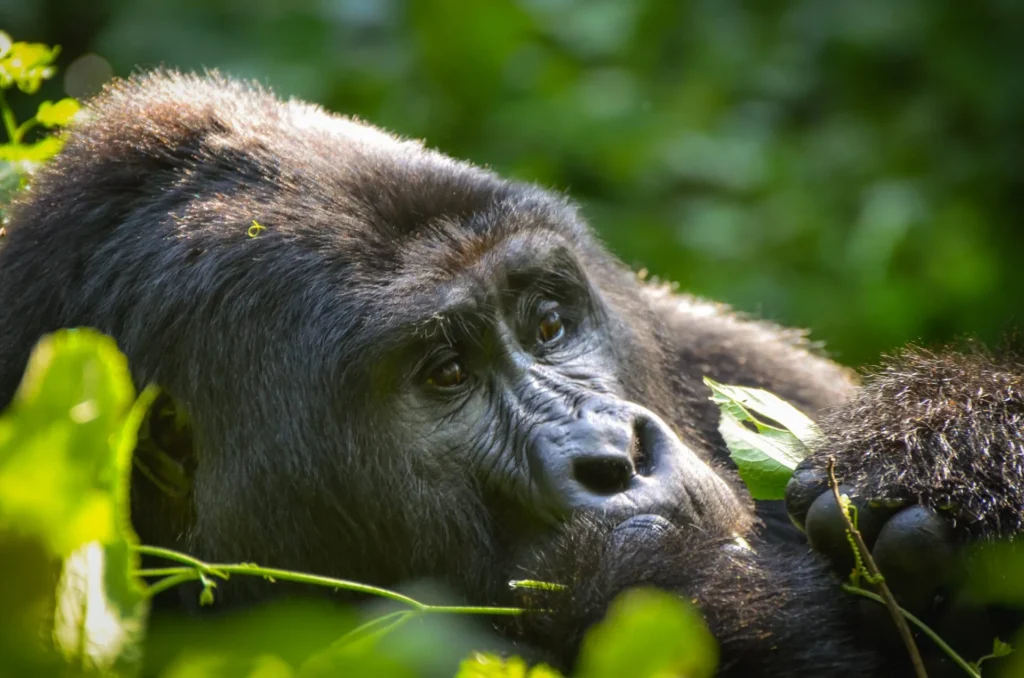
Rwanda mountain gorilla honeymoons offer couples an opportunity to share an extraordinary wildlife experience while discovering one of Africa’s most important conservation landscapes. Unlike a conventional honeymoon focused primarily on accommodation and relaxation, a mountain gorilla holiday places the natural world at the centre of the journey.
The experience of observing mountain gorillas in their forest habitat can be deeply memorable. These great apes live in social groups, maintain complex relationships and display behaviours that reveal remarkable intelligence and emotional sensitivity. Watching a silverback rest among his family, a mother care for an infant or juveniles interact through play can create lasting impressions.
For honeymoon couples, the encounter is meaningful because it is shared. The anticipation of entering the forest, the physical effort of the trek and the privilege of observing endangered animals can become an important part of the couple’s travel story.
However, Rwanda mountain gorilla trekking is a regulated conservation activity. The gorillas remain wild, and visitors must follow strict rules designed to protect their health and natural behaviour. Understanding the animals and their habitat helps couples approach the experience with realistic expectations and appropriate respect.
What Are Mountain Gorillas?
Mountain gorillas are a subspecies of eastern gorilla found in the highland forests of central Africa. Their remaining populations inhabit the Virunga mountain ecosystem and Uganda’s Bwindi region.
In Rwanda, mountain gorillas live within Volcanoes National Park, where the forested slopes provide food, shelter and space for family groups.
Mountain gorillas are the largest living primates and possess powerful bodies adapted to life on the ground and movement through forest vegetation. Despite their physical strength, much of their daily activity involves feeding, resting, travelling and maintaining social relationships.
Their diet consists mainly of plant material, including leaves, stems, shoots and other vegetation available within their habitat. The particular foods consumed vary according to location and seasonal availability.
Mountain gorillas are not animals that visitors can approach independently. Tourist encounters are restricted to habituated families under the supervision of authorised guides and trackers.
Why Mountain Gorillas Are Special for Honeymoon Couples
A mountain gorilla honeymoon safari offers an experience that differs fundamentally from conventional wildlife viewing. Visitors are not simply watching animals from a distant viewpoint or through the window of a safari vehicle. Instead, they enter the forest environment where the gorillas live and observe natural behaviour under carefully controlled conditions.
The encounter can encourage couples to reflect on family relationships, care and cooperation. Mountain gorillas live in social groups where adults and young animals interact throughout the day. Mothers protect infants, juveniles develop through play and silverbacks contribute to the group’s social organisation.
These behaviours can be especially fascinating to couples beginning a new chapter of their lives together. However, the animals should not be treated as symbols created for human romantic experiences. Their behaviour reflects their own biological and social needs, and the privilege of observing them comes with a responsibility to avoid disturbance.
The emotional impact of the encounter often comes from its authenticity. Gorillas may be feeding quietly, resting in vegetation or moving through the forest. Visitors cannot request particular behaviour or arrange a staged interaction.
Understanding Mountain Gorilla Family Groups
Mountain gorillas are social animals that generally live in groups containing adult males, females and young gorillas. The size and composition of groups vary, and changes can occur through births, deaths, dispersal and social interactions.
A mature male known as a silverback is often a central figure in the group. The name refers to the silver-grey hair that develops across the back as the male matures.
Silverbacks may influence group movement, respond to threats and participate in social interactions. Their role is important, but gorilla social organisation is more complex than a simple description of one dominant animal controlling every aspect of group life.
Adult females maintain relationships with their offspring and other group members. Young gorillas spend time exploring, playing and learning social behaviour.
For honeymoon couples, understanding these relationships before trekking can make the encounter more rewarding. Instead of focusing only on the largest gorilla, visitors can appreciate the behaviour of the entire family.
The Role of the Silverback
The mountain gorilla silverback is one of the most recognisable figures in gorilla tourism. Mature males can be physically imposing, with powerful shoulders, broad chests and distinctive silver colouring.
However, their behaviour is not defined solely by strength. Silverbacks may spend long periods resting, feeding or observing the group. They can also interact with juveniles and respond to changes in their surroundings.
Visitors should avoid interpreting every movement as aggression or assuming that a silverback will perform a dramatic display. Many encounters are characterised by calm behaviour.
If a gorilla moves unexpectedly or displays behaviour that requires a response, the authorised guide will provide instructions. Visitors should remain calm and avoid sudden movements.
For couples interested in wildlife photography, the silverback may be an impressive subject, but observation should always take priority over obtaining a particular image.
Mountain Gorilla Mothers and Infants
One of the most memorable aspects of a Rwanda mountain gorilla encounter can be observing mothers with their infants.
Young gorillas depend heavily on maternal care during their early development. Mothers carry, protect and nurse their offspring, while infants gradually become more independent as they grow.
Visitors may observe an infant clinging to its mother, resting nearby or exploring the surrounding vegetation. These interactions can provide insights into the social and developmental behaviour of great apes.
However, the presence of an infant in a particular gorilla family cannot be guaranteed, and park authorities control family allocations.
Couples should also avoid attempting to attract the attention of young gorillas. The animals must be allowed to behave naturally without human interference.
Juvenile Gorillas and Social Play
Juvenile mountain gorillas often display energetic behaviour, including climbing, chasing and playful interactions with other group members.
Play contributes to physical development and social learning. Young gorillas may explore their surroundings, interact with siblings or test their abilities through movement.
These behaviours can be fascinating to observe because they reveal the complexity of gorilla family life.
However, the animals’ activity varies throughout the day. Visitors may encounter a family during a quiet resting period rather than a particularly active moment.
The value of the experience should not be measured by how many dramatic behaviours are observed. Even a peaceful encounter can provide meaningful insight into the animals’ lives.
Where Rwanda’s Mountain Gorillas Live
In Rwanda, mountain gorillas inhabit Volcanoes National Park, part of the wider Virunga mountain ecosystem.
The park’s terrain includes volcanic slopes, bamboo forests and other highland vegetation zones. Environmental conditions vary with altitude, and the forest can be cool, wet and densely vegetated.
Mountain gorillas move through this habitat according to feeding opportunities, social behaviour and other natural influences.
Their movements explain why trekking routes and durations vary. The animals do not remain at fixed visitor locations, and no operator can guarantee that a particular family will be close to the trailhead on the trekking date.
For honeymoon couples, the forest environment is part of the experience. The sounds, vegetation and changing weather provide context for understanding how mountain gorillas live.
How Gorilla Habituation Makes Tourism Possible
Mountain gorilla habituation is the gradual process through which selected gorilla families become accustomed to the controlled presence of researchers, trackers and authorised visitors.
Habituation does not mean domestication. The animals remain wild and continue to make their own decisions about movement, feeding and social behaviour.
The process requires patience, specialist knowledge and careful monitoring. It allows authorised observation while seeking to minimise unnecessary disturbance.
Not every gorilla family is available for tourist visits. The park authorities manage which families are habituated and accessible under the applicable conservation arrangements.
For honeymooners, understanding habituation reinforces the importance of respectful behaviour. The opportunity to observe gorillas at relatively close range depends on years of conservation work and continued compliance with visitor regulations.
The Importance of Mountain Gorilla Conservation
Mountain gorilla conservation in Rwanda involves national park management, habitat protection, veterinary monitoring, research, anti-poaching efforts and cooperation with surrounding communities.
Mountain gorillas remain conservation-dependent despite significant progress in their protection. Their restricted habitat, vulnerability to disease and exposure to human pressures mean that continued conservation work is essential.
Tourism can contribute to conservation financing and local economic opportunities when managed responsibly. However, tourism also introduces risks, particularly through human contact and the potential transmission of infectious diseases.
The balance between visitor access and wildlife protection is therefore central to the management of gorilla trekking.
Couples who choose to visit mountain gorillas should understand that their experience is possible because of sustained conservation efforts rather than simply because the animals inhabit a scenic destination.
Gorilla Trekking Rules for Honeymoon Couples
Rwanda mountain gorilla trekking regulations apply equally to honeymooners and other visitors.
The minimum age is 15 years, and regular trekking groups contain a maximum of eight visitors per habituated family.
Once the gorillas are located, visitors normally spend one hour observing them.
Participants must follow the authorised guides’ instructions, maintain the required observation distance and avoid touching or feeding the animals.
Flash photography is prohibited.
Visitors experiencing symptoms of potentially contagious illness should not participate in a way that places gorillas at risk.
A private honeymoon safari does not provide exemptions from these rules.
Why Couples Cannot Have an Unrestricted Private Gorilla Encounter
Some honeymooners assume that booking a luxury lodge or private safari vehicle will provide exclusive access to a gorilla family. This is not how the standard tourist trekking experience operates.
The park authorities manage gorilla family allocations and visitor numbers according to conservation regulations. Couples may join other permit holders during the encounter.
The experience can still feel deeply personal because each visitor observes the animals from their own perspective. However, privacy outside the park should not be confused with exclusive wildlife access.
A responsible safari operator should explain these distinctions before booking.
Gorilla Trekking Permits for Honeymoon Couples
The standard international Rwanda mountain gorilla permit costs USD 1,500 per person per trek.
For a couple, the combined standard permit cost is USD 3,000 for one trek each.
The permit provides access to the regulated activity under the applicable park arrangements. Accommodation, private transport and other services are separate unless expressly included.
Permits are limited, so couples should confirm availability before finalising expensive non-refundable arrangements.
Official concessions may apply to qualifying visitor categories, but honeymoon status does not automatically provide a discount.
Preparing Physically for the Mountain Gorilla Encounter
Gorilla trekking can involve walking through steep and muddy mountain terrain.
The duration depends on the gorillas’ location, and the difficulty cannot be predicted with complete certainty.
Couples should assess their fitness individually. One partner may be more experienced with hiking than the other, and the holiday should be planned with both people’s abilities in mind.
Regular walking, hill training and suitable footwear can improve preparation.
Porter services may be available to assist with carrying equipment and provide practical support.
Visitors with mobility concerns should communicate their needs before booking.
What to Wear for Mountain Gorilla Trekking
The Virunga Mountains can be cool and wet, even during relatively drier months.
Sturdy hiking boots with good grip are important for muddy and uneven ground.
Long trousers and long-sleeved clothing help protect against vegetation.
A waterproof jacket provides protection from rain, while gloves may be useful when moving through dense forest.
Visitors should carry drinking water and essential personal medication.
Camera equipment should be selected with the physical demands of the trek in mind.
Mountain Gorilla Photography for Honeymoon Couples
Photography is one of the most popular aspects of Rwanda gorilla trekking, but the forest environment presents technical and ethical challenges.
Light levels may be low, and vegetation can obstruct clear views. Gorillas may move unexpectedly or remain partly concealed.
Flash photography is prohibited, and visitors must remain within the authorised viewing arrangements.
Couples should avoid focusing so heavily on photographs that they miss the experience of observing the animals directly.
A meaningful photographic record may include the volcanic landscape, the forest trek and moments at the lodge as well as images of the gorillas.
Best Time to See Rwanda’s Mountain Gorillas
Mountain gorilla trekking operates throughout the year.
The relatively drier months of June to September and December to February are popular because forest paths may be less muddy than during periods of heavier rainfall.
However, rain can occur at any time in Volcanoes National Park.
The wetter months often produce lush vegetation and atmospheric mountain scenery, although walking conditions may be more demanding.
The gorillas remain in their natural habitat throughout the year, and sightings cannot be guaranteed in any season.
Romantic Accommodation Near Mountain Gorilla Habitat
The Volcanoes region offers accommodation ranging from comfortable midrange lodges to premium luxury properties.
Singita Kwitonda Lodge, Wilderness Bisate, One&Only Gorilla’s Nest and Virunga Lodge are among the recognised high-end options associated with the region.
Couples should choose accommodation according to comfort, location, privacy and preferred services.
A premium lodge may provide a relaxing contrast to the physical demands of trekking, while a well-selected midrange property can offer excellent value.
The accommodation category does not influence the official gorilla family allocation or guarantee an easier trek.
Combining Mountain Gorillas with Other Primate Experiences
Couples interested in primates may consider additional experiences beyond mountain gorillas.
Golden monkey trekking in Volcanoes National Park offers an opportunity to observe smaller, active primates in bamboo forest habitat.
Chimpanzee tracking in Nyungwe National Park provides a different great ape encounter, although the forest conditions and tracking experience differ from gorilla trekking.
Each activity has its own permit requirements, age restrictions and physical demands.
Couples should avoid scheduling too many demanding activities without sufficient rest.
Rwanda Mountain Gorillas Versus Uganda Mountain Gorillas
Both Rwanda and Uganda protect mountain gorillas and offer regulated trekking experiences.
Rwanda’s standard international permit costs USD 1,500, while Uganda’s standard foreign non-resident permit has been USD 800.
Rwanda’s gorilla trekking destination is Volcanoes National Park, while Uganda offers trekking in Bwindi Impenetrable National Park and Mgahinga Gorilla National Park.
The choice depends on budget, travel time, accommodation preferences and wider safari interests.
Couples seeking a compact Rwanda honeymoon may prefer Volcanoes National Park, while those planning a broader East African journey may consider Uganda or a combination of both countries.
Responsible Honeymoon Tourism and Local Communities
Responsible gorilla tourism extends beyond following wildlife rules.
Visitors can support appropriate local employment through guiding, porter services, accommodation and community-based experiences.
Cultural activities should be arranged respectfully, with attention to local participation and consent.
Couples should avoid purchasing wildlife products, disturbing natural habitats or participating in activities that exploit animals or communities.
A memorable honeymoon can contribute positively to conservation and local livelihoods when planned responsibly.
Frequently Asked Questions About Rwanda Mountain Gorilla Honeymoons
Are mountain gorillas suitable for a honeymoon experience?
Yes. Gorilla trekking offers a distinctive wildlife experience for couples who enjoy nature and adventure.
Can couples see gorilla mothers and infants?
They may observe mothers and infants, but the composition and behaviour of the assigned family cannot be guaranteed.
Will we see a silverback?
Habituated gorilla families commonly include mature males, but specific viewing conditions and individual sightings cannot be guaranteed.
Can we choose a particular gorilla family?
No. Gorilla family allocations are controlled by park authorities.
Can we take photographs with the gorillas?
Photography is permitted under park rules, but visitors cannot approach or pose with gorillas as though they were domesticated animals.
How much do permits cost for two people?
Two standard international permits cost USD 3,000 for one trek each.
Are gorillas dangerous?
Mountain gorillas are powerful wild animals. Encounters are managed by authorised guides, and visitors must follow all instructions.
Can we trek gorillas twice?
Yes, subject to permit availability. A separate permit is required for each trek.
Is gorilla trekking physically difficult?
It can be. The terrain and walking duration vary according to the animals’ location.
Can we combine mountain gorillas with a luxury honeymoon?
Yes. The Volcanoes region offers premium accommodation and opportunities for relaxation after trekking.
Plan Your Rwanda Mountain Gorilla Honeymoon
At Gorilla Rwanda Safaris, we organise Rwanda mountain gorilla honeymoons for couples seeking meaningful wildlife encounters, comfortable accommodation and personalised travel arrangements.
Our services include gorilla permit assistance, private transfers, accommodation selection and suitable additional experiences around Volcanoes National Park and other Rwanda destinations.
Share your preferred travel dates, accommodation category and interests so that your journey can be designed around your priorities.
Celebrate your honeymoon with an extraordinary encounter with Rwanda’s mountain gorillas, discovering the beauty of their forest habitat and the importance of protecting these remarkable animals for future generations.
END-OF: https://www.gorillarwandasafaris.com/gorilla-trekking/mountain-gorillas-honeymoons-guide/