
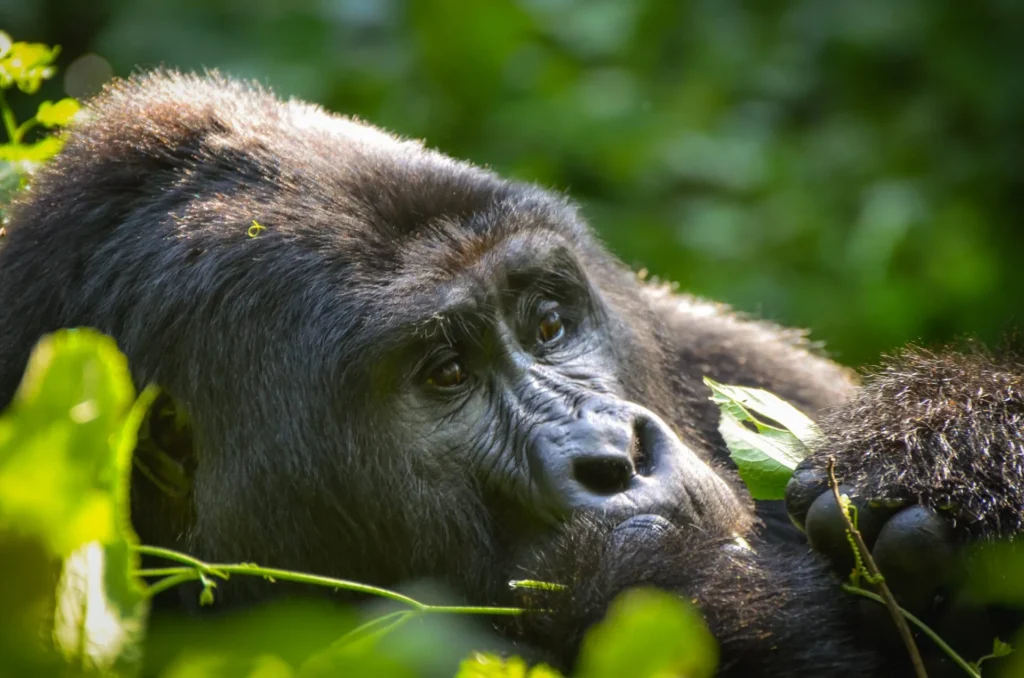
Volcanoes National Park gorilla trekking is Rwanda’s signature wildlife experience, offering a carefully regulated opportunity to observe endangered mountain gorillas in their natural forest habitat. The park occupies part of the Virunga volcanic landscape in northwestern Rwanda, where mountain gorilla families move through bamboo forests, montane vegetation and high-altitude slopes.
Booking a Volcanoes gorilla trekking permit involves several important decisions. Travellers must select an available date, apply under the correct visitor category, complete the authorised reservation process and prepare to report at the designated park headquarters in Kinigi early on trekking morning. The park authorities then organise visitors into groups and coordinate the day’s encounters with habituated gorilla families.
The standard international Rwanda gorilla trekking permit costs US$1,500 per person. The permit provides access to one organised trekking visit, subject to official regulations, but does not include accommodation, transport or unlimited time with the gorillas.
This comprehensive Volcanoes Gorilla Trekking Booking Guide explains the park’s reservation procedures, visitor limits, trekking arrangements, family allocation system, physical requirements and conservation rules. It is designed to help visitors understand not only how to secure a permit, but also what that permit means once they arrive at Volcanoes National Park.
Understanding Volcanoes National Park
Volcanoes National Park, also known as Parc National des Volcans, is located in Rwanda’s northwestern highlands.
The park protects part of the Virunga Massif, a chain of volcanic mountains extending into Uganda and the Democratic Republic of the Congo.
Its forest ecosystem supports endangered mountain gorillas alongside other wildlife, including golden monkeys and numerous bird species.
The landscape includes bamboo vegetation, montane forest, volcanic slopes and high-altitude habitats.
Mountain gorillas move freely through these environments according to feeding opportunities and social behaviour.
The park’s tourism system is designed around these natural movements.
Visitors do not enter the forest independently. They participate in organised treks under the supervision of authorised guides and trackers.
Why Gorilla Trekking Requires Advance Booking
The number of visitors allowed to approach habituated mountain gorilla families is strictly limited.
The official Visit Rwanda website identifies a normal daily capacity of 96 gorilla trekking permits.
This figure reflects the published arrangement of eight visitors for each of 12 tourism gorilla families.
The limit helps reduce disturbance and disease transmission.
Because permits are allocated for specific dates, popular trekking days may become fully booked.
A traveller cannot assume that additional permits will be issued simply because accommodation is available.
Advance booking is particularly important when international flights and other travel arrangements depend on the gorilla encounter.
Step 1: Select Your Preferred Trekking Date
The first step is choosing when to visit Volcanoes National Park.
Gorilla trekking generally operates throughout the year.
The relatively drier months from June to September and December to February are popular because forest walking conditions may be more manageable.
However, rainfall can occur at any time in the Volcanoes region.
The wetter periods, commonly associated with March to May and October to November, may bring muddy paths and slippery vegetation.
The gorillas remain within their natural habitat throughout the year.
Visitors should therefore choose dates according to permit availability, physical preferences and wider travel plans rather than assuming that one month guarantees a better sighting.
Step 2: Check Permit Availability
The Rwanda Development Board manages the official permit booking system.
Visitors can access the authorised platform at:
https://visitrwandabookings.rdb.rw/
The system provides tourist permit applications and related booking services.
Travellers can also request availability checks through a reputable operator.
The relevant information includes the intended trekking date, number of visitors and applicable visitor categories.
A date showing available permits may become fully booked before payment is completed.
Travellers should therefore distinguish between an availability enquiry and a confirmed reservation.
Step 3: Confirm the Correct Permit Price
The standard international Volcanoes National Park gorilla permit costs US$1,500 per person.
The permit applies to one authorised trekking visit.
Visitors wishing to trek on multiple days normally require separate permits.
Rwanda also publishes preferential tariffs for qualifying visitor categories.
For eligible periods in 2026, qualifying Rwandan and East African Community citizens may access a US$200 promotional rate.
Certain African citizens and foreign residents in Africa may qualify for US$500 permits.
These promotions have restrictions and do not apply from June through October 2026.
Future rates should be checked against the official tariff applicable to the intended trekking date.
Step 4: Prepare the Required Documents
Permit applications require accurate visitor information.
Travellers should ensure that their names and identification details match their travel documents.
Applicants seeking discounted rates must provide the required proof of eligibility.
The Rwanda Development Board warns that incorrect or false applications may result in denial of entry.
A permit generated through an inaccurate application does not override the official visitor category requirements.
Travellers should review all details before completing payment.
Step 5: Complete the Reservation
Once the intended date and visitor category have been confirmed, the applicant can proceed through the authorised booking process.
The official platform includes direct permit applications and certain advance-booking arrangements.
The applicable payment conditions depend on the booking service.
For qualifying advance bookings, the Rwanda Development Board describes arrangements involving initial payments of 40% to 99% of the permit fee.
The balance must be settled under the relevant confirmation deadline.
Travellers should not assume that every booking can be held indefinitely with a deposit.
A confirmed permit should be distinguished from a provisional reservation or quotation.
Step 6: Verify Your Permit Confirmation
After the authorised booking process is completed, travellers should verify the permit information.
Check the trekking date, visitor details and permit category.
Any discrepancy should be raised promptly.
Visitors booking through an operator should request confirmation that the official permit has actually been secured.
A hotel booking, safari itinerary or availability screenshot does not provide the same assurance.
The confirmed permit is the central document around which the rest of the visit should be organised.
Step 7: Choose Accommodation Near the Park
Most visitors stay in Musanze, Kinigi or the surrounding Volcanoes region.
Musanze provides town facilities and a variety of accommodation options.
Kinigi offers convenient access to the principal trekking briefing area.
The wider region includes premium lodges and smaller properties with different levels of comfort.
Travellers should compare location, meal arrangements, transport requirements and cancellation conditions.
Accommodation category does not change the standard park viewing rules.
Visitors staying at luxury lodges do not automatically receive longer gorilla encounters or guaranteed access to particular families.
Step 8: Arrange Transport to Kinigi
The official trekking briefing takes place at Kinigi, where visitors must report at 7:00 a.m.
Transport should be organised before the trekking date.
Visitors staying in Musanze generally require an early morning transfer.
Those staying in Kigali must allow considerably more time for the road journey.
After the briefing, trekking groups may travel to different forest starting points.
The location depends on the assigned gorilla family and the day’s operational arrangements.
A suitable vehicle may therefore be required even when accommodation is close to Kinigi.
What Happens at Kinigi Park Headquarters?
The morning programme begins with registration and briefing.
Park personnel verify the necessary arrangements and organise visitors into trekking groups.
Guides explain the rules governing behaviour around mountain gorillas.
These include health precautions, viewing distance, photography restrictions and the importance of following instructions.
The authorities then coordinate the groups with trackers monitoring the habituated gorilla families.
Visitors should not assume that the trekking route will be identical to one described in a previous traveller’s review.
The gorillas move naturally, and their locations change.
How Are Trekking Groups Allocated?
The park authorities determine trekking group allocations.
The official tourism information states that visitor fitness is considered during this process.
The location of gorilla families and other operational factors may also influence arrangements.
Visitors with mobility concerns should communicate them before the trek.
However, no operator can guarantee allocation to a particular family or an easy walking route.
The natural movements of the gorillas remain an important factor.
A standard permit provides access to the organised trekking activity rather than a fixed route.
Can You Choose a Particular Gorilla Family?
Volcanoes National Park has several well-known habituated gorilla families.
Names associated with the park’s tourism history include Sabyinyo, Amahoro, Kwitonda, Susa and Hirwa.
However, family composition and movements change over time.
A family described as easy to reach in an older guide may have moved to a different part of its range.
Visitors cannot ordinarily guarantee a named family through a standard permit.
The park authorities determine the appropriate allocations according to current conditions.
What Do Gorilla Trackers Do?
Gorilla trackers are trained personnel who monitor the movements of habituated families.
Their knowledge of the forest and gorilla behaviour helps guides locate the animals.
Trackers may use information about recent movements and feeding activity to assist the process.
Communication between trackers and guides helps coordinate the day’s trekking arrangements.
However, the gorillas remain wild animals.
Their movements cannot be controlled to suit a visitor’s schedule.
The tracking system supports the encounter but does not guarantee a particular sighting or walking duration.
Where Does the Forest Walk Begin?
After the briefing, visitors may travel to the relevant trekking starting point.
The trailhead depends on the assigned gorilla family.
Some groups may begin relatively close to Kinigi, while others require additional vehicle travel.
The walking route may pass through agricultural landscapes near the park boundary before entering forest habitat.
Once inside the park, visitors follow authorised guides.
The route may involve bamboo vegetation, uneven ground and steep slopes.
The exact conditions cannot be predicted reliably before the day’s allocation.
How Long Does Gorilla Trekking Take?
The duration varies considerably.
Some visitors reach the assigned gorilla family after a relatively short walk.
Others may hike for several hours.
The official visitor guidance describes treks ranging from approximately half an hour to four hours or longer in reaching the gorillas.
The return walk must also be considered.
Visitors should avoid scheduling tightly timed onward travel immediately after the activity.
The most practical approach is to allow sufficient time for an unpredictable mountain forest experience.
What Happens When the Gorillas Are Located?
Once the assigned family has been located, the guide organises the viewing arrangements.
Visitors must follow instructions and maintain the required distance.
The maximum standard observation period is one hour.
During this time, the gorillas may feed, rest, groom one another or interact socially.
Young gorillas may play, while adults may remain relatively still.
The animals do not perform for visitors.
Their natural behaviour determines what can be observed.
Why the One-Hour Viewing Limit Matters
The one-hour limit is a conservation measure.
Mountain gorillas are endangered and susceptible to disturbance and certain human diseases.
Restricting the duration of tourist encounters helps reduce pressure on habituated families.
The limit also reinforces the principle that tourism must operate around wildlife welfare.
Visitors should not assume that a higher payment entitles them to additional standard viewing time.
The park authorities determine the applicable regulations.
Gorilla Trekking Health Regulations
The standard minimum trekking age is 15 years.
Visitors with colds, influenza or other contagious illnesses may be denied access.
This helps protect mountain gorillas from human infections.
The published minimum viewing distance is seven metres.
Visitors must follow instructions concerning movement, noise and behaviour.
Flash photography is prohibited.
Eating, drinking and smoking near the gorillas are not permitted.
These rules are essential components of responsible tourism.
What If a Gorilla Approaches You?
Mountain gorillas are powerful wild animals.
Although habituated families are accustomed to regulated human presence, visitors must remain cautious.
If a gorilla approaches, the guide will provide instructions.
Visitors should avoid sudden movements, touching the animal or attempting to control the situation themselves.
The required distance should be maintained whenever possible.
The guide’s instructions take priority over photography or personal preferences.
Responsible behaviour protects both the visitor and the animals.
How Difficult Is Trekking in Volcanoes National Park?
The park contains steep volcanic slopes, dense vegetation and high-altitude environments.
Trekking difficulty depends on the assigned family, weather and terrain.
Some routes are manageable for visitors with reasonable fitness.
Others can be physically demanding.
Rain may make paths slippery, while elevation can increase the effort required.
Travellers should prepare for variable conditions rather than assuming a fixed level of difficulty.
Technical mountaineering skills are not normally required for standard gorilla trekking, but appropriate physical preparation is beneficial.
Gorilla Trekking for Older Visitors
Older travellers can enjoy Volcanoes National Park gorilla trekking, provided their individual circumstances are suitable.
Age alone does not determine fitness.
Walking ability, balance and relevant health considerations are more important.
Visitors should discuss mobility concerns before booking.
Porter assistance and certain specialised support arrangements may be possible with advance coordination.
However, no operator should guarantee that every natural terrain challenge can be removed.
The park authorities remain responsible for operational safety and group allocation.
What to Wear for Gorilla Trekking
Visitors should wear suitable hiking boots and long trousers.
Long-sleeved clothing helps protect against vegetation.
A waterproof jacket is useful because mountain weather can change quickly.
Gloves may provide additional protection when walking through dense plants.
A small daypack should contain water, essential medication and photographic equipment.
Visitors should avoid carrying unnecessary weight.
Porters can provide assistance for an additional charge.
Photography Rules in Volcanoes National Park
Photography is permitted during the authorised encounter.
However, flash photography is prohibited.
Visitors must maintain the required distance and avoid disturbing the gorillas.
Forest light can be challenging, particularly under dense vegetation.
Photographers should prepare equipment that performs well in changing light conditions.
A long lens may be useful, but heavy equipment can make trekking more difficult.
The encounter should never be treated as a controlled photographic session.
What Happens If the Gorillas Cannot Be Found?
Mountain gorillas move naturally through their habitat.
Experienced trackers work to locate the assigned family, but sightings cannot be guaranteed.
The Rwanda Development Board publishes specific provisions for unsuccessful tracking experiences.
Certain circumstances may qualify for another opportunity or a refund.
Its published guidance includes a 75% refund provision under specified conditions where visitors trek throughout the day without making contact with the assigned family.
These rules should not be confused with ordinary cancellation refunds.
The applicable decision rests with the park authorities.
Can You Change a Confirmed Trekking Date?
The official booking platform includes rescheduling services.
However, changes are subject to the relevant permit conditions.
Some advance-booking arrangements have specific deadlines.
Visitors should not assume that a permit can be moved freely after confirmation.
The requested new date must also be compatible with the applicable booking arrangements.
Before changing flights or accommodation, obtain confirmation that the permit amendment has been approved.
What Happens If You Arrive Late?
The official reporting time is 7:00 a.m.
Late arrival may result in missing the trekking activity.
The Rwanda Development Board’s published guidance does not provide a general refund for late arrivals or missed flights.
Travellers should therefore allow sufficient time to reach Kinigi.
Staying in the Volcanoes region before trekking can reduce the risk of delays.
Reliable transport arrangements are particularly important.
Can You Book Multiple Trekking Days?
Visitors may reserve more than one trekking date, subject to permit availability.
Each standard visit requires a separate permit.
Multiple treks may provide opportunities to observe different behaviours.
However, the park authorities determine family allocations.
Purchasing two permits does not automatically guarantee visits to two different families.
Travellers should also consider the physical demands of consecutive trekking days.
Volcanoes Gorilla Trekking vs Golden Monkey Trekking
Golden monkey trekking is another important primate activity in Volcanoes National Park.
However, it is separate from standard gorilla trekking.
The animals occupy different ecological niches and the activities have their own permit arrangements.
A gorilla permit does not automatically include golden monkey trekking.
Visitors interested in both experiences should check the relevant booking requirements and dates.
These activities can complement one another, but they should not be confused.
Why Gorilla Trekking Revenue Matters
Mountain gorilla conservation requires habitat protection, monitoring, trained personnel and cooperation with surrounding communities.
Tourism generates revenue associated with protected-area management and related development programmes.
The Rwanda Development Board reports that 10% of national park tourism revenues is directed towards community development initiatives.
Tourism also creates employment through guiding, tracking, porter services, accommodation and transport.
However, conservation benefits depend on responsible management and continued protection of the habitat.
Visitors contribute most positively by following the rules and using legitimate booking channels.
Common Volcanoes Gorilla Trekking Booking Mistakes
A common mistake is confusing permit availability with confirmation.
Another is booking accommodation before checking whether the preferred trekking date is available.
Some travellers underestimate the importance of the 7:00 a.m. briefing.
Others assume that a particular gorilla family or short trekking route can be guaranteed.
Visitors may also overlook the minimum age restriction or health requirements.
Careful planning and accurate information help avoid these problems.
Frequently Asked Questions About Volcanoes Gorilla Trekking Booking
How do I book Volcanoes National Park gorilla trekking?
Use the official Rwanda Development Board tourism booking platform or arrange the permit through a reputable operator.
How much is the standard permit?
The standard international permit costs US$1,500 per person.
How many permits are available each day?
Visit Rwanda publishes a normal daily capacity of 96 permits, subject to actual availability and park management.
What time must visitors arrive?
The official reporting time at Kinigi is 7:00 a.m.
Can I choose a gorilla family?
Standard permits do not ordinarily guarantee a named family.
How long does the trek take?
Walking duration varies according to gorilla movements, terrain and weather.
How long can visitors stay with the gorillas?
The standard maximum viewing period is one hour.
Can children participate?
The standard minimum age is 15 years.
Is the trek suitable for older travellers?
Many older visitors participate successfully, but suitability depends on individual fitness and mobility.
Are gorilla sightings guaranteed?
No. Mountain gorillas remain wild animals.
Can I change my permit date?
Rescheduling services exist, but changes are subject to official conditions.
Does the permit include accommodation?
No. Accommodation and transport are separate unless specifically included in a confirmed quotation.
Plan Your Volcanoes National Park Gorilla Trekking Visit
A successful Volcanoes gorilla trekking booking requires a valid permit, an accurate understanding of the official regulations and reliable arrangements for reaching Kinigi.
Travellers should confirm the trekking date, verify their identification details, choose suitable accommodation and prepare for changing forest conditions.
Gorilla Rwanda Safaris can assist with permit enquiries, booking coordination, transport arrangements and practical guidance for visiting Rwanda’s endangered mountain gorillas.
Contact our team with your preferred dates and number of visitors to begin organising your Volcanoes National Park gorilla trekking experience.