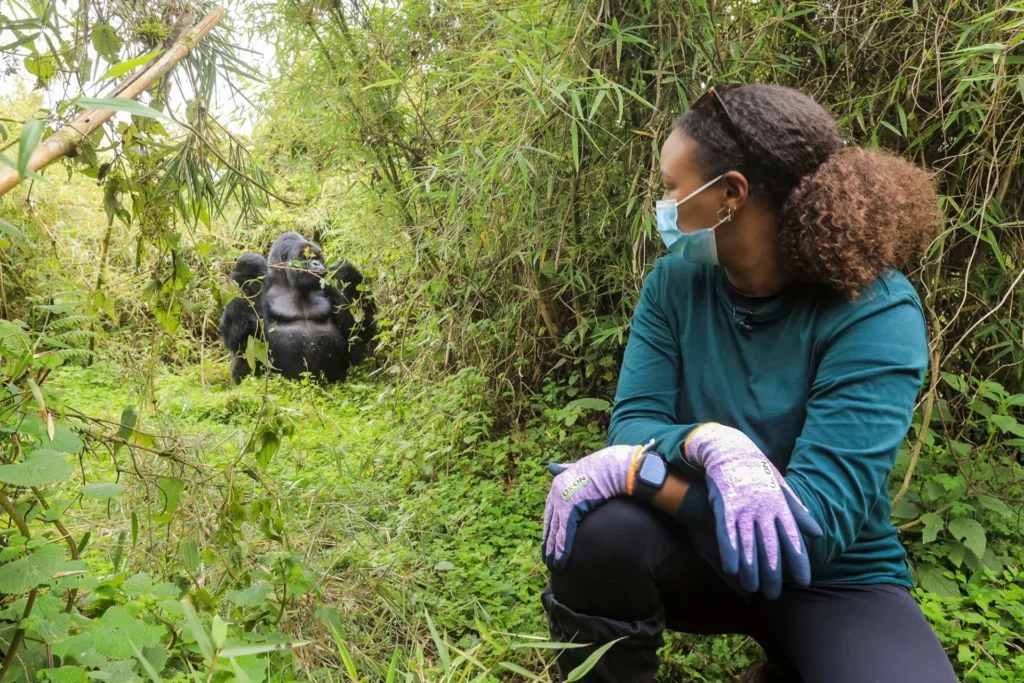
1 Day Bwindi Gorilla Trek
A one-day mountain gorilla trek in Bwindi for travellers who are already in southwestern Uganda.
View SafariHandpicked Kenya Safari Tours for Every Traveler
Rwanda primate safaris offer some of Africa's most extraordinary opportunities to observe primates in their natural habitats.
Rwanda's primate diversity is closely connected to its geography.
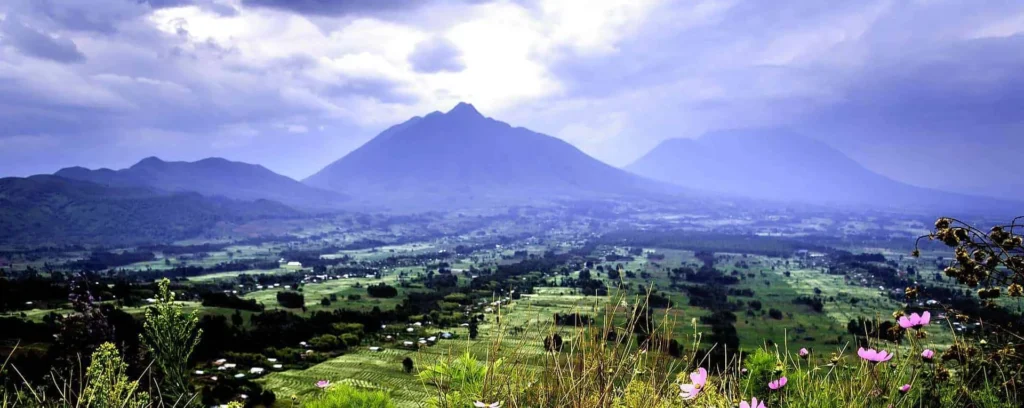
The country's western and northern regions contain high-altitude forests associated with the Albertine Rift and Virunga mountain systems. These habitats support primates adapted to cooler mountain conditions, dense vegetation and complex forest environments.
Unlike the open savannah landscapes associated with many African safaris, primate habitats often require visitors to walk through forests where visibility is limited and animals may move freely through the canopy.
The experience is therefore more dependent on tracking skills, patient observation and the behaviour of the animals.
Primates include both great apes and monkeys, but these groups differ in anatomy, behaviour and ecology.
Mountain gorillas and chimpanzees are great apes. They lack external tails and have complex social relationships.
Golden monkeys, colobus monkeys, L'Hoest's monkeys and other forest monkeys belong to different primate groups with their own adaptations.
Understanding these differences makes a Rwanda primate trekking safari more rewarding because each encounter reveals something distinct about forest life.
Rwanda's protected areas contribute to the conservation of endangered and threatened primates.
Tourism generates revenue associated with park management, conservation programmes and community benefits.
However, primate tourism also requires strict controls because close human contact can disturb animals and expose great apes to infectious diseases.
Responsible trekking therefore involves small visitor groups, authorised guides and rules governing observation distances and behaviour.
Showing 1–12 of 222 safaris
A one-day mountain gorilla trek in Bwindi for travellers who are already in southwestern Uganda.
View SafariA single day in Kampala for the kasubi and palace area, a cultural show, and a market or…
View SafariA full day in Kigali covering the Genocide Memorial, a neighborhood market, and one or two museums.
View SafariA single day on Mount Bisoke, with the crater lake as the turnaround point.
View SafariThe 1 Day Rwanda Family Safari offers an exciting and educational wildlife adventure for families visiting Rwanda.
View SafariThe 3 Day Rwanda Gorilla and Akagera Safari combines mountain gorilla trekking in Volcanoes National Park with wildlife…
View SafariThe 4 Day Rwanda Gorilla and Nyungwe Safari combines mountain gorilla trekking in Volcanoes National Park with chimpanzee…
View SafariThe 1 Day Rwanda Gorilla Trekking Safari offers an unforgettable opportunity to encounter endangered mountain gorillas in their…
View SafariThe 1 Day Rwanda Honeymoon Safari offers couples a romantic escape to the beautiful shores of Lake Kivu,…
View SafariThe 1 Day Rwanda Luxury Safari offers an exclusive wildlife experience in Akagera National Park, Rwanda's premier Big…
View SafariThe 1 Day Rwanda Primates Safari offers an exciting opportunity to encounter Rwanda's endangered golden monkeys in the…
View SafariThe 1 Day Rwanda Wildlife Safari offers an exciting opportunity to explore Akagera National Park, Rwanda's premier savannah…
View SafariMountain gorilla trekking in Rwanda is the country's most famous primate experience.
Mountain gorillas are a subspecies of eastern gorilla found in the Virunga Mountains and Uganda's Bwindi region.
In Rwanda, tourists visit habituated gorilla families within Volcanoes National Park.
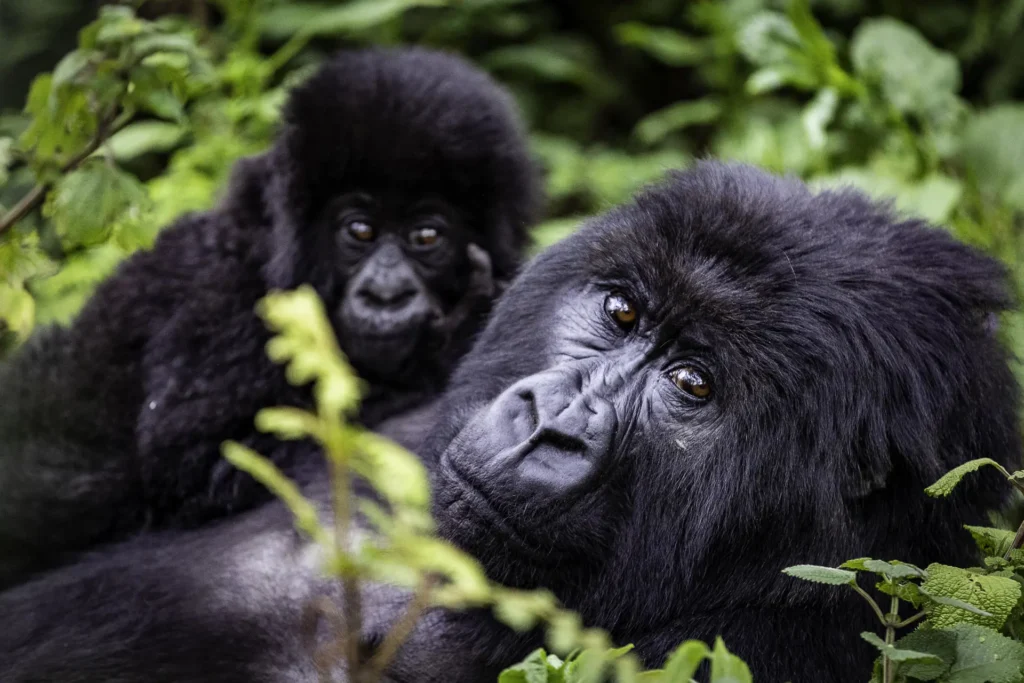
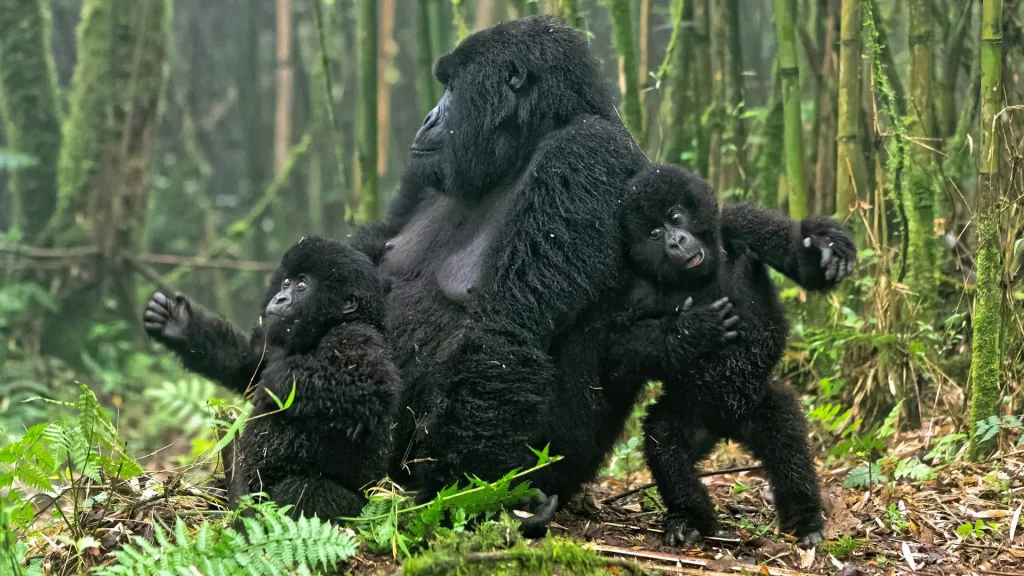
These animals live in social groups that commonly include a dominant silverback, adult females, younger males, juveniles and infants.
The silverback plays an important role in the group's social organisation.
He may influence movement, respond to threats and maintain relationships within the family.
Adult females care for their offspring, while young gorillas engage in play and social learning.
Visitors may observe grooming, feeding, resting and interactions between different family members.
These behaviours are not staged, and the character of each encounter depends on the animals' activities.
Gorilla habituation is the gradual process through which selected wild gorilla families become accustomed to the controlled presence of researchers and authorised visitors.
Habituation does not mean domestication.
The animals remain wild and can respond unpredictably to disturbance.
Visitors must follow guide instructions throughout the encounter.
Trekkers report to the park headquarters at Kinigi for registration and briefing.
Park authorities allocate visitors to available gorilla families, taking operational considerations into account.
Participants then travel to an assigned trailhead and enter the forest with authorised guides and trackers.
The walking distance depends on the location of the gorillas, terrain and weather.
Once the assigned family is located, visitors normally spend one hour observing the animals.
Regular Rwanda gorilla trekking groups are limited to a maximum of eight visitors per habituated gorilla family.
A private safari booking does not automatically provide a private gorilla trekking group.
Travellers should distinguish between exclusive transport arrangements and the regulated national park experience.
The standard international Rwanda gorilla permit costs USD 1,500 per person per trek.
Official concessions may apply to eligible visitor categories or qualifying arrangements, but these should be verified directly before booking.
The minimum age for regular gorilla trekking is 15 years.
Permit availability should be confirmed before making non-refundable travel commitments.
The physical demands of Rwanda mountain gorilla trekking vary considerably.
Some gorilla families may be located relatively close to a trailhead, while others require lengthy walks through steep forest terrain.
The park's mountain environment can be cool, wet and muddy.
A reasonable level of cardiovascular fitness and comfort walking on uneven ground are beneficial.
Travellers should prepare for changes in elevation and slippery trails.
Those with mobility concerns should discuss their needs before booking.
Porters can assist with carrying daypacks and provide practical support during the trek.
Using porter services can improve comfort while supporting employment in nearby communities.
Sturdy waterproof hiking boots, long trousers, gloves and a rain jacket are useful.
Visitors should also carry drinking water and suitable personal medication.
Flash photography is prohibited during gorilla encounters.
Golden monkey trekking in Rwanda offers an entirely different primate experience.
Golden monkeys inhabit the Virunga mountain forests and are especially associated with bamboo vegetation.
Their distinctive golden-orange colouring and energetic movements make them attractive subjects for wildlife observation and photography.
Golden monkeys are active and social animals.
They may move rapidly between bamboo stems, feed on vegetation and interact within groups.
Unlike the relatively settled behaviour sometimes observed during gorilla encounters, golden monkeys can be highly mobile.
The bamboo forests of Volcanoes National Park provide important habitat for golden monkeys.
These forests are part of a wider mountain ecosystem that changes with elevation.
Visitors may observe differences in vegetation as they approach the monkeys' preferred areas.
Both activities involve guided forest walking, but the encounters differ.
Gorilla trekking focuses on observing a habituated great ape family under strict time and group limits.
Golden monkey tracking focuses on a smaller, more agile primate that often moves quickly through bamboo vegetation.
Golden monkey trekking is generally less expensive than gorilla trekking, although current official fees and eligibility rules should be confirmed.
Golden monkeys can be difficult to photograph because of their movement and the contrast between shaded forest and bright openings.
A camera with reliable autofocus and suitable low-light performance can be useful.
Visitors should follow all park photography rules.
Rwanda chimpanzee trekking is principally associated with Nyungwe National Park and its protected forest ecosystem.
Chimpanzees are highly intelligent great apes with complex social relationships, communication systems and feeding behaviour.
They differ considerably from gorillas in movement and social organisation.
Chimpanzees live in communities containing multiple adult males and females.
Their social system is often described as fission-fusion, meaning individuals may separate into smaller parties and reunite.
This makes chimpanzee tracking unpredictable because the animals can move over substantial distances.
Chimpanzees communicate through calls, gestures and facial expressions.
Their loud vocalisations can sometimes be heard before the animals are seen.
Experienced trackers use calls, movement signs and knowledge of feeding areas to help locate them.
Chimpanzees eat a varied diet that includes fruit, leaves and other available foods.
Their movements can be influenced by seasonal food availability.
Observing feeding behaviour can provide insights into the ecological relationships between primates and forest vegetation.
Chimpanzees frequently move through trees and across forest slopes.
Visitors may need to walk quickly or change direction as the animals travel.
The forest can be dense, and visibility may be limited.
An encounter cannot be guaranteed, even with experienced guides.
Chimpanzee tracking requires an official permit and adherence to park regulations.
The applicable price depends on the current tariff and visitor category.
Travellers should verify the latest official fees rather than relying on outdated online figures.
Colobus monkey tracking in Rwanda is another rewarding experience for primate enthusiasts.
Nyungwe is particularly associated with black-and-white colobus monkeys, which can form conspicuous groups in the forest canopy.
Black-and-white colobus monkeys are recognised by their contrasting coat patterns and long tails.
Their appearance makes them relatively distinctive when seen clearly among the trees.
Colobus monkeys spend much of their time in trees.
They are capable of impressive leaps between branches and rely heavily on forest canopy connectivity.
Colobus monkeys are primarily leaf-eating primates with specialised digestive adaptations.
Their feeding ecology differs from that of fruit-eating primates.
A colobus encounter adds diversity to a Rwanda primate safari.
It allows travellers to compare the behaviour of leaf-eating monkeys with chimpanzees and mountain gorillas.
Rwanda's forests support additional monkey species that contribute to the country's biodiversity.
L'Hoest's monkeys are forest-dwelling primates associated with Central and East African montane habitats.
They are generally more elusive than some of the better-known tourist primates.
Blue monkeys occur in forest environments and may be observed during suitable nature activities.
Their common name can be misleading because their overall appearance is not bright blue.
Red-tailed monkeys are another species associated with forest habitats.
Their movements and feeding behaviour contribute to the diversity of rainforest primate communities.
Owl-faced monkeys, also known as Hamlyn's monkeys, are among the more elusive primates associated with the region's forests.
Sightings should be considered fortunate rather than expected.
Small nocturnal primates such as galagos occur in suitable African forest habitats.
They are not normally the principal focus of standard daytime Rwanda primate trekking programmes.
Specialised nocturnal activities require appropriate authorisation and should not be assumed available in every park.
Nyungwe protects a large area of montane rainforest with considerable biological diversity.
Its forest habitats support primates, birds, insects and specialised plant communities.
Primate populations depend on suitable habitat and the ability to move through forest environments.
Habitat fragmentation can affect feeding opportunities, breeding and long-term population resilience.
Many primates contribute to forest ecology through seed dispersal and interactions with vegetation.
Their feeding behaviour can influence the distribution and regeneration of plant species.
Well-managed primate tourism can contribute to conservation funding and local economic activity.
However, visitor numbers and behaviour must be controlled to reduce disturbance.
Both Rwanda and Uganda are outstanding destinations for primate tourism.
Rwanda offers mountain gorilla trekking in Volcanoes National Park and chimpanzee tracking in Nyungwe.
Uganda offers gorilla trekking in Bwindi Impenetrable National Park and Mgahinga Gorilla National Park, along with chimpanzee tracking in Kibale National Park and other authorised locations.
The standard international Rwanda gorilla permit costs USD 1,500.
Uganda's standard foreign non-resident gorilla permit has been USD 800.
This difference may influence destination choice, although the complete safari cost also depends on accommodation and transport.
Uganda offers a specialised gorilla habituation experience in Bwindi under a separate permit and operating framework.
This is distinct from standard gorilla trekking and is not equivalent to the regular Rwanda gorilla encounter.
Travellers interested in longer primate observation should compare the current official experiences and regulations.
A Rwanda Uganda primate safari can include mountain gorillas, chimpanzees and golden monkeys across both countries.
The best route depends on permit availability, travel duration and preferred destinations.
Rwanda primate safaris operate throughout the year.
The relatively drier months of June to September and December to February are popular for forest trekking.
However, rainfall can occur at any time in mountain and rainforest environments.
Trails may be less muddy during relatively dry periods.
These months are also popular with visitors, making advance permit booking important.
Rainfall can make forest trails slippery and physically demanding.
However, wet conditions create lush vegetation and atmospheric photographic opportunities.
Primate movements depend on food availability, social behaviour and other ecological factors.
No season guarantees easier sightings of every species.
Rwanda primate photography safaris require preparation for challenging light and movement.
Forest environments often have deep shade, bright openings and dense vegetation.
Gorillas may remain relatively still while feeding or resting, but their behaviour is unpredictable.
Flash photography is prohibited.
Chimpanzees can move quickly and may remain high in trees.
Fast autofocus and appropriate exposure settings are useful.
Golden monkeys are active and often move through bamboo.
Photographers should be prepared for rapid changes in position and lighting.
Wildlife should never be disturbed for a photograph.
Visitors must follow guide instructions and avoid blocking animal movement.
Great apes share important biological similarities with humans and can be vulnerable to human infectious diseases.
Visitors should not participate in great ape tracking when suffering from potentially contagious illnesses.
Park authorities may apply health screening and other protective measures.
Travellers should follow current instructions regarding observation distance, masks where required and permitted behaviour.
Responsible primate tourism places the animals' welfare above the desire for a close photograph.
Accommodation location affects early morning departures and overall comfort.
Musanze and Kinigi offer accommodation ranging from budget guesthouses to premium lodges.
Staying near the park can reduce early morning transfer time.
Accommodation should be selected according to the location of the planned tracking activity.
Nyungwe is extensive, and travel times between accommodation and activity starting points can be significant.
Travellers can choose accommodation according to budget, location and responsible operating practices.
The most expensive property is not automatically the most suitable for every primate-focused holiday.
The total Rwanda primate safari cost depends on permits, accommodation, transport, guiding and duration.
Gorilla trekking is generally the largest individual activity expense.
Chimpanzee tracking, golden monkey trekking and other experiences require separate fees.
Private vehicle costs may be shared among travellers.
A clear quotation should identify every permit and activity rather than presenting a single unexplained total.
Major attractions include mountain gorillas, chimpanzees, golden monkeys and black-and-white colobus monkeys. Other forest primates may also be encountered.
Tourist gorilla trekking takes place in Volcanoes National Park.
Nyungwe National Park is Rwanda's principal established chimpanzee tracking destination.
Yes. A combined Rwanda primate safari can include Volcanoes National Park and Nyungwe.
The standard international permit costs USD 1,500 per person per trek, subject to official changes and eligibility rules.
No. Primates are wild animals, and sightings depend on their location and behaviour.
Difficulty varies. Chimpanzees can move rapidly, while gorilla trekking may involve steep mountain terrain.
Age restrictions differ by activity. Gorilla trekking requires participants to be at least 15 years old.
Yes. Rwanda offers remarkable primate subjects, although forest lighting and movement can be challenging.
Yes. Combined safaris can include gorillas, chimpanzees and other primates across both countries.
At Gorilla Rwanda Safaris, we create personalised Rwanda primate safari packages featuring mountain gorillas, chimpanzees, golden monkeys and rainforest wildlife.
Our team can help you compare Volcanoes National Park gorilla trekking, Nyungwe chimpanzee tracking, golden monkey experiences and combined Rwanda Uganda primate tours.
Share your preferred dates, number of travellers, accommodation category and primate interests. We will help arrange a practical journey with suitable permits, guiding and accommodation.
Discover Rwanda's remarkable primates through an expertly planned safari that connects mountain gorillas, chimpanzees and the extraordinary biodiversity of Central Africa's forests.