
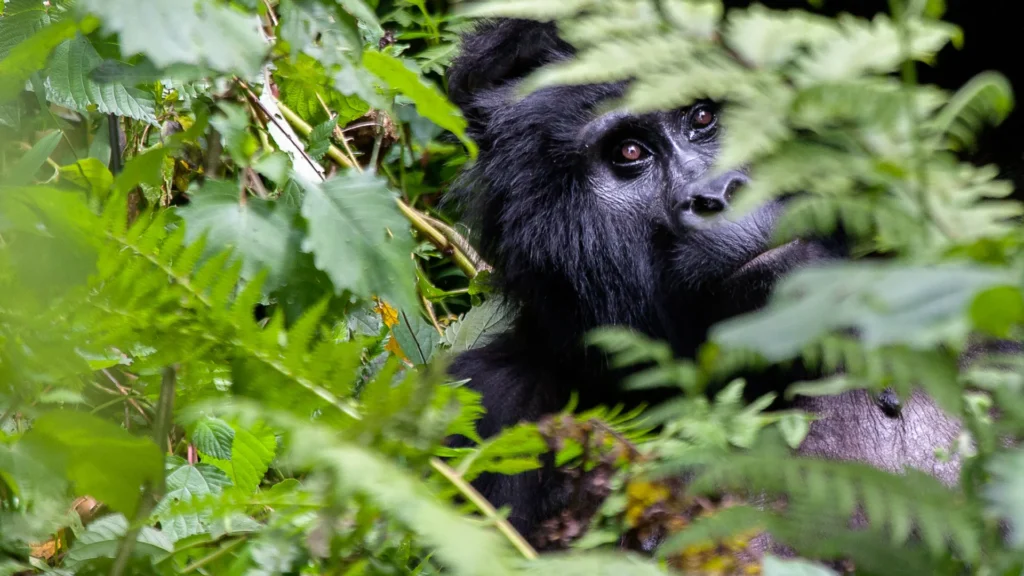
Gorilla trekking in Volcanoes National Park is an extraordinary opportunity to observe endangered mountain gorillas in Rwanda within their natural high-altitude forest habitat. The experience takes visitors into the Virunga Mountains, where habituated gorilla families move freely through bamboo woodland, montane forest, thick undergrowth and volcanic slopes. Unlike conventional African wildlife safaris, where animals are usually observed from vehicles, Rwanda gorilla trekking involves entering the animals’ environment on foot under the supervision of trained park rangers.
This close encounter makes responsible behaviour particularly important. Volcanoes gorilla trekking etiquette encompasses official park regulations, wildlife observation practices, disease-prevention measures, photography restrictions and respect for the wider forest ecosystem. These guidelines are designed to protect both the gorillas and the people visiting them, while maintaining the conservation value of Rwanda’s carefully managed gorilla tourism programme.
Visitors should understand that mountain gorillas are not captive or domesticated animals. Although selected families have undergone habituation and can tolerate carefully controlled human presence, they retain their natural instincts, social relationships and freedom of movement. A relaxed gorilla resting nearby does not invite physical interaction, and a curious juvenile approaching a tourist does not justify touching or feeding it.
The fundamental principle of responsible mountain gorilla trekking is straightforward: visitors must adapt their behaviour to the needs of the gorillas, rather than expecting the gorillas to accommodate human preferences.
This guide examines the etiquette required before entering the park, while trekking through the forest, during the gorilla encounter and after leaving the protected area. It also explains why individual regulations exist and how they contribute to the long-term protection of one of Africa’s most remarkable endangered primates.
Why Etiquette Is Essential in Volcanoes National Park
Volcanoes National Park, situated in northwestern Rwanda, protects part of the Virunga Massif, a chain of volcanic mountains extending across Rwanda, Uganda and the Democratic Republic of the Congo. This landscape supports a portion of the world’s remaining wild mountain gorilla population, alongside golden monkeys, forest birds and other highland wildlife.
The park is not simply a tourism destination. It is a protected ecological landscape where conservation authorities manage human access to minimise disturbance, monitor wildlife populations and preserve habitats.
Mountain gorilla conservation has benefited from decades of ranger protection, scientific research, veterinary interventions, community engagement and regulated tourism. The species remains endangered despite important population recovery, making careful management essential.
Tourism creates both opportunities and risks. Permit revenue helps support conservation and generates wider economic benefits, while human visitors can introduce disease, disturb natural behaviour or damage sensitive habitats if their activities are poorly managed.
The International Gorilla Conservation Programme (IGCP) promotes responsible visitation through its Gorilla Friendly initiative, which emphasises reduced disturbance and disease prevention.
The etiquette followed by individual travellers therefore contributes to a much larger conservation effort. Every visitor who maintains the required distance, follows health precautions and respects ranger instructions helps reduce the pressures associated with human presence.
Understanding the Official Gorilla Trekking Rules in Rwanda
The Rwanda Development Board (RDB) oversees tourism management and permit arrangements for gorilla trekking in Volcanoes National Park. Visitors are required to follow the instructions communicated by authorised park personnel.
Several core requirements are particularly important.
Minimum Age for Gorilla Trekking
The standard gorilla trekking age limit in Rwanda is 15 years. Children younger than the permitted age cannot participate in ordinary tourist gorilla trekking.
This restriction reflects the physical demands of trekking, the need for visitors to follow wildlife safety instructions and health considerations associated with close proximity to endangered primates.
Families should verify ages before purchasing permits and avoid assuming that parental supervision creates an exemption.
Maximum Number of Visitors
A habituated mountain gorilla family is normally visited by a group of no more than eight tourists during its scheduled daily tourist encounter.
This limitation reduces the number of people present around the gorillas and helps rangers manage the viewing experience.
The maximum group size does not mean every trek will necessarily include eight tourists. Actual allocations depend on permit bookings and park operations.
One-Hour Gorilla Viewing Limit
Standard Volcanoes National Park gorilla trekking permits allow approximately one hour of observation once visitors reach the assigned gorilla family and the official viewing period begins.
The time spent walking through the forest is separate from this hour.
Visitors should respect the ranger’s announcement when the viewing period has ended, even if the gorillas are particularly active or a photographic opportunity appears promising.
Minimum Gorilla Viewing Distance
The established minimum gorilla viewing distance in Rwanda is seven metres, subject to the current instructions of park rangers.
This is a minimum separation, not an invitation to approach gorillas as closely as possible.
Maintaining greater distance when practical provides additional protection against disease transmission and disturbance.
Conservation specialists frequently advocate a precautionary approach to separation, especially where respiratory infections are concerned.
The ranger’s directions always take precedence during the encounter.
Before the Trek: Responsible Preparation and Visitor Etiquette
Arrive on Time for the Kinigi Briefing
Most gorilla trekking excursions in Volcanoes National Park begin with registration and a briefing at the park headquarters in Kinigi, near Musanze.
Visitors should arrive at the reporting time confirmed by their safari operator and park authorities. The briefing is a mandatory operational stage, not an optional introduction.
Park staff explain the day’s procedures, group allocation, safety considerations and expected behaviour around gorillas.
Late arrival may disrupt the allocation process or prevent participation, depending on operational circumstances.
Prepare the necessary identification and booking documents in advance, and allow sufficient time for the journey from your accommodation.
Listen Carefully to Ranger Instructions
The gorilla trekking ranger briefing is the most authoritative source of instructions for the day’s activity.
Even travellers who have previously trekked gorillas in Rwanda or Uganda should pay attention because conditions, group movements and operational procedures may differ.
Rangers may discuss walking difficulty, forest conditions, the location of the allocated gorilla family and specific precautions.
Visitors should ask questions before departure rather than make assumptions during the trek.
Declare Health Concerns Honestly
One of the most important aspects of gorilla trekking health etiquette is being honest about illness.
Mountain gorillas can contract certain human infectious diseases, including respiratory illnesses. Because they live in close social groups, infections may spread between family members.
Visitors experiencing fever, coughing, influenza-like symptoms or another potentially infectious condition should notify their operator and park authorities.
Do not conceal symptoms because a permit was expensive or the trip required considerable planning.
Park officials determine whether participation is appropriate under the applicable health rules.
Prepare Appropriate Clothing and Equipment
Volcanoes National Park trekking terrain can include steep paths, wet vegetation, uneven ground and slippery volcanic soil.
Visitors should wear sturdy hiking boots with reliable grip, long trousers and clothing that protects against vegetation.
A waterproof jacket is recommended because rainfall can occur even during comparatively dry months.
Gloves can help when navigating thick vegetation, although unnecessary disturbance of plants should be avoided.
Carry sufficient drinking water, essential medication and personal necessities in a manageable daypack.
Heavy equipment may make the walk more difficult and slow the group.
Etiquette While Walking Through the Forest
Stay With Your Assigned Trekking Group
Mountain gorilla trekking in Rwanda is conducted under the supervision of trained park personnel.
Visitors must remain with their assigned group throughout the activity.
Do not walk ahead, explore alternative paths or separate from the group to photograph wildlife.
The forest contains steep terrain, dense vegetation and areas where navigation can be difficult.
Rangers coordinate with trackers who monitor the movements of habituated gorilla families. Their guidance helps maintain a controlled approach to the animals.
Respect the Forest Habitat
The Virunga mountain ecosystem contains numerous plants and animals beyond the gorillas.
Visitors should avoid unnecessarily trampling vegetation, removing plants, disturbing wildlife or creating informal trails.
Do not collect flowers, seeds, stones or other natural materials.
A protected national park is not a place to gather souvenirs.
Even seemingly minor actions can have cumulative effects when repeated by large numbers of visitors.
Avoid Excessive Noise
Loud conversations, shouting, music and unnecessary electronic sounds are inappropriate during a guided gorilla trekking experience.
The forest is an active wildlife habitat where animals respond to their surroundings.
Keeping noise low helps avoid disturbance and allows visitors to appreciate natural sounds.
Phones should be silenced before entering the gorilla viewing area.
Follow Instructions on Difficult Terrain
Some forest sections may require careful climbing, stepping over vegetation or descending slippery slopes.
Do not rush or attempt to overtake other trekkers.
If you need assistance, tell the ranger or porter.
A controlled walking pace reduces the likelihood of falls and helps keep the group together.
Approaching a Habituated Gorilla Family
When trackers locate the allocated gorilla family, the ranger team prepares visitors for the encounter.
Depending on the circumstances, tourists may be instructed to leave walking sticks, bags or other equipment at a designated location before approaching the gorillas.
This helps reduce clutter and unnecessary movement within the viewing area.
Visitors should approach quietly and remain attentive to the ranger.
The gorillas may be feeding, resting, grooming or moving through vegetation.
Do not expect the animals to remain stationary for photographs.
Gorilla habituation means the animals have gradually become accustomed to controlled human observation; it does not mean their movements can be directed by tourists.
The ranger determines where visitors should stand and when they may change position.
Maintaining a Safe and Respectful Distance
The seven-metre minimum gorilla viewing distance is intended to reduce direct human-gorilla interaction and associated health risks.
Respiratory pathogens can spread through droplets and other transmission pathways, making physical separation an important precaution.
Visitors should not deliberately approach gorillas to obtain close-up photographs.
A camera zoom or appropriate lens should be used instead.
If a gorilla moves closer voluntarily, remain calm and follow the ranger’s directions.
Do not reach towards the animal or attempt to initiate contact.
Sometimes the safest response is to remain still while the ranger assesses the situation.
The fact that a gorilla has approached does not remove the prohibition on touching it.
How to Behave Around Silverback Gorillas
A silverback gorilla is a mature adult male distinguished by the silver-grey hair that develops across his back.
In many mountain gorilla families, the dominant silverback plays an important role in group protection, movement and social organisation.
Silverbacks are powerful wild animals, but they frequently display calm behaviour during authorised tourist encounters.
Visitors may observe a silverback resting, feeding, grooming or interacting with other gorillas.
Occasionally, a silverback may vocalise, beat his chest or move rapidly.
Such behaviour can have several meanings within gorilla social communication and should not automatically be interpreted as an attack.
Nevertheless, tourists must avoid provoking or challenging the animal.
Do not stare aggressively, imitate chest beating, shout or attempt to attract his attention.
If a silverback approaches, follow the ranger’s instructions immediately.
Running away, screaming or making sudden movements may increase the risk of an unpredictable response.
Respecting Female Gorillas, Infants and Juveniles
A mountain gorilla family includes individuals with different social roles and behaviours.
Adult females care for infants, while juveniles spend considerable time exploring and playing.
These interactions are among the most rewarding aspects of gorilla watching in Rwanda.
However, visitors must avoid interfering with family relationships.
Never position yourself deliberately between a mother and her infant.
Do not attempt to attract a baby gorilla or encourage a juvenile to approach.
Young gorillas may appear playful and curious, but they remain wild animals.
Touching or feeding them can create health risks and interfere with normal behaviour.
Photographers should be particularly careful not to crowd mothers and infants while searching for a better viewing angle.
Disease Prevention and Gorilla Trekking Hygiene
Why Respiratory Infections Are Dangerous
Mountain gorillas and humans are closely related primates, which creates important disease-transmission concerns.
Research and veterinary monitoring have documented respiratory illnesses among gorilla populations, including infections associated with human pathogens.
A visitor who feels only mildly unwell may still represent a significant risk to endangered wildlife.
Disease prevention is therefore one of the strongest scientific reasons for regulating gorilla tourism.
Face Masks and Current Health Protocols
Face masks are widely recognised by gorilla conservation specialists as an important protective measure.
Visitors must follow the current Volcanoes National Park mask requirements and any additional instructions issued during the briefing.
Because operational health protocols can change, travellers should confirm requirements before their visit.
Bring a suitable face mask and be prepared to use it throughout the encounter.
Hand Hygiene and Personal Cleanliness
Good personal hygiene supports responsible wildlife tourism.
Visitors should follow any instructions concerning hand cleaning, equipment hygiene and contamination prevention.
Avoid handling discarded materials or leaving used tissues in the forest.
If you cough or sneeze, turn away from the gorillas and follow the ranger’s guidance.
Food and Drink Restrictions
Eating, drinking and smoking are not permitted during the gorilla viewing period.
Food should remain securely packed while visitors are near the animals.
Meals and snacks may be consumed only in appropriate areas identified by the ranger.
Never feed gorillas or leave food scraps behind.
Human food is unsuitable for wild gorillas and may encourage undesirable associations between visitors and food.
Photography Etiquette in Volcanoes National Park
Flash Photography Is Prohibited
Gorilla trekking photography rules prohibit the use of flash.
Flash can startle animals and disrupt the encounter.
Before approaching the gorillas, disable automatic flash on cameras and mobile phones.
Photographers should familiarise themselves with their equipment in advance rather than adjusting unfamiliar settings while standing near the animals.
Avoid Moving Constantly for Photographs
Gorillas do not remain in ideal photographic positions.
Vegetation, shadows and uneven terrain can make photography challenging.
Visitors should not repeatedly move closer, push past others or leave the approved viewing position to improve a composition.
The ranger may permit limited repositioning when it is safe.
Patience often produces more natural photographs than constant movement.
Photographing Gorillas in Low Light
The forests of Volcanoes National Park can be heavily shaded, particularly beneath dense vegetation.
A camera with good low-light performance and a suitable zoom lens can be helpful.
Photographers may benefit from adjusting ISO, shutter speed and exposure settings before the encounter.
Avoid carrying excessive equipment that becomes difficult to manage during the trek.
Protect cameras from moisture and keep straps secure.
Respect Other Visitors
A gorilla trekking group includes people with different interests.
Some may prioritise photography, while others simply want to observe the animals.
Do not obstruct another visitor’s view or monopolise a particular position.
Respect the limited viewing period and allow everyone to enjoy the experience.
Understanding the One-Hour Viewing Restriction
The one-hour gorilla viewing rule is an important conservation safeguard.
Repeated human presence can influence wildlife behaviour and increase opportunities for disease transmission.
Limiting the duration of encounters helps reduce these pressures.
The restriction also creates a consistent framework for tourism management.
Visitors should avoid treating the encounter as a photographic assignment in which every possible image must be captured.
Instead, observe the family as a functioning social group.
Notice feeding behaviour, grooming, maternal care and communication.
When the ranger announces the end of the viewing period, leave promptly and quietly.
What Happens If a Gorilla Approaches You?
A gorilla may occasionally approach visitors despite the required minimum viewing distance.
This can occur because the animal is moving along its preferred route or because a juvenile is curious.
Do not interpret the approach as an invitation to interact.
Remain calm, avoid sudden movements and listen to the ranger.
Do not attempt to touch the gorilla or move towards it.
If instructed to crouch, remain still or withdraw slowly, comply immediately.
The ranger is responsible for managing the encounter according to the animal’s behaviour and the surrounding terrain.
There is no universal visitor response suitable for every situation, which is why following professional instructions is essential.
Toilet Etiquette and Waste Management
The absence of conventional facilities along forest routes makes appropriate waste management important.
If you need to use the toilet during a gorilla trekking excursion, inform the ranger.
The ranger will identify an appropriate location and explain the necessary disposal procedure.
Human waste and contaminated materials can introduce health risks into protected environments.
Do not leave tissues, sanitary products or other waste exposed.
Carry personal rubbish out of the forest.
The principle of leave-no-trace gorilla trekking applies to both visible litter and less obvious forms of environmental contamination.
Gorilla Trekking Etiquette for Senior Travellers
Many older visitors successfully participate in Rwanda mountain gorilla trekking.
However, the physical demands vary significantly depending on terrain, rainfall and the gorilla family’s location.
Age alone does not determine trekking ability.
Visitors should consider their fitness, mobility and comfort walking on uneven mountain paths.
Communicate any limitations before the trekking date.
Where operationally possible, rangers may consider visitor capabilities when allocating groups, although a short or easy trek cannot be guaranteed.
Porters can provide valuable support.
Travellers requiring specialised assistance should discuss arrangements well in advance.
The Role of Porters in Responsible Gorilla Tourism
Gorilla trekking porters assist visitors with carrying bags and negotiating difficult terrain.
Their services can improve comfort and reduce the risk of accidents.
Porters also form part of the wider local tourism economy.
Employment opportunities associated with conservation tourism can provide alternative sources of income for communities near the park.
The IGCP has documented initiatives to train porters in gorilla visitation rules, reflecting their importance in responsible tourism.
Visitors should treat porters respectfully, agree on service arrangements clearly and follow local guidance on appropriate payment.
Seasonal Conditions and Trekking Etiquette
Gorilla trekking in Rwanda is available throughout the year, but seasonal conditions influence the walking experience.
The comparatively drier periods generally occur from June to September and around December to February.
Wetter periods are commonly associated with March to May and October to November.
These are broad climatic patterns rather than guarantees of daily weather.
Rain can occur at any time in the Virunga Mountains.
During wet conditions, trails may become muddy, vegetation may be slippery and progress may be slower.
Visitors should avoid pressuring rangers or fellow trekkers to move faster than conditions safely permit.
A successful trek is not necessarily a short trek.
Respecting Local Communities Around Volcanoes National Park
Responsible gorilla tourism in Rwanda extends beyond wildlife viewing.
Communities around the park contribute to tourism through employment, guiding, agriculture, accommodation and cultural activities.
Visitors should respect local customs and private property.
Ask permission before photographing residents.
Avoid entering farms or villages without appropriate arrangements.
Choose legitimate community tourism services and support locally produced goods where practical.
The relationship between conservation and community wellbeing is particularly important in landscapes where protected areas border densely populated agricultural regions.
Tourism is more sustainable when surrounding communities receive meaningful benefits.
Ethical Gorilla Trekking and Conservation Funding
The Rwanda gorilla trekking permit system forms part of a regulated tourism model that generates revenue associated with conservation and tourism management.
The standard permit price publicly advertised by Visit Rwanda is USD 1,500 per person, with certain eligibility-based offers and conditions.
Permit prices should always be reconfirmed before booking.
The financial contribution of tourism is significant, but paying for a permit does not exempt visitors from conservation responsibilities.
The value of a gorilla encounter should be measured not only by the experience enjoyed by tourists but also by whether the activity protects the animals.
Ethical gorilla trekking requires both appropriate management by authorities and responsible behaviour by individual visitors.
Common Gorilla Trekking Etiquette Mistakes
Several avoidable behaviours can undermine an otherwise well-organised trek.
Arriving late for registration creates unnecessary complications.
Ignoring the health rules can expose gorillas to infectious disease.
Moving too close for photographs violates separation requirements.
Making excessive noise may disturb the animals and other visitors.
Leaving litter damages the protected environment.
Attempting to touch a curious juvenile creates unnecessary risk.
Ignoring ranger instructions can compromise safety.
Responsible visitors recognise these problems in advance and prepare accordingly.
Frequently Asked Questions About Volcanoes Gorilla Trekking Etiquette
What is the minimum distance from gorillas in Rwanda?
The established minimum is seven metres, subject to current park instructions. Visitors should maintain greater separation where practical and always follow the ranger.
Can tourists touch mountain gorillas?
No. Physical contact is prohibited because it can transmit disease and create safety risks.
Is flash photography allowed?
No. Flash photography is prohibited during mountain gorilla encounters.
How many tourists visit a gorilla family?
A standard tourist group normally contains no more than eight visitors per habituated gorilla family.
How long can visitors stay with the gorillas?
The standard viewing period is one hour. The forest walk before and after the encounter is separate.
Can I trek if I have a cold?
You must report symptoms of potentially infectious illness. Park authorities determine whether participation is permitted.
What should I do if a silverback charges?
Follow the ranger’s instructions immediately. Do not run, scream or attempt to challenge the animal.
Can I eat during the gorilla encounter?
No. Food and drinks must not be consumed while observing gorillas.
Are gorillas aggressive towards tourists?
Habituated mountain gorillas generally tolerate controlled tourist visits, but they remain powerful wild animals. Visitors must follow all safety instructions.
Is gorilla trekking suitable for older people?
Many older travellers participate successfully. Fitness, terrain, health and available assistance should be considered individually.
Do I need to hire a porter?
Hiring a porter is optional for many visitors but can be helpful on difficult terrain and contributes to local employment.
Can I use a drone during gorilla trekking?
Visitors should not assume drone use is permitted. Protected-area filming and drone operations require appropriate authorisation under applicable regulations.
Can I leave the group to photograph another animal?
No. Visitors must remain with their assigned ranger group.
Are gorilla sightings guaranteed?
No. Trackers work to locate habituated families, but mountain gorillas remain wild animals moving freely within their habitat.
Why are gorilla trekking rules so strict?
The rules reduce disease-transmission risks, protect natural behaviour, improve visitor safety and support long-term conservation.
Responsible Gorilla Trekking Begins With the Visitor
A Volcanoes National Park gorilla trekking experience offers a rare opportunity to observe mountain gorillas in one of Africa’s most important conservation landscapes.
The privilege of entering their habitat carries responsibilities that extend beyond the excitement of seeing a gorilla family.
Maintaining the required distance, respecting health precautions, following ranger instructions and protecting the forest are essential components of responsible Rwanda gorilla trekking.
Travellers preparing for their visit can consult official guidance from Visit Rwanda, the International Gorilla Conservation Programme and conservation specialists such as Gorilla Doctors.
At Gorilla Rwanda Safaris, we encourage visitors to approach every gorilla encounter with patience, respect and an understanding of the conservation principles that make regulated tourism possible.
For travellers planning a visit, our team can provide guidance on permit arrangements, local transport and trekking preparation, with relevant tour options available separately.